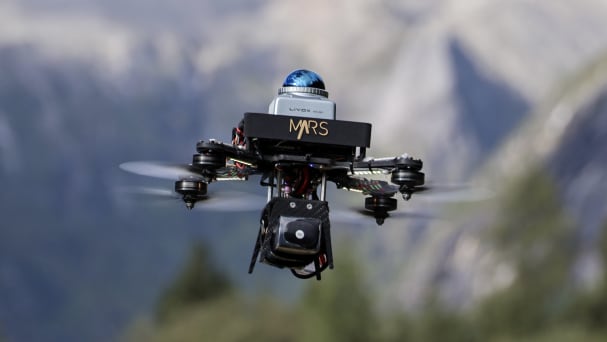
Unlike birds, which navigate unknown environments with remarkable speed and agility, drones typically rely on external guidance or pre-mapped routes. However, a development by Professor Fu Zhang and researchers from the Department of Mechanical Engineering of the Faculty of Engineering at the University of Hong Kong (HKU) has enabled drones and micro air vehicles (MAVs) to emulate the flight capabilities of birds more closely than ever before.
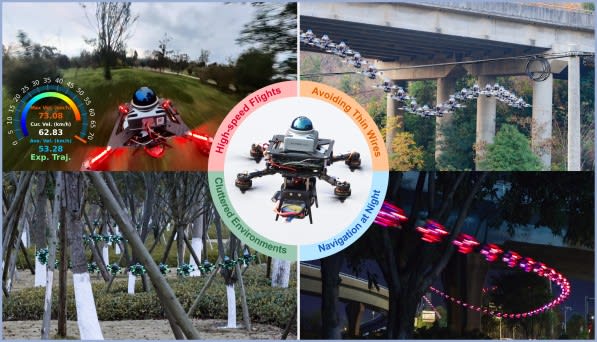
The team has developed the Safety-Assured High-Speed Aerial Robot (SUPER), capable of flying at speeds exceeding 20 meters per second [about 45 miles per hour] and avoiding obstacles as thin as 2.5 millimeters [about 0.1 inch] — such as power lines or twigs — using solely onboard sensors and computing power. With a compact design featuring a wheelbase of just 280 mm [about 11 inches] and a takeoff weight of 1.5 kg [about 3.3 pounds], SUPER demonstrates exceptional agility.
Zhang describes this invention as a game-changer in the field of drone technology, “Picture a 'Robot Bird' swiftly maneuvering through the forest, effortlessly dodging branches and obstacles at high speeds. This is a significant step forward in autonomous flight technology. Our system allows MAVs to navigate complex environments at high speeds with a level of safety previously unattainable. It’s like giving the drone the reflexes of a bird, enabling it to dodge obstacles in real-time while racing toward its goal.”
The breakthrough lies in the sophisticated integration of hardware and software. SUPER utilizes a lightweight 3D light detection and ranging (LiDAR) sensor capable of detecting obstacles up to 70 meters [about 230 feet] away with pinpoint accuracy. This is paired with an advanced planning framework that generates two trajectories during flight: one that optimizes speed by venturing into unknown spaces and another prioritizing safety by remaining within known, obstacle-free zones.
By processing LiDAR data directly as point clouds, the system significantly reduces computation time, enabling rapid decision-making even at high velocities. The technology has been tested in various real-life applications, such as the autonomous exploration of ancient sites, and has demonstrated seamless navigation in both indoor and outdoor environments.
“The ability to avoid thin obstacles and navigate tight spaces opens up new possibilities for applications like search and rescue, where every second counts. SUPER’s robustness in various lighting conditions, including nighttime, makes it a reliable tool for round-the-clock operations,” said Lead Author Yunfan Ren.
Here is an exclusive Tech Briefs interview, edited for length and clarity, with Zhang.
Tech Briefs: What was the biggest technical challenge you faced while developing SUPER?
Zhang: The biggest hurdle was building a small drone that could fly really fast through unknown, messy places like forests or disaster zones without crashing. We needed it to think and react quickly using only its onboard sensors and computer, which was tough. The drone had to spot obstacles far away, plan safe paths in several milliseconds, and avoid hidden dangers in areas it hadn’t fully seen yet. Getting all these pieces — speed, safety, and real-time planning — to work together on a tiny drone was a huge challenge.
Tech Briefs: Can you explain in simple terms how SUPER works?
Zhang: SUPER is a small, super-agile drone that can zoom through unknown places at high speeds, like 45 miles per hour, without hitting anything. It uses a laser sensor called LiDAR to “see” obstacles up to 230 feet away, creating a 3D map of its surroundings, like trees, wires, or walls. Every tenth of a second, SUPER’s onboard computer plans two paths: a fast one that assumes unexplored areas are safe, to maximize speed, and a backup one that sticks to areas it knows are clear, to avoid crashes. It picks the best path to fly fast but stay safe, all without needing external help like GPS or extra computers.
Tech Briefs: What was the catalyst for this work? How did it come about?
Zhang: We were inspired by the idea of drones helping in emergencies, like finding people in disaster areas or delivering supplies in tough spots where speed and safety are critical. Most drones either flew fast but risked crashing or were too slow to be useful in these situations. We saw a gap: No one had built a drone that could be both fast and safe in unknown places using only its own sensors. So, we set out to create SUPER, combining new laser sensors with smart planning to make a drone that could handle real-world challenges like search and rescue.
Tech Briefs: Do you have any set plans for further research/work/etc.? If not, what are your next steps?
Zhang: We’re excited to keep improving SUPER. One big plan is to make it better at dealing with moving objects, like people or vehicles, by predicting where they’ll go next to plan smoother, safer paths. We also want to make the drone even lighter and more aerodynamic, maybe with better motors or a sleeker design, so it can fly faster and use less energy. We’re looking at upgrading the LiDAR to see smaller objects and farther distances. Plus, we’re exploring ways to speed up the software using powerful chips like GPUs, opening the door to uses like exploring unknown areas, inspecting bridges, or delivering packages quickly and safely.
Tech Briefs: Is there anything else you'd like to add that I didn't touch upon?
Zhang: SUPER’s ability to fly in all kinds of conditions — day or night, through dense forests or tight spaces — makes it special. It can even dodge super thin obstacles, like a 2.5-millimeter wire, which most drones can’t see. This makes it ready for real-world jobs, not just lab tests. For example, it could track a moving car or explore a collapsed building. We’re proud that SUPER shows how drones can move from research to actually helping people in tough situations, like disaster relief or emergency response, and we hope it inspires more practical robotics solutions.
Tech Briefs: Do you have any advice for researchers aiming to bring their ideas to fruition (broadly speaking)?
Zhang: Start with a real problem that matters to people, like making life easier or safer. Team up with others who have different skills — maybe someone great at building hardware, another at coding, or someone who knows the practical side of things. Test your ideas early and often, using computer simulations and real-world experiments to spot problems and fix them. Don’t be afraid to fail; each test teaches you something. Stay patient and keep pushing, because turning a cool idea into something that works in the real world takes time, grit, and a lot of tweaking.
Transcript
00:00:01 birds have long captivated humans with their ability to navigate at high speeds through cluttered environments while maintaining remarkably low failure rates similarly microair Vehicles among the most agile machines created by humans hold the potential to achieve bird-like agile flights while human experts can replicate bird-like agility balancing
00:00:24 high speed and safety in autonomous flights remains a challenge current approaches often sacrifice safety for Speed or vice versa this raises a critical question how can autonomous Mavs achieve both high-speed and safe flights in unknown real world environments introducing super a safety assured high-speed aerial
00:00:51 robot super is compact with a wheelbase of just 280 mm and a takeoff weight of 1.5 kg achieving a Thrust weight ratio greater than 5.0 it is equipped with a 360° light detection and ranging sensor capable of detecting objects up to 70 M away at a point rate exceeding 200,000 Herz with Advanced liar based perception safety assured planning and optimal
00:01:20 control modules super navigates unknown environments at speeds over 20 m/s relying entirely on onboard sensing and computation it can maneuver nimbly through extremely cluttered environments at high speeds without compromising safety with its Advanced liar based perception system super can efficiently
00:01:51 detect and avoid thin obstacles such as power lines moreover it can identify thin objects less than 2.5 mm in just 20 milliseconds enabling precise navigation through challenging environments that pose significant difficulties for state-of-the-art vision-based commercial products the active detection mechanism of the lar also enables super to operate
00:02:21 all day around even in total darkness thanks to these exceptional capabilities super has been tested across various real world applications it can be applied to autonomously explore ancient sites seemlessly navigating both indoor and outdoor spaces it can also Traverse dense forests with safety guarantees
00:02:51 overcoming complex obstacles sup agility extends to object tracking mission allowing it to closely follow targets and avoid obstacles in both indoor and outdoor environments during both day and night with its high-speed navigation abilities safety assured design and robust performance super marks a
00:03:22 significant milestone in transitioning high-speed autonomous navigation from the laboratory to real world applications although not perfect researchers hope super will unlock new possibilities in future real world scenarios such as autonomous delivery inspection mapping and search and rescue missions