

In today’s manufacturing landscape, the speed and reliability of daily operations translate directly into enhanced productivity. Motion control systems rely on miles of wires that connect various components, all converging in control panels filled with numerous connection terminals.
Given the high number of conductor termination points, there is a greater risk of signal loss or intermittence due to poor terminations. Any of these interruptions can reduce the ability to meet production goals, as downtime will be necessary until faults are corrected.
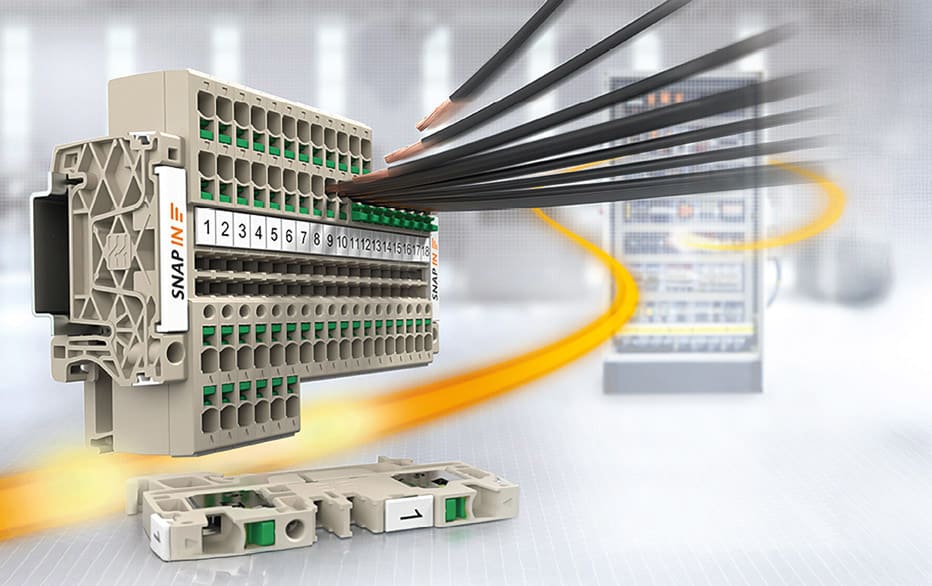
Today, there is innovative conductor terminating technology, known as SNAP IN technology, that allows for the fastest wiring connections to date. To best understand the advantages that SNAP IN technology brings to motion control systems, let’s start by exploring the evolution of connection technology.
Screw Clamp
Benefits: Modern screw clamp technology is primarily designed to separate electrical and mechanical functions. A reliable termination (mechanical) contact force is generated to hold the conductor securely and provide a solid conductor to the busbar contact (electrical) to prevent any signal loss. Screw clamp technology provides the highest applied contact force, widest range of configuration types while providing traditional side entry.
Drawbacks: In some instances, screws may need to be retorqued if not done correctly during the original installation. Screws must be torqued to the manufacturer’s torque specification value to ensure consistent reliability. Monitoring the performance of this technology is time intensive, dependent upon customer inspection practices and could add steps to validate connections and has some complexities. During quality reviews, inspectors often approach offline control cabinets with flashlights as they look sideways at each screw design to see if a proper connection was made or has come loose. That manual analysis to ensure each wire is secure and functioning means lost productivity and revenues.
Tension Clamp
Benefits: Tension clamp technology sped up wiring and secured connections even in high-vibration environments. The spring mechanism of the tension clamp automatically secures the conductor when terminated and adapts to different cross-sectional areas. An integrated wire protection bracket ensures fine-stranded conductors do not splay or cut. Due to the high contact force, the tension clamp terminal is particularly suitable for corrosive and high-vibration environments.
Drawbacks: Tension clamps move away from being physically set to a defined torque specification, as was needed with screw versions, but they still require a screwdriver or other tool to open the clamp to terminate a wire. Every task needs two hands to execute.
PUSH IN
Benefits: Tool-free wiring arrived with PUSH IN technology, with a stripped solid or ferruled wire that is sturdy enough to force open the pressure spring. That stainless steel compression spring guarantees a high contact force of the conductor on the busbar. The spring and conductor stop ensure optimal connection. This connection offers higher conductor pull-out forces than tension springs. The insulated pusher provides freedom to use an uninsulated screwdriver as well as visual guidance on how and where to open the spring clamp.
Drawbacks: Wires must be solid or be outfitted with a ferrule to reap the full benefit/consistency of wire termination, which limits applicability or adds time to prepare the conductors.
SNAP IN
Benefits: With its unique spring design, SNAP IN technology brings one-handed, tool-free connectivity without the need of a ferrule. Not only is it faster, but SNAP IN technology also works with or without wire end ferrules. Simply insert a stripped conductor directly into one of the pre-loaded, open connection points and it’s snapped into place. The spring mechanism only activates when the wire is inserted deep enough to ensure proper connection. Two methods then verify the wire is connected: You’ll hear an audible click and see a green pusher pop up.

Once a wire is terminated, SNAP IN technology behaves just like the well-known and widely accepted PUSH IN technology and comes with the same perks, such as being maintenance-free and suitable for high vibration conditions. The system can terminate stranded wires without the need for additional tools, further enhancing installation efficiency. Releasing a connection is just as quick: Simply press the pusher to quickly reopen the terminal point, enabling fast and easy disconnection.
Panel Building for the Future
The innovation behind SNAP IN doesn’t serve any specific industrial segment, but instead provides a trusted technology for any environment where efficient, effective connections are required. SNAP IN currently supports any business using between 22 and 4-gauge wires in control cabinets, such as intralogistics, industrial automation, data centers and process industries (e.g. food and beverage, oil and gas). Users can apply this technology to any signal wiring or power distribution project. The latest releases include disconnect and fuse terminals in addition to the already available feedthrough and ground (PE) terminal blocks.
Planning Panels
SNAP IN technology was designed with users in mind, giving them an easier, safer, and faster way to plan their control panels. By design, SNAP IN can scale up with business needs. Some providers such as Weidmuller offer an online configurator, which is provided as free design software, and allows rails to be planned in single-and double-layer layouts, using pluggable cross-connectors that marshal these components into space-effective designs. Especially in mid- to largesized shops, where thousands of panel connections must be executed every week, designers can quickly line up modular terminal blocks on rails and connect those signals according to targeted business needs.
The configurator gives users greater flexibility in planning for rail assembly with SNAP IN terminal blocks. The tool delivers full documentation, along with 3D images of all cabinet components. SNAP IN terminal blocks share the same accessories as other Weidmuller terminal blocks, such as PUSH IN terminals, which helps panel designers adapt their solutions as technology evolves. Next releases of SNAP IN terminal blocks will accept larger wires, which will support higher current applications, such as power distribution.
Executing New Panels

Time and cost savings continue in the execution stage, because installation is faster and easier. The technology’s streamlined structure minimizes installation issues due to human error because terminations only happen when wires are inserted correctly at the proper depth to trigger the spring clamp. With its toolfree and onehanded operation, SNAP IN offers faster installation, directly serving up precisely what customers need for success. Again, SNAP IN delivers two verifications: Installers hear an audible click once the conductor is secure, and a visible green pusher pops up. No questions remain about whether a wire is terminated correctly.
Other traditional technologies may require manually checking each point to ensure every wire is connected properly, a time-intensive maintenance requirement even after the installation is completed. Each SNAP IN terminal’s clamping system is delivered with an open clamping point, making the technology conductor-termination ready. Each SNAP IN terminal block also comes with integrated test tabs, allowing for users to test circuits and perform troubleshooting tasks.
Design Intended for Future Automation
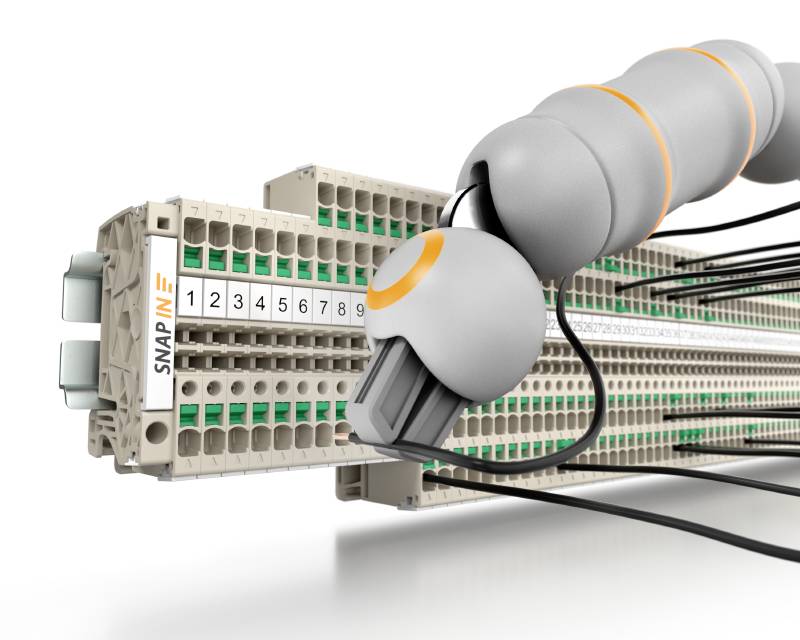
The design intentionally puts companies in the ready position for automation. The shape of the terminal molding was developed to meet specifications for robot handling, in preparation for the transition to a future of automated wiring. Two features are important for automation:
Strategic design: The contour of the SNAP IN terminal block mold is flat on the sides. That is critical for allowing a robotic gripper to pick up and place the block on a DIN rail, opening opportunities for automated rail assembly.
Ease of installation: The amount of pressure required to insert a wire to trigger the spring mechanism is very low, a targeted feature for automation.
That means SNAP IN delivers not just automated assembly, but also automated wiring.
Additionally, the terminal block series comes with pre-marked components, which makes automated marking possible with technologies like an Automated RailLaser. Using terminal blocks with markers already attached eliminates the need to separate, assign, and mount individual markers, driving time savings of up to 90 percent in marking processes.
Conclusion
With the introduction of SNAP IN technology, users have an innovative technology that is redesigning how control cabinets are constructed — leading to time savings, higher reliability, and greater safety. More importantly, SNAP IN allows customers to act now and ready their wiring and signal transmission for automation, where they will benefit from exponential gains in effectiveness and efficiency, significantly enhancing their competitive advantage in their market.
This article was written by Hannah Witopil, Product Manager-Terminals, Cabinet Products Division, North America, Weidmuller USA (Richmond, VA). For more information, visit here .











