

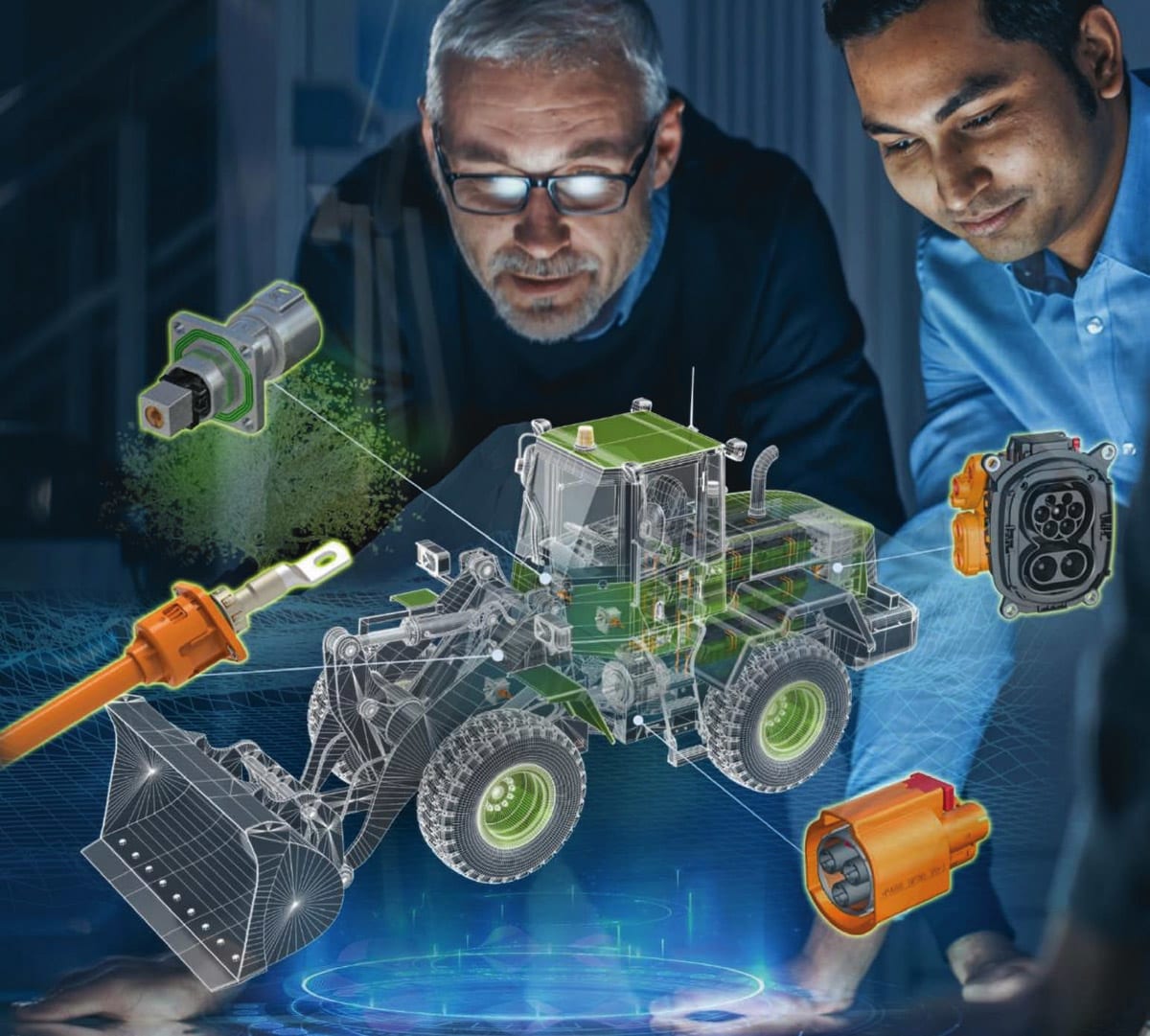
In the commercial and off-highway vehicle industry, the transition from internal combustion engines to hybrid and electric alternatives is underway. In 2024, sales of electrified trucks reached more than 97,000, while buses notched 72,000 sales, according to the International Energy Agency (IEA). Estimates for 2025 suggest these numbers will be even greater.
Electric trucks and equipment are attractive for a variety of reasons. Not only do they offer a quieter, lower-vibration, and more comfortable operator experience, but they also help to reduce emissions, extend operational hours, and improve worker safety. For example, electric delivery trucks can operate quietly overnight, helping reduce daytime congestion in cities. Similarly, in the construction industry, the lower noise level of electric vehicles (EVs) is extremely beneficial in residential areas. For farmers, EVs help to facilitate more precise farming operations.
However, the move to electrified on- and off-highway equipment is not without its challenges. The industry itself lags greatly behind the passenger car industry, which accounted for 17.5 million EVs sold globally last year. But why?
Perceived Obstacles Are Stalling EV Adoption
There are several myths currently slowing adoption of electrified on- and off-highway equipment.
Myth 1: EVs don’t provide enough range. While many fleet operators believe they need 600 to 1,000 miles (965 to 1,610 km) per charge, these are often extreme cases. A TE Connectivity analysis found that 80 percent of trucking use cases require a range of 350 to 500 miles (565 to 805 km). Operators who drive longer distances typically incorporate charging into their schedules. As a result, most firms are already well-served by current solutions and range capacity.
Myth 2: Small electric engines are underpowered for heavy-duty applications. Electric motors provide instant torque and acceleration, making them well-suited for use in challenging environments, such as driving up steep grades or through rugged terrain. TE’s research also found that 90 percent of all trucking loads stay within standard weight limits, requiring less power than commonly assumed.
Myth 3: One or two gears can’t replace 12-16 in ICE vehicles. Unlike ICE engines, EVs operate efficiently across a wide rpm range. As a result, they require far fewer gears — typically one or two — to deliver smooth, responsive performance.
Myth 4: If one battery pack fails, the entire vehicle fails. Many commercial EVs use modular battery systems with multiple independent packs. As a result, if one module fails or underperforms, the others can continue to power the vehicle at a reduced capacity, depending on system design and load requirements.
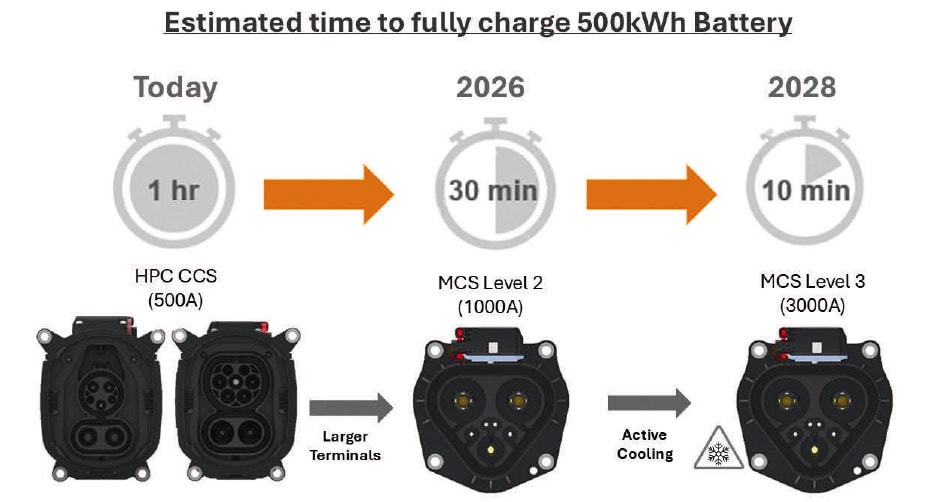
However, amid all these myths lies truth. First, charging infrastructure is essential. Industry adoption of EVs closely follows the availability of a robust, interoperable charging infrastructure and proximity to a reliable power grid. The Asia-Pacific (APAC) and Europe, Middle East, and Africa (EMEA) regions have outpaced the U.S., in part due to strong regulatory and policy frameworks that support infrastructure investment, renewable energy integration, and EV purchases. Government actions include emission standards, sales targets, financial incentives, and penalties for heavy ICE vehicles. Without similar measures in the U.S., commercial and off-highway EV adoption will likely continue incrementally.
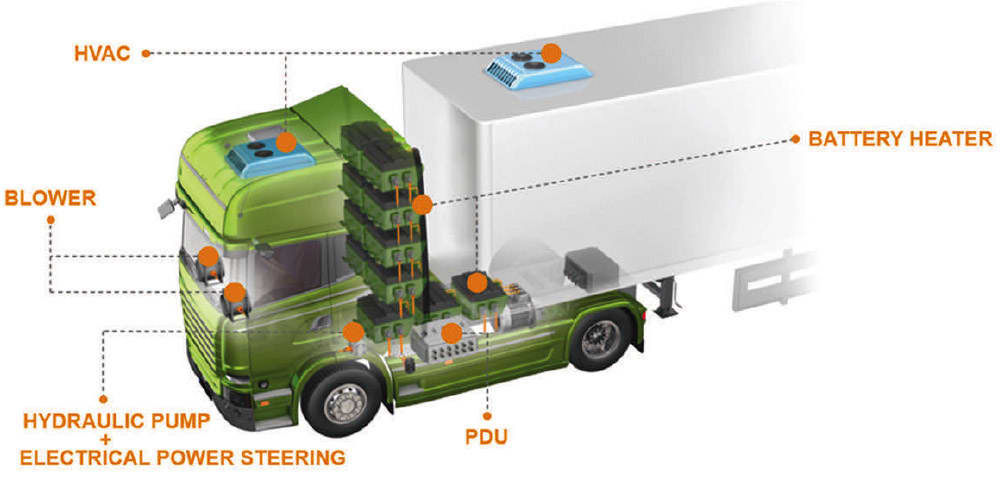
Additionally, OEMs are being tasked with balancing ICE and EV production. OEMs are managing production through mixed manufacturing models — building diesel and EVs on the same lines. While dedicated EVs would be more efficient, current demand levels don’t yet justify the shift. Despite these obstacles, OEMs are continuing to develop advanced electrification solutions with a laser focus recently on the importance of battery technology.
Next-Generation Battery System Design
In an EV, the battery remains the linchpin, enabling faster charging, energy storage, and seamless power distribution — even in rugged, high-demand field operations. In fact, advancements in battery technology could be the key to enabling greater adoption of EVs across the commercial vehicle industry.
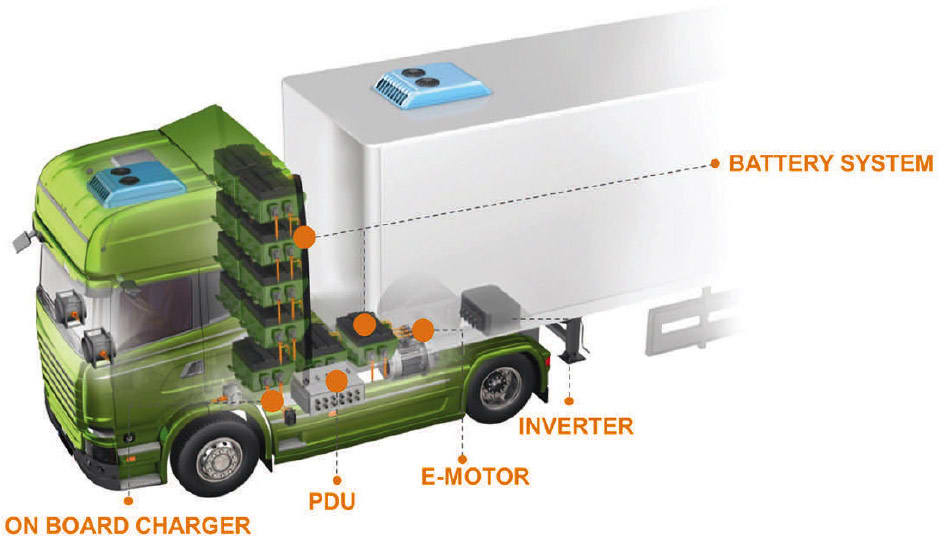
Next-generation batteries will offer the power, range, and seamless integration and serviceability that commercial and off-highway vehicle owners and operators want. Development is being driven by several industry trends, including standardization of components, the transition to high-voltage systems and the evolution of power architectures.
Instead of customizing interfaces for every application, OEMs increasingly prequalify high-voltage connectors across platforms. For example, TE offers modular one- to three-pin configurations for DC and AC power, simplifying procurement and assembly.
Commercial vehicles are also shifting from 600V-650V to 800V-850V, reducing current and enabling more powerful drivetrains. For some applications, it is creeping even higher, reaching up to 1500 volts. This shift requires OEMs to use next-generation semiconductors (such as silicon carbide) and robust insulation to support high-voltage charging and operations. Designed specifically for commercial and industrial e-mobility applications, TE’s PowerTube and HVA HD400 connectors support voltages of up to 1000, and deliver reliable, shielded performance in high-vibration, heavy-duty environments.
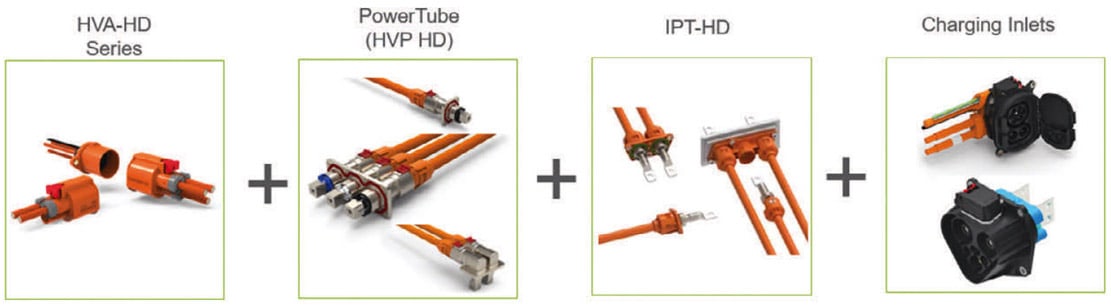
Finally, traditional architectures run individual lines from the charging inlet to each battery pack. At TE, we are currently working on new architecture layouts to optimize wire routing, reduce raw material and increase assembly efficiency at the OEM production line. The goal is to minimize cost to make commercial EVs even more competitive for the future.
Requirements for Battery Systems in Commercial Vehicles
While industry trends are paving the way for more efficient battery system designs, there are several standardized requirements that a system must meet for greater adoption to take hold.
The system must be rugged. Batteries must operate across long duty cycles and in extreme environments — heat, cold, humidity, salt, and dust. To protect them, batteries are housed in rigid, lightweight boxes that use chemically stable, flame-retardant materials and incorporate ventilation to prevent fires. Components are sealed using adhesives with rapid activators to harden the seal and create a durable bond.
The system must support diverse charging. Depending on the use case, vehicles may need overnight, destination, or mobile charging. High-power interfaces enable rapid energy replacement, allowing expensive equipment to be brought back into operation more quickly. This helps owners to maximize ROI on vehicles such as large excavators, specialized cranes, and mining trucks.
OEMs design interfaces to be easily and securely inserted, allowing maintenance teams to service batteries and exchange cables and components, while ensuring robustness for multi-year, high-vibration, high mileage operations. TE’s megawatt charging inlet currently supports up to 1000 amps and up to 3000 amps in the future. When paired with high-voltage systems (such as 1000V), TE’s inlet enables megawatt-level charging, essential for large, high-capacity batteries.
The system must ensure battery balance. Balancing charge across all modules in a battery system — also known as cell or pack balancing — is essential to maximize performance, extend range and maintain operational efficiency over time.
In the coming years, as the commercial vehicle industry continues its pursuit of zero-emission vehicles, all eyes will be on battery system design and the products available to support the ever-changing needs of electric vehicles. By working in tandem with suppliers, OEMs can ensure that they are creating and deploying the right solutions for their vehicles, which in turn will help to unlock new levels of efficiency, sustainability, and profitability.
This article was written by Daniel Domke, Product Manager, E-mobility Solutions, TE Connectivity (Berwyn, PA). For more information, visit here .











