


Charging infrastructure has become the primary bottleneck to fleet electrification. Despite growing demand for electric trucks and increasing pressure to decarbonize logistics operations, many fleet operators face long delays for grid upgrades, transformer installations, and permitting, at times waiting more than a year to power vehicles that have already arrived.
OptiGrid was formed in response to this growing gap between vehicle readiness and infrastructure availability. Drawing on core technology initially developed by FreeWire Technologies and refined through several commercial generations, OptiGrid has been restructured to deliver a modular, scalable, and rapidly deployable battery-integrated charging solution tailored to fleet use cases. The team combined proven engineering with manufacturing and field experience to develop a system capable of bypassing traditional infrastructure constraints.
One of the earliest adopters of the system is Orange EV, a U.S. manufacturer of Class 8 electric trucks. Orange EV created and invested in OptiGrid, and announced the new company in 2025. With more than 1,000 electric yard trucks deployed across ports, rail yards, and warehouses, Orange EV’s customers frequently face limited grid access at their operating sites.
In many of these environments, trucks are running multiple shifts with tight turnaround times. Even a brief delay in charging can ripple through a day’s logistics schedule. Sites are often located in grid-constrained areas, such as industrial corridors and freight hubs, where infrastructure has not kept pace with growing energy demand. Conventional utility-led charging projects typically involve a cascade of complications like securing permits, coordinating with utility providers, and performing civil engineering work, all of which slow deployment and increase cost.
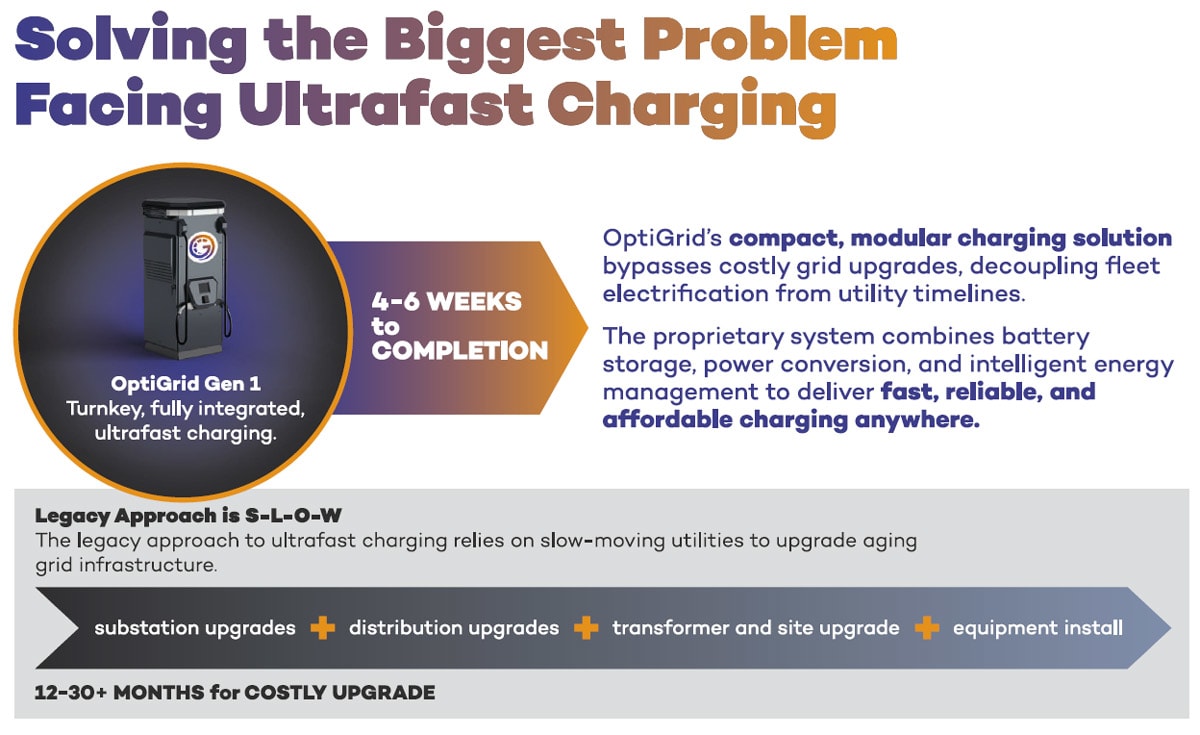
By deploying a self-contained charging solution that minimizes dependency on lengthy utility upgrades, fleets can keep their transition to electric trucks aligned with business objectives. This approach ensures new vehicles immediately contribute to reducing operating expenses and protecting margins from fuel volatility. It also preserves the tight sequencing that many logistics providers rely on, allowing them to fulfill delivery contracts and maintain service levels while building out more sustainable operations over time.
A Compact, All-in-One Charger Built for Fleets
OptiGrid’s battery-integrated charging (BIC) system combines 180 kWh of onboard energy storage with up to 200 kW of DC fast charging power. The unit is fully self-contained, integrating storage, conversion, and power electronics in a single, UL-certified enclosure, with no external cabinets or supporting hardware required.
One of the design goals was to make the BIC agnostic to energy input. Thus, the charger can draw from low-capacity grid connections, solar, or microgrids, charging its internal battery slowly and discharging quickly to support EV charging events. This “time-shifted charging” architecture enables deployments at sites with limited or inconsistent power availability, a frequent issue in older industrial zones and crowded port facilities.
For Orange EV and other heavy-duty vehicle OEMs, systems like these provide immediate value by enabling customers to deploy electric trucks without waiting on utility coordination or capital-intensive infrastructure upgrades. In scenarios where major freight operators are ready to deploy electric yard trucks but face long delays for grid upgrades, the BIC units can be delivered in weeks and activated quickly, allowing fleets to stay on schedule and avoid operational delays that could otherwise stretch into years.
This rapid deployment transforms how fleets plan capital projects. Instead of syncing new electric truck deliveries to uncertain utility upgrade timelines, operators can order trucks and chargers simultaneously, with confidence that charging will be ready ahead of or in tandem with vehicle arrival. This not only protects operational rollouts but also improves financial ROI calculations, reducing the payback window by ensuring immediate asset utilization.
Installation in Days, Not Months
Traditional DC fast charging deployments often require trenching, transformer installations, and coordination with local utilities, resulting in project timelines of 12 to 24 months. OptiGrid’s system is installed using an 8-bolt surface mount and does not require trenching, concrete pads, or site certification, and permitting and site certification are also often unnecessary. Units can also be relocated with forklifts if site layouts change.
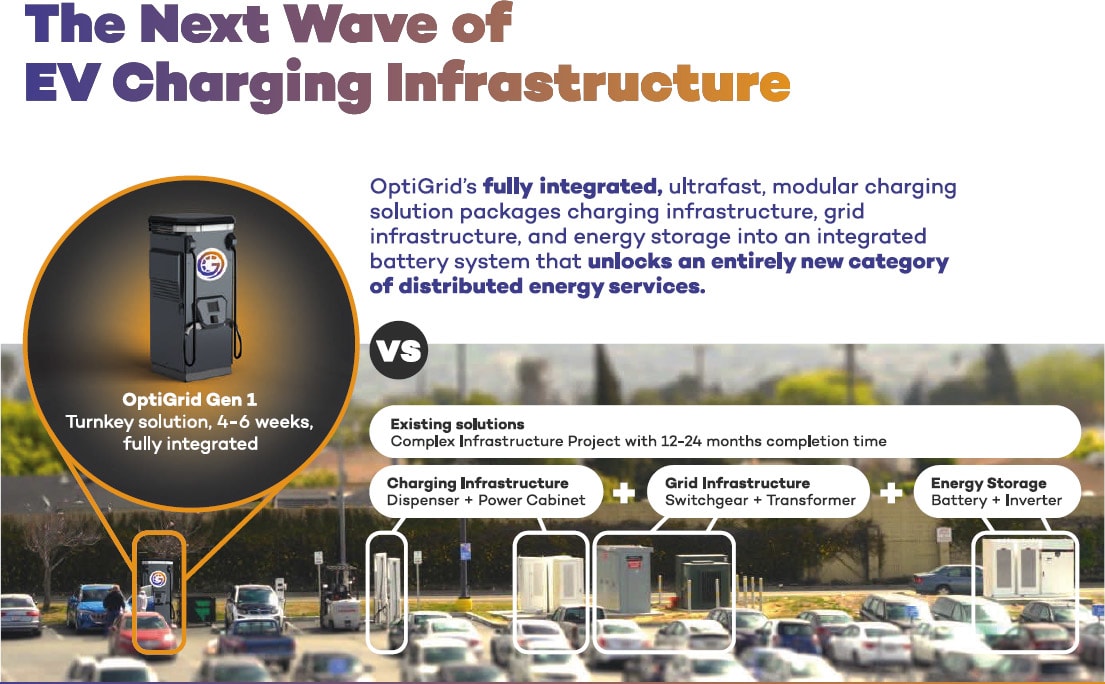
The system’s compact footprint, up to 90 percent smaller than comparable battery-buffered solutions, makes it deployable in constrained locations like loading bays, fence lines, or curbside parcels. This is particularly valuable at logistics centers where space and traffic flow are tightly managed.
For logistics operators running dozens of sites nationwide, speed of deployment isn’t just a convenience, it’s a strategic advantage. A plug-and-play charging model allows fleet managers to standardize charging infrastructure, redeploy assets as network needs evolve, and avoid stranded investments at leased or temporary facilities.
For companies operating under shortterm leases or contracts with third-party logistics providers, the ability to move charging assets across facilities as needs evolve directly protects capital and minimizes stranded costs. It reduces investment tied up in site-specific electrical upgrades or civil work that might otherwise be lost when operations shift. As more fleets turn to electric trucks to lower total cost of ownership and reduce exposure to volatile diesel prices, being able to rapidly scale infrastructure across multiple sites — without waiting 18 months for traditional utility buildouts — becomes a crucial advantage in securing new contracts and improving overall asset utilization.
Smart Charging for Real-World Operations
Beyond the hardware, OptiGrid includes its AMP software for smart energy management and charge scheduling. The system can prioritize vehicles based on duty cycles, optimize charging around peak demand rates, and track vehicle readiness in real time. It also integrates with fleet management systems via an open API, supporting the Open Charge Point Protocol (OCPP) and OpenADR communication standard.
For Orange EV’s customers, battery-integrated charging systems mean charging that fits within existing workflows, reducing operational disruption while meeting uptime targets. The technology is especially valuable at sites with mixed-use schedules or back-to-back shift operations, where charging time is limited.
AMP also provides granular reporting that helps fleets align with internal sustainability goals and external ESG reporting requirements. By tracking charging efficiency and grid energy usage, operators can quantify emissions savings and demonstrate progress to customers, regulators, or investors.
The system’s detailed logs can tie energy consumption directly to individual vehicles, offering a clear audit trail that supports Scope 2 emissions reporting and fleet-level carbon accounting. As more shippers and major retailers push zero-emission requirements downstream to their transport partners, being able to provide verifiable data on energy sourcing and GHG reductions becomes a competitive differentiator. AMP’s architecture is also built to plug into low-carbon-fuel programs, as well as emerging utility and market signals, opening the door to participate in demand response events or monetize stored energy as grid services in the future.
Broader Applications and Future Directions
While initially focused on fleet depots and logistics hubs, OptiGrid’s architecture has applications in multifamily dwellings, rental car return facilities, robotaxi, and remote commercial fueling stations — anywhere that electrical upgrades are costly or delayed.
Current development efforts include supporting bi-directional charging (from the facility to the utility grid and vice versa), microgrid and off-grid support, and integration with utility demand response programs. As utilities begin to incentivize distributed energy resources (DERs), battery-integrated chargers like OptiGrid can play a more significant role in stabilizing the grid while facilitating the adoption of mass electrification.
Electrifying fleet operations isn’t just about building better vehicles; it’s about making charging infrastructure faster, more flexible, and easier to deploy. BIC systems demonstrate that it’s possible to bypass long utility timelines and deliver dependable, high-power charging wherever it’s needed. Orange EV’s experience highlights how a modular, battery-buffered approach can unlock real-world deployments, helping fleets meet financial targets and operational needs without waiting on grid modernization.
This article was written by Tyler Phillipi, CEO of OptiGrid (Kansas City, KN). For more information, visit here .











