

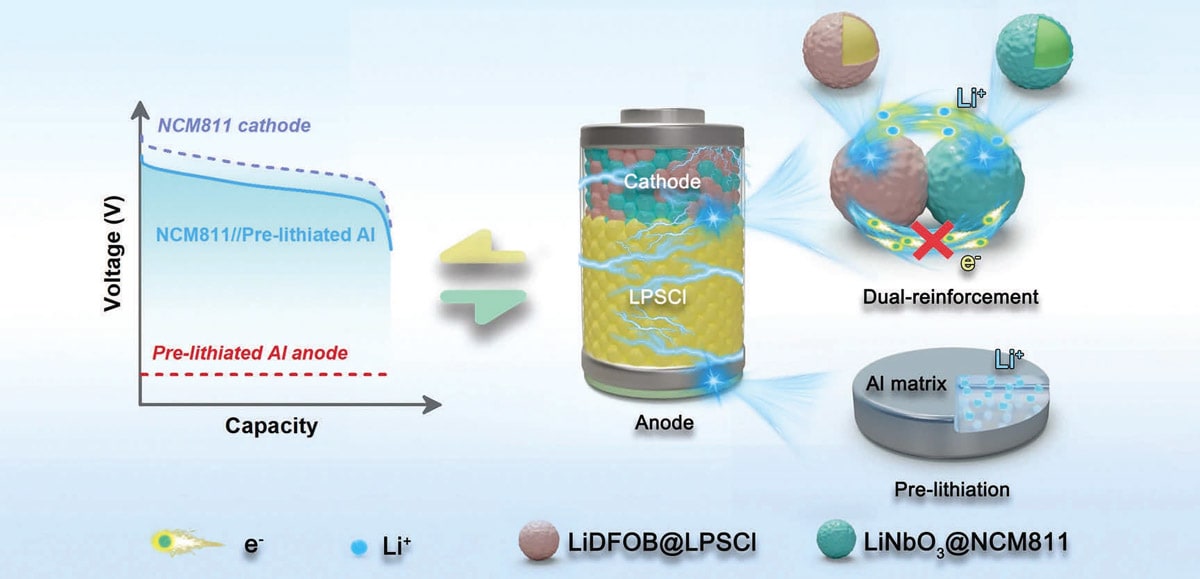
Researchers from Nanjing University, led by Professor Ping He and Professor Shaochun Tang, have published a comprehensive study in Nano-Micro Letters on the development of high-energy, stable all-solid-state lithium batteries (ASSLBs) using aluminum-based anodes and high-nickel cathodes. This study highlights the latest advancements in addressing the challenges of electrode-electrolyte interface instability and achieving long-term cycling stability in ASSLBs.
ASSLBs with aluminum-based anodes and high-nickel cathodes can achieve high energy density, making them suitable for long-range electric vehicles and electric flight. Aluminum exhibits excellent interfacial stability with sulfide electrolytes, while high-nickel cathodes deliver high output voltage and specific capacity. The combination of pre-lithiated aluminum anodes and dual-reinforced high-nickel cathodes shows great potential for practical applications in high-energy, stable ASSLBs.
The study employs an anode pre-lithiation technique to promote the reversibility of aluminum, enhancing its interfacial stability with the sulfide electrolyte. A dual-reinforcement approach is developed to address the interfacial incompatibility between the high-nickel cathode active material and sulfide electrolyte, improving the oxidation tolerance of the electrolyte at high potentials.
The fabricated ASSLB achieved stable cycling for 1000 cycles with a capacity retention of 82.2 percent. At a critical negative-to-positive ratio of 1.1, the battery’s specific energy reaches up to 375 Wh kg–1, maintaining over 85.9 percent of its capacity after 100 charge-discharge cycles.
The scalable synthesis methods and practical battery configurations discussed in the study highlight the potential for real-world applications of ASSLBs in high-energy, stable battery systems.
Future work may focus on optimizing the synthesis of electrode materials to improve their stability and electrochemical performance. Additionally, integrating advanced materials and technologies could enhance the functionality and applicability of ASSLBs.
For more information, contact Ping He at











