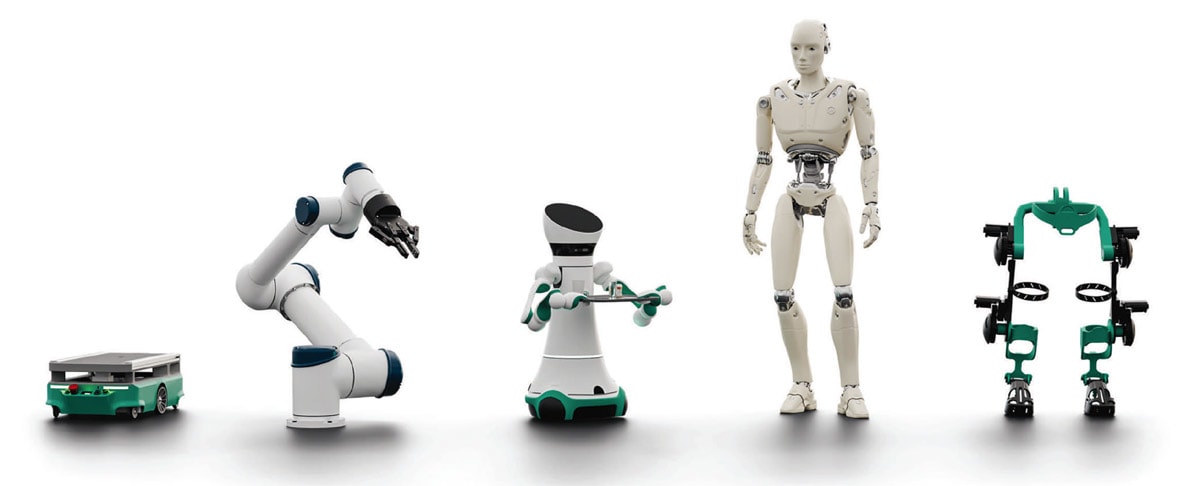
While traditional industrial robots have long been the workhorses of manufacturing, excelling at pre-programmed, repetitive tasks within controlled, isolated environments, the landscape of automation is shifting. Collaborative robots (cobots), robotic systems designed to interact physically and safely with humans in a shared workspace, are vital not only for future industrial endeavors, such as Industry 5.0, but also for enhancing safety and efficiency across various sectors, including healthcare, agriculture, logistics, and even consumer service applications. Their ability to quickly adapt to changes in a production process or tool failures without compromising quality is a significant advancement.
Cobots, working alongside humans, reduce the risk of injuries associated with tasks requiring physical strength or precision. They can operate in tight spaces and hazardous conditions where human safety might be compromised. Safety during close-proximity operations is enhanced with advanced sensors that can detect the presence of nearby humans.
While some cobots, such as collaborative pick-and-place systems, might look like conventional robotic arms, they are inherently more complex — for example, it is critical that cobots, have a safety-first design. That makes the shift from pre-programmed to adaptive, intelligent, and collaborative control a paradigm leap in robotic engineering. From the control side, advanced embedded software, including edge AI for real-time processing, is needed, and from the mechatronic side, there is a significant shift in the level of feedback required.
Understanding the Sensor Shift
Robots operating in complex, shared environments require far greater precision in understanding their own movements and surroundings than their industrial predecessors, which typically operated behind light gates and safety cages. Unlike traditional arms that repeat fixed routines, cobots must manage variable tasks, such as handling delicate objects or interacting with humans, which demands much higher positional accuracy and situational awareness.
As degrees of freedom increase, so does the potential for cumulative error. Unlike fixed-path robots, cobots that follow unpredictable trajectories cannot be reliably corrected through software alone. Therefore, accurate, real-time feedback at every joint and interface is critical.
That calls for a large number of sensors, each of which require a high degree of precision and reliability. And the complexity of information required by a cobot calls for equally complex integration of all the sensors, including high-speed motor and joint encoders and resolvers, as well as tactile sensors.
Ensuring High-Speed Feedback
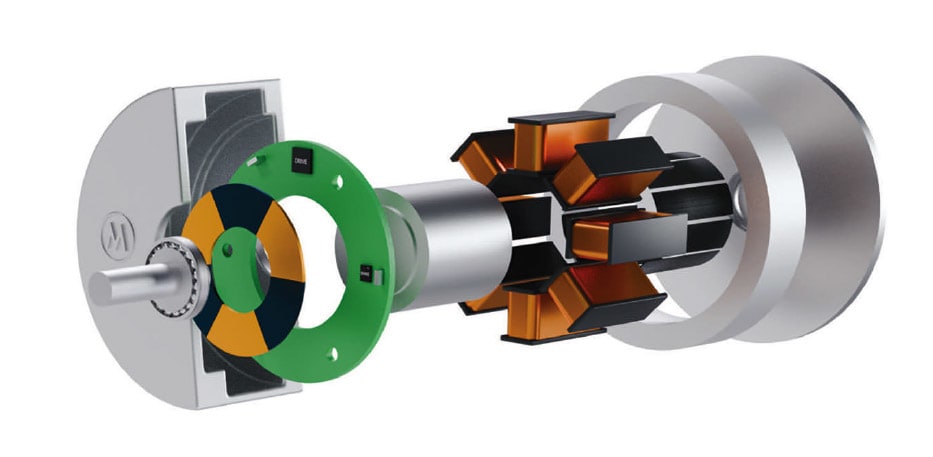
Central to every cobot joint lies an electric motor whose rapid movement must be precisely monitored in order to maintain highly controlled torque and acceleration profiles. This can be achieved with a high-speed, low-latency, precise motor position encoder. One example is the Melexis MLX90382, which provides precise three-axis magnetic field measurements from a single sensor. Operating at speeds up to 200,000 rpm with zero latency, the encoder offers 14-bit resolution and ±0.35° accuracy across the full 360° range, by utilizing on-chip sixteen-point linearization and integrated stray-field immunity.
In practical terms, this allows a control system to adjust drive signals almost instantaneously, smoothing acceleration profiles and eliminating torque spikes that might otherwise compromise human safety.
While high-speed motor feedback ensures responsive torque control, maintaining end-effector accuracy demands measurement of the gearbox’s output shaft angle with high precision. The high resolution of optical encoders makes them a traditional choice, but their expense and assembly difficulties are impractical for the high-volume, multi-joint architectures required by cobots.
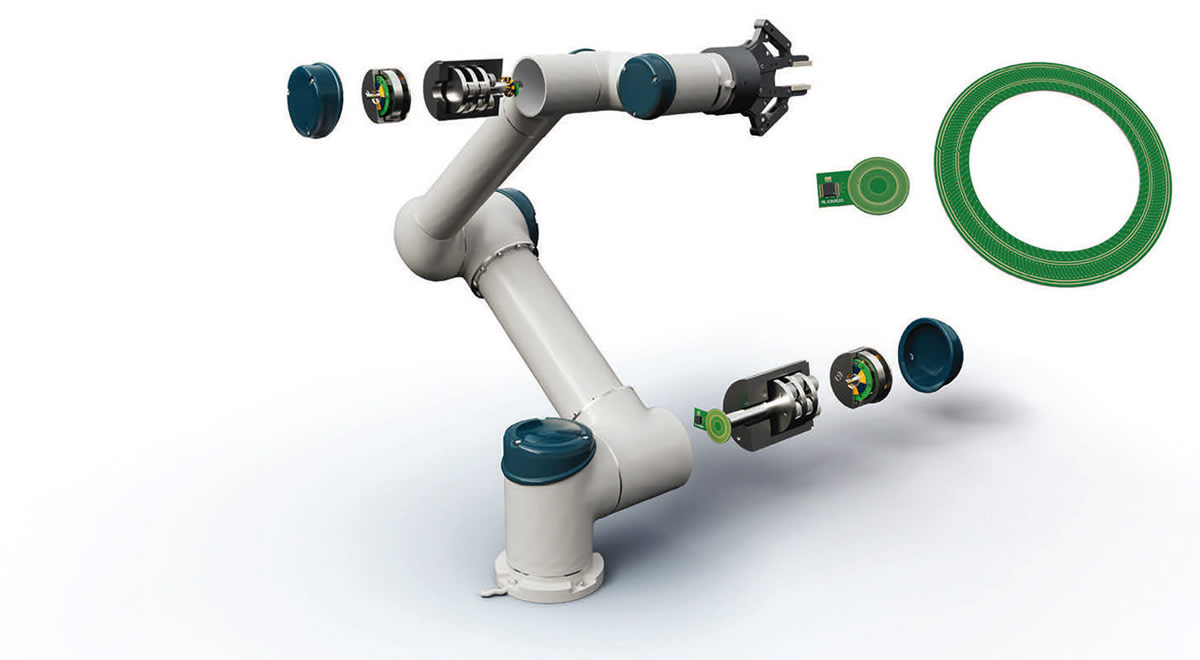
The Melexis Arcminaxis encoder leverages Triaxis magnetic sensing to deliver precise position and speed data. Using a Vernier magnet, the sensor measures axial and tangential magnetic field components. Four distinct signal paths and embedded algorithms minimize crosstalk and harmonic distortion, while a lookup table (LUT) corrects for non-linearity caused by magnet imperfections. The result is up to 18-bit resolution across a full rotation, tracking even the smallest joint movements.
Alternatively, the upcoming MLX90520 resolver employs variations in inductance across patterned PCB coils to obtain angular position data. This means the sensor is entirely immune to the external magnetic interference, which is common in proximity to high-power environments. It has up to 22-bit resolution, an accuracy better than 0.1°, and an air gap range of up to 2 mm, delivering high performance with simplified integration.
End-Effector Perception: Tactile and Thermal Sensing
While accurate joint feedback allows for repeatable movements, effective end-effector sensing is crucial for safe collaborative robot operation. There are different methods for incorporating end effector sensing.
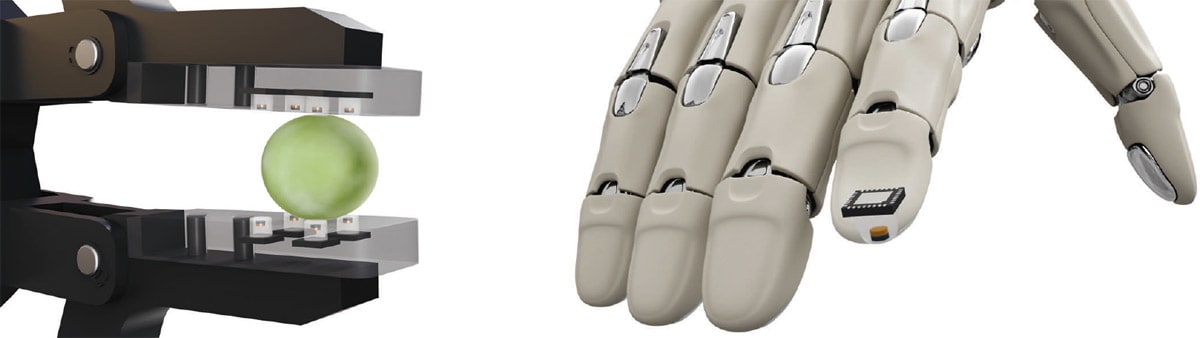
Melexis’ Tactaxis® technology delivers touch capability through compact, integrated tactile sensors that measure 3D force vectors at the point of contact. Each “taxel” combines a soft elastomer and embedded magnet above a 3D magnetic sensing IC. This simple construction translates pressure on the surface, whether applied vertically or laterally, into real-time, high-resolution force data.
For cobots working in shared spaces or handling delicate materials, this level of tactile feedback can be transformative. Unlike traditional force-torque sensors that are often bulky, expensive, or limited to single-point measurements, Tactaxis® offers a compact and scalable solution. Each sensor can detect normal forces up to 5 N and shear forces up to 2 N with fine resolution — enough to register weight changes of just a few grams. This enables cobots to grip gently, sense slippage, and respond to minute variations in contact pressure — all vital for tasks involving fragile parts, close human collaboration, or variable object geometries.
The ability to arrange multiple taxels into flexible arrays allows engineers to construct tactile surfaces that conform to curved or articulated geometries, akin to the sensory input provided by human skin. Whether deployed in a cobot effector, humanoid hand, or robotic exoskeleton, the system delivers rich, distributed force data. This enables a new class of robotic behaviors — where grip is adapted dynamically, contact is interpreted intelligently, and physical interaction is handled with the subtlety required for safe and intuitive human–machine collaboration.
Temperature feedback is also crucial for monitoring both the robot’s internal integrity and its operating environment. Melexis offers a range of highly accurate single-point thermometers, including user-friendly digital infrared thermometers in TO-can packages and sophisticated infrared sensor arrays. The MLX90642 infrared thermal sensor array can measure object temperatures from -40 °C to 300 °C with ±1 °C typical accuracy, making it suitable for everything from component protection to human interaction.
The 32 × 24-pixel array provides a spatial resolution that enables gesture detection, human presence recognition, and other AI-assisted behaviors that were never required in traditional pre-programmed industrial robots but are essential for cobots and humans operating in dynamic environments.
Conclusion
The transition from isolated, pre-programmed robots to adaptive cobots marks a significant advancement in industrial automation — one that depends not only on software but on a new generation of sensing technologies. Companies like Melexis are helping to meet this challenge, equipping engineers with compact, high-performance sensors that support motion, perception, and safe interaction. As collaborative systems become central to modern robotics, sensing will remain the key to building machines that are not only efficient but also aware and intuitive by design.
This article was written by Julien Ghaye, Ph.D., Product Line Manager, Robotics at Melexis. For more information, go here .