

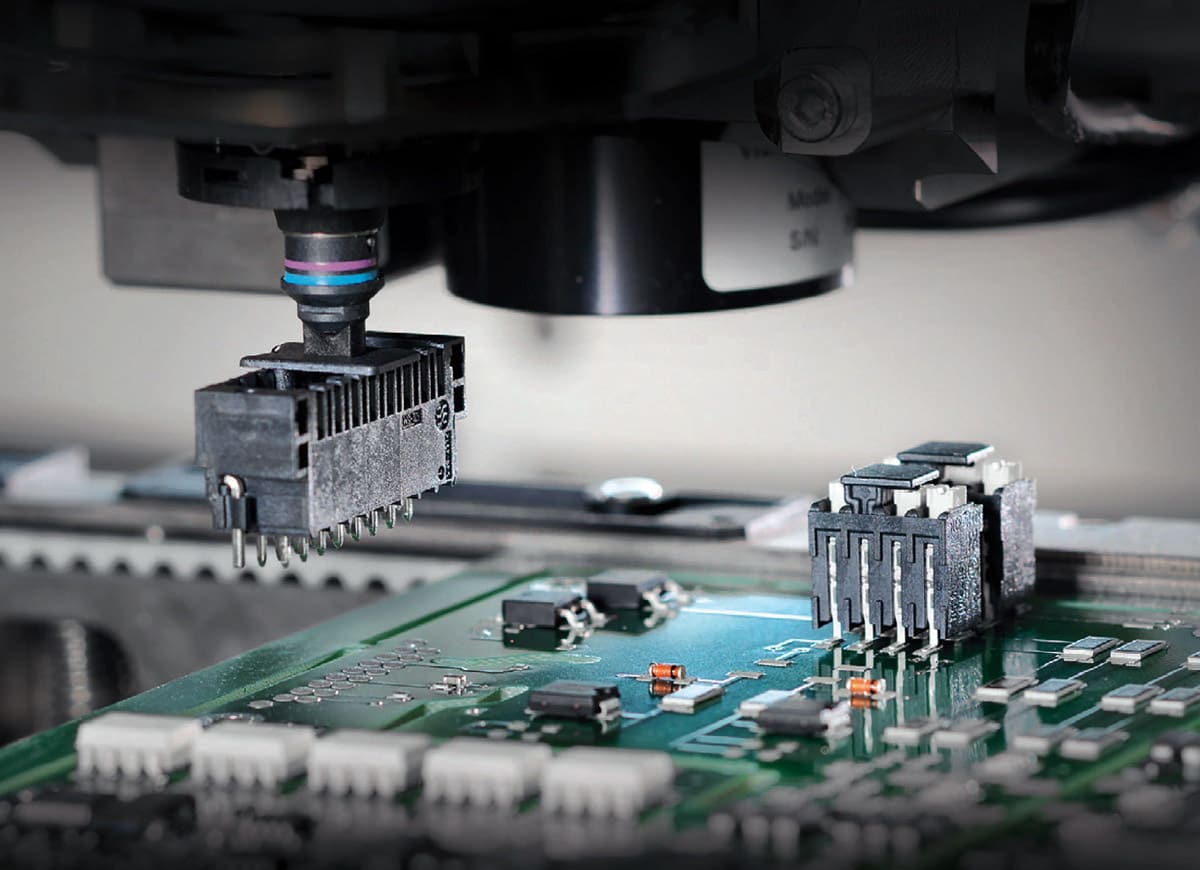
Today’s printed circuit board (PCB) is a platform for electronic components, creating circuits whose complexity may vary from simple to highly sophisticated. Increasing requirements — including the miniaturization of components, greater functional densities and lower production costs — led to surface mount technology (SMT).
However, many components, including those that might require stronger connections still must be attached by through-hole technology (THT). Those components are inserted into pre-drilled holes on the board, then manually secured by soldering on the opposite side.
A new technology closes the gap and combines PCB production into a single process, leveraging the capabilities of SMT. The resulting through-hole reflow (THR) process allows for components to be mounted through those pre-drilled holes — but secured during the same soldering process as the SMT-designed components. By eliminating the need for a separate soldering process, THR technology brings production a massive step forward, delivering exponential time and cost savings.
THR Technology for Streamlined Production
THR allows larger components to be processed in the same automated SMT reflow oven as surface mounted devices. This means one streamlined production line, one reflow cycle, and significantly less manual handling — not to mention easier inspection and quality control.
THR refers to processing components, which are inserted through a hole in the PCB and then soldered with other SMT components. This represents a milestone in PCB assembly with the following characteristics:
A mechanically stable solder connection is established to the PCB.
All that is required is one soldering process.
Manual and wave soldering can be eliminated.
PCBs are automatically populated at low production costs.
The approach also reduces and eliminates related risks, such as varying pin lengths, pin widths, and holes that are drilled either too big or too small. The uncertainty of perfect fits leads to risks of inadequate soldering results, which, in turn, limits or prevents component performance.
Weidmuller has developed a product range for the THR process that also makes wired connection technique applicable in the SMT process, which supports complete continuity in SMT production.
For companies seeking to maximize automation, minimize manual labor and build scalability into their operations, THR adoption is a logical next step. In a typical scenario, a control board includes both SMT chips and larger through-hole connectors.
Engineers should look for THR connectors that are designed with high-temperature-resistant materials and optimized pin lengths and widths to ensure consistent and trusted soldering performance. The components should be delivered in packaging formats compatible with pick-and-place, making them ready for high-volume production from day one.
Historically, that meant two separate processes: SMT reflow for the chips and manual or selective soldering for the connectors. With Weidmuller’s THR components, both component types can now be processed simultaneously — reducing labor hours, simplifying logistics, and increasing throughput.
Real-World Savings for THR Adoption
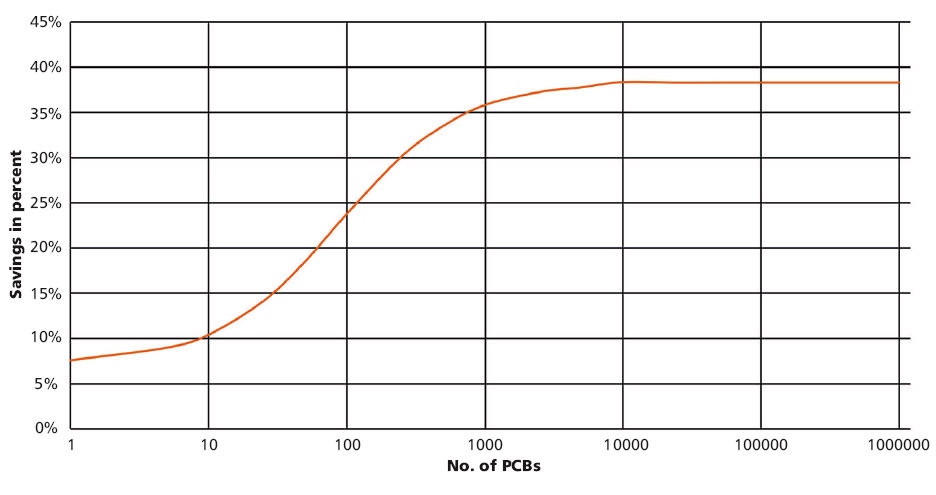
A cost analysis done in collaboration with a major device manufacturer showed a 38 percent reduction in total cost per board when moving to a full SMT-plus-THR setup. Even small- to mid-sized manufacturers that outsource production to contract manufacturers benefit, as THR lowers the processing costs quoted by those vendors.
By specifying THR components at the start of a new project, engineers can design PCBs optimized for a single, automated reflow process. This “design to cost” approach ensures savings are integrated into the product from the ground up. And when updating legacy boards, THR parts offer a clear upgrade path that avoids costly production redesigns.
When looking for reliable PCB assembly with THR technology, look for optimum solder pin length. The pin length of 1.50 mm enables space saving, double-sided assembly of PCBs. At the same time, components should meet all the requirements of IPC-A-610 E. With a position tolerance of less than ± 0.1 mm around the zero position, solder pins should comply with the IEC 61760-3 standard, and thanks to the latest production techniques they will always remain dimensionally stable.
Stable positioning with solder flange pins is important. Solder flanges make additional fixing with screws unnecessary. You can fix the THR components to the circuit board securely in a single step.
Amplifying Efficiencies with SNAP IN Connection Technology
Highly efficient electronic device manufacturing requires connection elements that are designed to handle full automation together with the component assembly in a single manufacturing process, which reduces associated costs. Applied in combination with THR, the latest SNAP IN connection technology for PCBs further drives faster time to market, reduced development costs, minimal wiring errors, and improved consistency in high-volume production.
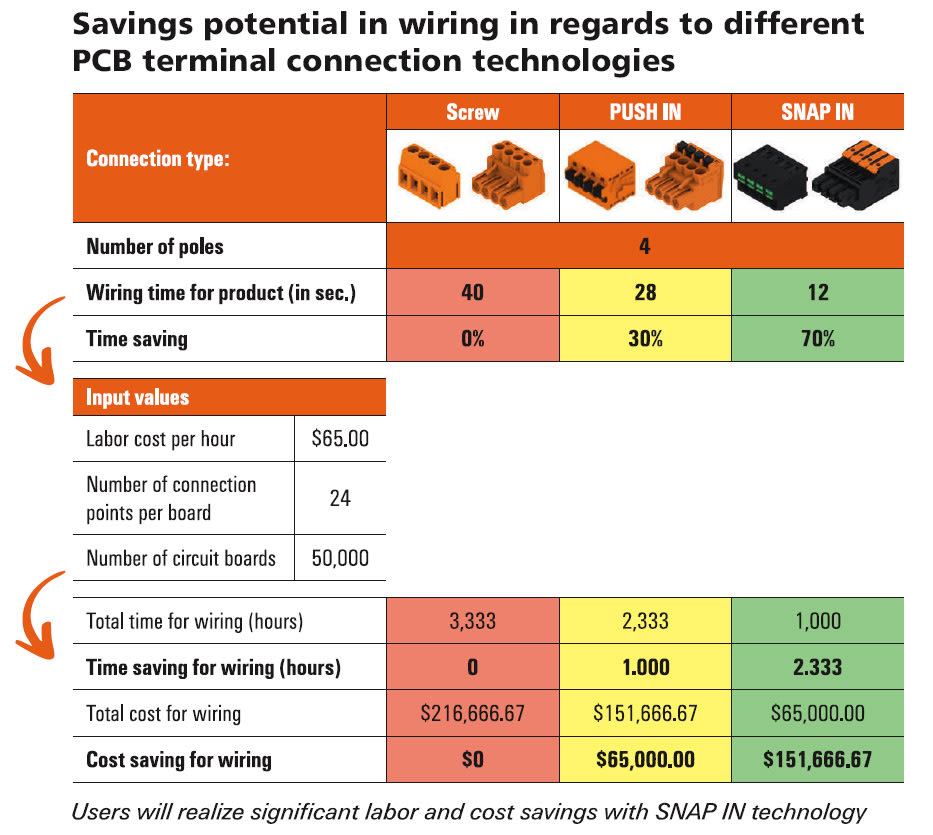
An Easy Transition Plan to THR Technology
THR products can generate significant gains for those who still rely on manual or wave soldering for connectors, seek to reduce lead times and labor costs, and are designing new products or revising existing PCBs.
Adopting a new technology can be daunting, but introducing THR can be game changing with large PCB volumes. To consider whether this is the right move for your organization, here are four key steps that inform smart transitions.
Audit the current manufacturing process. Do you use selective soldering? Manual connector placement? That’s your opportunity area. Consider how using a design-to-cost approach would generate a streamlined, tailored process at lower time and operational investments.
Evaluate PCB volume. Even at modest scale, THR offers measurable cost and time savings. The small difference in component costs can be overcome by looking at volume operations where you can generate operational gains — critical when every dollar matters in today’s competitive economic climate.
Engage an experienced provider as a trusted partner early in the design phase. Professional engineers can help optimize layouts and pin lengths and widths for specific PCB needs. Your technology partner will assist you with products, in-depth knowledge of applications and proven solutions expertise.
Talk to contract manufacturers. Ensure they’re prepared to support SMT and THR production — and ask for cost comparisons. Drive the change you want to implement in your organization.
Through-hole technology (THT) delivers design to cost, which is a smarter way to build today’s PCB boards. By eliminating additional soldering steps and embracing fully automated board and wire assembly, through-hole reflow (THR) coupled with SNAP IN products come together as a clear path to faster, more cost-effective production.
The key benefits include:
Up to 40 percent reduction in assembly costs per board when switching from traditional through-hole connections to THR, which provides for streamlined processing and reduced manual steps.
No additional soldering processes (manual or wave) needed; components pass through the reflow oven with the rest of the board.
Fewer steps, fewer errors, and shorter lead times.
Same proven reliability as conventional through-hole soldered components.
Adopting THR as the new standard isn’t just an incremental upgrade: It’s a strategic shift that aligns with the future of smart manufacturing.
This article was written by John Froustet, Division Director, Device & Field Connectivity, Weidmuller USA (Richmond, VA). For more information, visit here .











