

A method of fabricating flexible assemblies comprising flexible integrated circuits bonded onto or into flexible membranes has been developed. The method provides for bonding of thinned (more specifically, thin enough to be flexible) integrated-circuit chips to the membranes and for electrical connection of the integrated circuits to other circuitry on or in the membranes. The method is expected to enable the further development of a variety of membrane-based flexible, lightweight electronic systems and assemblies — for example, phasedarray antenna assemblies comprising integrated-circuit transmitting/ receiving (T/R) modules further integrated with arrays of transmission lines and antenna radiator elements.
The conventional method of integrating T/R modules and other electronic circuitry into phasedarray radar antenna assemblies involves bolting or epoxying the modules to rigid boards and making the electrical connections by soldering the package leads to contact pads on the boards. Recently, flexible membrane materials have been used to make lighter-weight antenna assemblies. In the present method, in order to further reduce the weight of a given antenna assembly, the T/R circuitry is miniaturized and integrated into one thinned device or a few thinned devices and, instead of packaging the integrated circuits and soldering the packages to contact pads on the membrane, one utilizes the so-called flipchip- on-flex technology to directly integrate the thinned dice with the membrane and the circuitry on or in the membrane. Flip-chip-on-flex technology is not new, but the application of it to thinned integrated circuits is new.
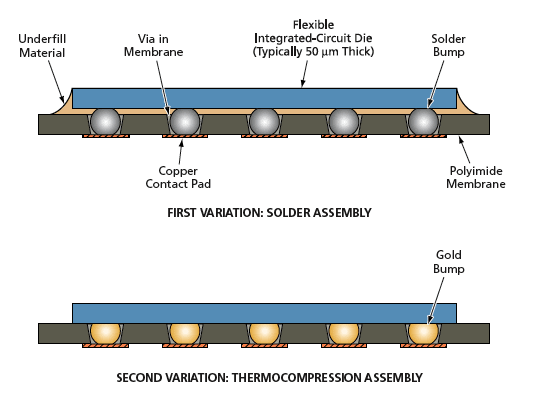
In the second variation, the bumps on the contact pads on the die are made of gold (instead of solder) and flexible membrane is made of a liquid-crystal polymer (instead of a polyimide). As in the first variation, the die is placed on one side of the membrane with its bumps intruding into vias in the membrane. Then in a thermocompression process, the die becomes bonded to the membrane and the bumps become bonded to copper contact pads on the opposite side of the membrane. In this case, no underfill is needed.
The method as described thus far can be extended to enable embedment of a die between two flexible membranes to form a laminated flexible membrane containing flexible electronic circuitry.
This work was done by Alina Moussessian and Linda Del Castillo of Caltech and R. Wayne Johnson of Auburn University for NASA's Jet Propulsion Laboratory. For more information, contact









