3D-Printed Titanium Alloy
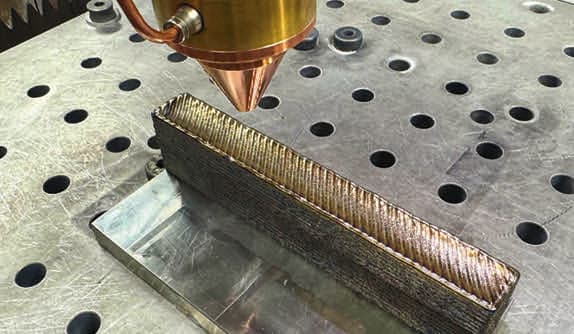
Engineers from RMIT University have produced a new type of 3D-printed titanium that’s about a third cheaper than commonly used titanium alloys. The team used readily available and cheaper alternative materials to replace the increasingly expensive vanadium. The latest study outlines a time- and cost-saving method to select elements for alloying, to take advantage of emerging 3D-printing technology. This work provides a clearer framework for predicting the printed grain structure of metallic alloys in additive manufacturing. It has already been used to achieve impressive results: the team’s alloy, while not presented in the study for commercial reasons, is 29 percent cheaper to produce than standard titanium. Through this design framework, the metal also prints more evenly, avoiding the column-shaped microstructures that lead to uneven mechanical properties in some 3D-printed alloys. The team is considering commercial opportunities to develop the new low-cost approach for aerospace and medical device industries.
Contact: Michael Quinn
+61 439-704-077
This email address is being protected from spambots. You need JavaScript enabled to view it.
Metasurface-Based Quantum Optics

Optics researchers in the Harvard John A. Paulson School of Engineering and Applied Sciences (SEAS) have created specially designed metasurfaces — flat devices etched with nanoscale light-manipulating patterns — to act as ultra-thin upgrades for quantum-optical chips and setups. The team showed that a metasurface can create complex, entangled states of photons to carry out quantum operations, like those done with larger optical devices with many different components. Their work enables miniaturization of an entire optical setup into a single metasurface that is very stable and robust. It embodies metasurface-based quantum optics which, beyond carving a path toward room-temperature quantum computers and networks, could also benefit quantum sensing or offer “lab-on-a-chip” capabilities for fundamental science. It also offers fresh insight into the understanding, design, and application of metasurfaces, especially for generating and controlling quantum light.
Contact: Anne J. Manning
617-496-1351
This email address is being protected from spambots. You need JavaScript enabled to view it.
Portable Slide Staining System for Microscopy
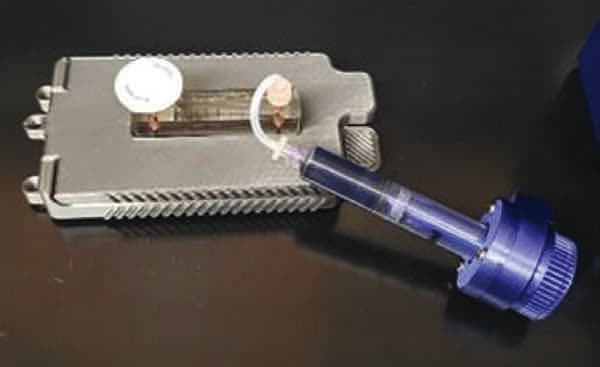
Innovators at NASA Johnson Space Center have developed a handheld slide staining system designed to support medical, research, or environmental monitoring. Although deployed aboard the ISS to work in conjunction with NASA’s high-powered handheld microscope in the absence of gravity, the system may be applicable to all known staining procedures for terrestrial field and lab microscopes. This novel system is comprised of two primary components that are entirely self-contained when assembled. One component, the dispenser, is designed with an adjustable reagent sponge delivery system that not only serves as a containment unit for fluids, but also whose volume allows for multiple uses until the reagents from the dispenser are depleted. The sponges can be replenished with commercial off-the-shelf reagents. The second component, the slide staining device, traps and seals the specimen slide, which then receives the titrated reagent from the dispenser.