Robotics & Motion Control - September 2025
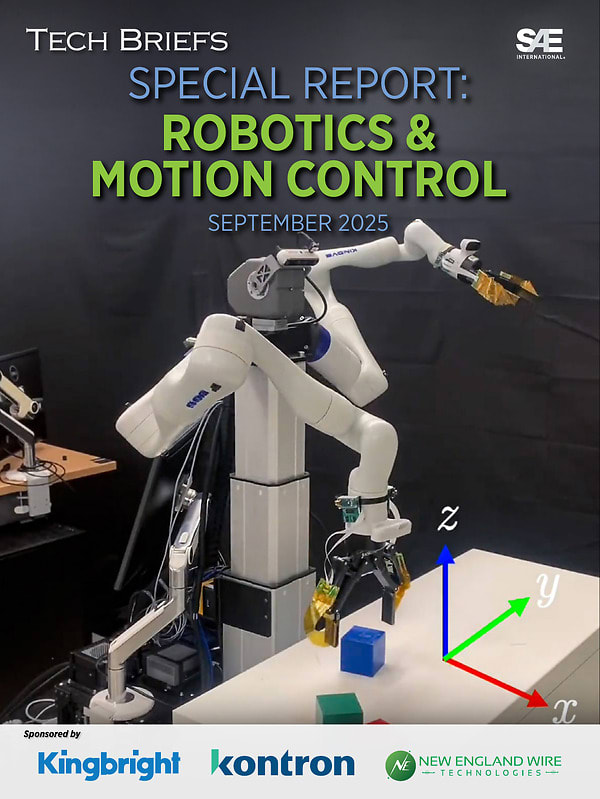
Dronelike robot has the “brains” to morph from fly to drive mode midair…new cobot cuts construction time in half…AI system empowers robots with human‐like perception. Read about these innovations and more in this compendium of articles from the editors of Tech Briefs and Motion Design magazines.
Don't have an account?
Overview
The "Robotics & Motion Control Special Report" from September 2025 presents a comprehensive overview of advancements in robotics and automation, particularly focusing on their applications in various industries, including medical device manufacturing and construction.
The report begins by discussing the importance of precision in robotics, emphasizing how automation is revolutionizing medical device manufacturing. It highlights the role of robotics in enhancing efficiency, compliance, and sustainability, which are critical in the production of medical devices.
One of the key innovations featured is the development of drywall finishing robots that significantly accelerate construction schedules. These robots automate the labor-intensive process of drywall finishing, thereby improving productivity and reducing the time required for project completion.
Another notable application is the use of automated pallet inspection systems, which enhance quality control by effectively separating defective products from good ones. This technology ensures that only high-quality items reach consumers, thereby maintaining brand integrity and customer satisfaction.
The report also covers collaborative robots (cobots) that are designed to repair and refurbish electronic appliances, promoting sustainability by extending the life of products and reducing electronic waste. This application reflects a growing trend towards environmentally responsible manufacturing practices.
In the tech briefs section, the report introduces a novel algorithm developed by researchers from MIT and NVIDIA, which dramatically speeds up a robot's planning process. This algorithm allows robots to evaluate thousands of potential solutions simultaneously, enabling them to solve complex manipulation problems in seconds. This advancement is crucial for applications that require quick decision-making and adaptability in dynamic environments.
Additionally, the report discusses the development of electronics-free 3D-printed robots by the Bioinspired Robotics Laboratory at UC San Diego. These robots can operate without electronics, using compressed gas for movement, making them suitable for environments where traditional electronics may fail, such as disaster response or space exploration.
Overall, the report underscores the rapid advancements in robotics and motion control technologies, showcasing their potential to transform various sectors by improving efficiency, safety, and sustainability. The innovations highlighted reflect a future where robotics play an integral role in everyday operations across multiple industries.