

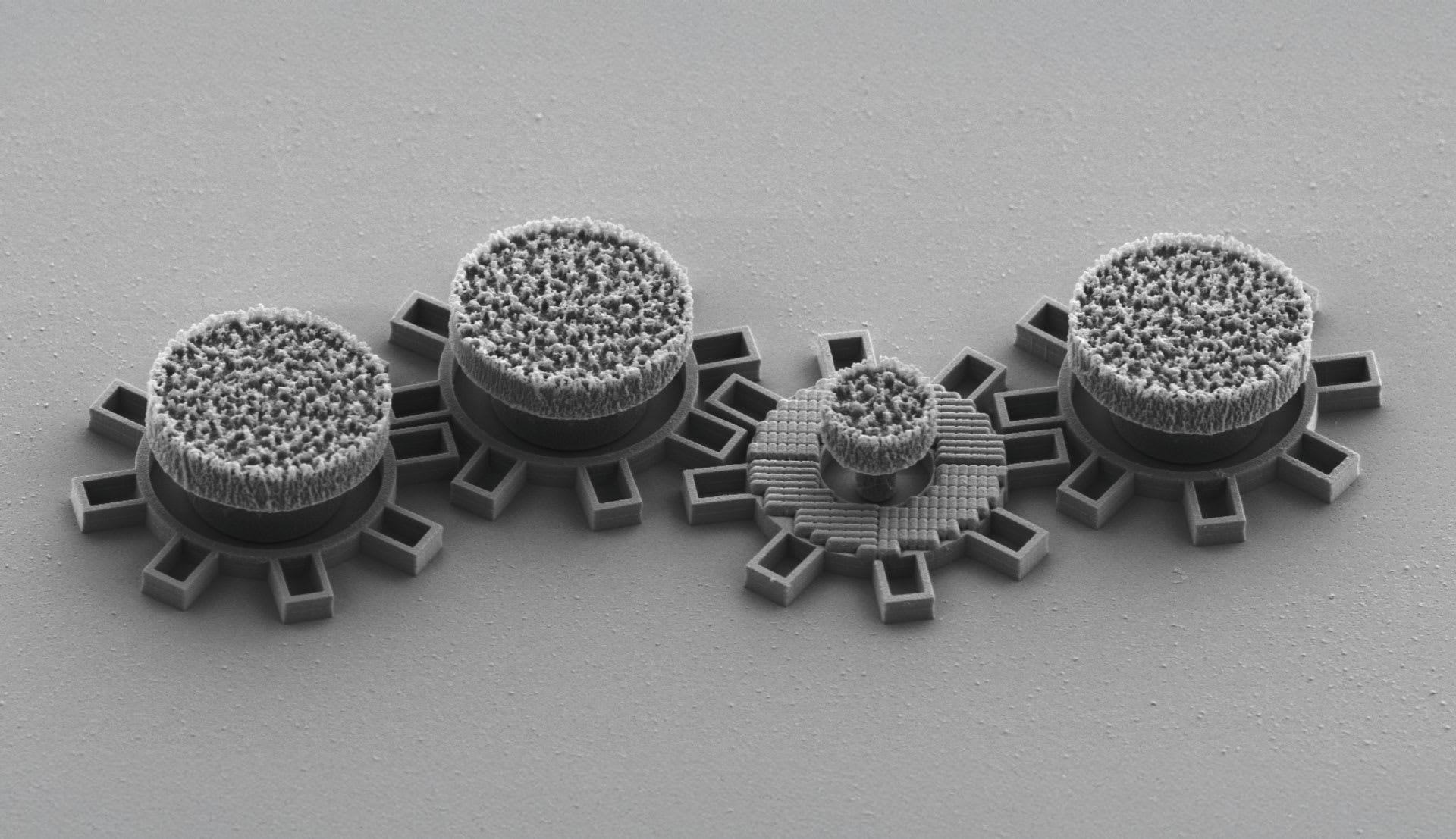
For more than 30 years, researchers have been trying to create small gears in order to construct micro-engines. But progress stalled at 0.1 millimeters, as it was not possible to build the drive trains needed to make them move any smaller. But Researchers from Gothenburg University, among others, have now broken through this barrier by ditching traditional mechanical drive trains and instead using laser light to set the gears in motion directly.
In their new study, the researchers show that microscopic machines can be driven by optical metamaterials — small, patterned structures that can capture and control light on a nanoscale. Using traditional lithography, gears with an optical metamaterial are manufactured with silicon directly on a microchip, with the gear having a diameter of a few tens of micrometers. By shining a laser on the metamaterial, the researchers can make the gear wheel spin. The intensity of the laser light controls the speed, and the direction of the gear wheel can be changed by changing the polarization of the light. The researchers are thus close to creating micromotors.
"We have built a gear train in which a light-driven gear sets the entire chain in motion. The gears can also convert rotation into linear motion, perform periodic movements, and control microscopic mirrors to deflect light," said the study's first author, Gan Wang, a researcher in soft matter physics at the University of Gothenburg.
The ability to integrate such machines directly onto a chip and drive them with light opens up entirely new possibilities. Since laser light does not require fixed contact with the machine and is easy to control, the micromotor can be scaled up to complex microsystems. “This is a fundamentally new way of thinking about mechanics on a microscale. By replacing bulky couplings with light, we can finally overcome the size barrier,” said Gan Wang.
With these advances, researchers are beginning to imagine micro- and nanomachines that can control light, manipulate small particles or be integrated into future lab-on-a-chip systems. A gear wheel can be as small as 16 – 20 micrometers — there are human cells of that size.
Medicine is a field that is within reach, believes Gan Wang. “We can use the new micromotors as pumps inside the human body, for example to regulate various flows. I am also looking at how they function as valves that open and close.”











