Robert Moerck
MOEWERS Aps
Værløse, Denmark
On the modern battlefield, a critical dilemma exists: To see, one must emit energy with active radar, which instantly reveals one’s position to be jammed or targeted. This makes surveillance a high-stakes gamble. Furthermore, the proliferation of stealth technology has rendered many conventional radar systems obsolete, creating a dangerous gap in national defense. The “Silent Sentry” design solves the challenge of detecting advanced threats without becoming one.
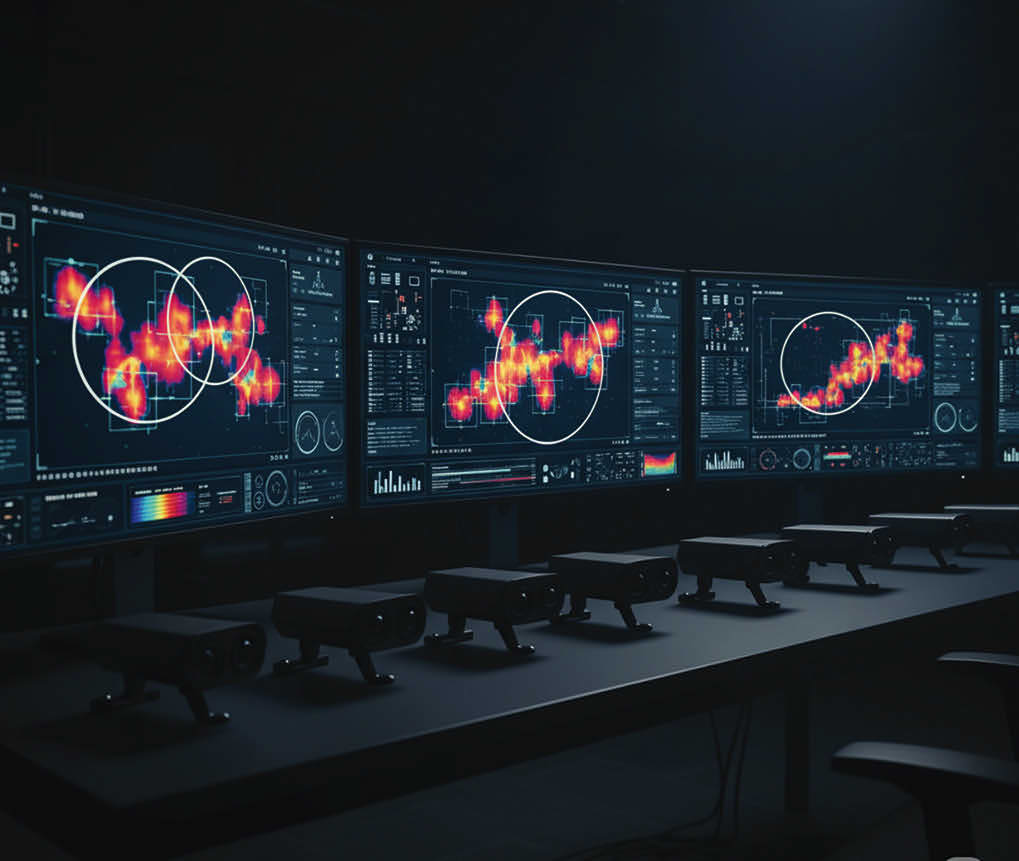
Silent Sentry is a software system that transforms existing passive microwave sensors into advanced threat detectors. The system is based on Passive Microwave Radiometry (PMR), which “listens” for the faint, naturally emitted thermal radiation from all objects. The core of the technology is a proprietary neural network that processes this data. It intelligently filters out complex background noise to isolate the unique thermal signatures of targets, turning a noisy environment into a clear, actionable intelligence picture that works day or night, in any weather.

“The concept for Silent Sentry was born from the fusion of two distinct worlds: my two decades of experience in tactical military operations and the deep-space expertise of an aerospace engineer,” said Robert Moerck. “He was tracking the conflict in Ukraine, seeing it through the lens of satellite technology, while I was analyzing it from the ground up, constantly seeking new ways to gain an advantage and new capabilities to find, fix, fight, and/or finish the enemy. We didn’t just have a discussion; we identified a critical capability opportunity.”
“We architected a solution that turns passive commercial satellite data into an active, decisive surveillance tool, moving from a theoretical framework to a viable, groundbreaking concept with immediate real-world applications,” said Moerck.
This system represents a significant advance over the current solutions. Its novelty lies in the software-driven ability to overcome the traditional limitations of passive sensing, delivering two game-changing benefits. First, it detects the invisible. The neural network can identify the minute thermal contrast between a stealth aircraft and the cold background of the sky. This allows it to detect low-observable threats that are explicitly designed to be invisible to the active radar systems that form the backbone of modern air defense, improving public safety and security.
The second benefit is that it ensures survivability. As a completely passive, non-emitting system, it has a Low Probability of Intercept (LPI). Users can monitor adversaries continuously without ever revealing their own location, saving the lives of military personnel by preventing them from being targeted. This silent vigilance also saves time and money by providing persistent surveillance without the risks associated with active sensor platforms.
“Our primary challenge wasn’t the theory — the physics are sound — but access to high-fidelity, multi-spectral satellite data at scale,” said Moerck, adding that “instead of viewing this as a roadblock, we treated it as an operational parameter. We took decisive action and successfully validated our proof of concept using existing, commercially available data. This proved our core detection algorithms are not just valid, but effective even with current limitations.”
The primary market for Silent Sentry is the global defense and intelligence community, with direct applications in air defense, naval warfare, and ground-based reconnaissance. The growing investment in counter-stealth capabilities and survivable ISR (Intelligence, Surveillance, and Reconnaissance) assets represents a multi-billion-dollar market. From ships and aircraft to vehicles and fixed sites, any platform can be retrofitted, creating a vast and immediate addressable market.
“We are ready for immediate implementation. The system is operationally viable today, and because the core technology is hardware-agnostic, we can deploy on existing sensor networks without needing to develop bespoke hardware,” said Moerck.
For more information, visit here .