

Electric Vehicles - October 2025
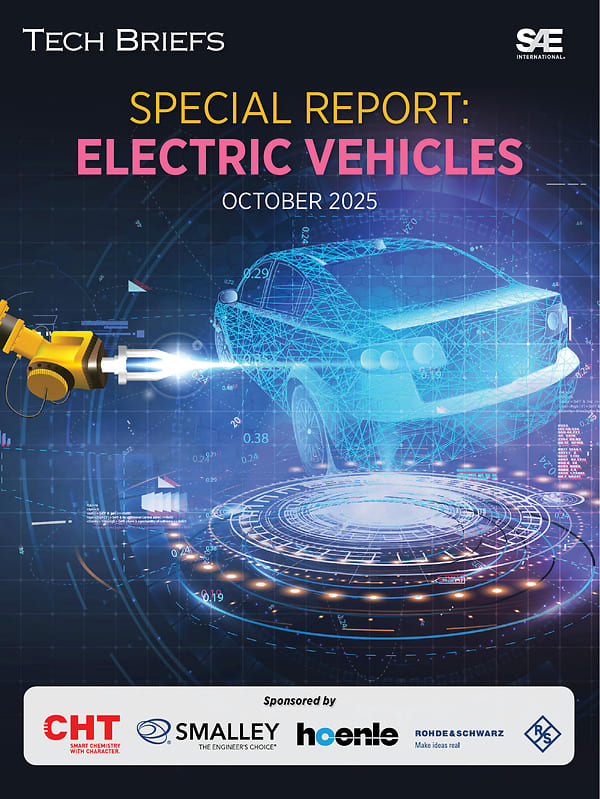
In this collection of articles from the editors of Automotive Engineering and Battery & Electrification Technology, learn how improvements in power electronics will redefine EVs, how a groundbreaking technology for load management promises to solve the biggest EV fleet challenge, why SoC/SoH accuracy is critical for battery longevity, and much more.
Don't have an account?
Overview
The October 2025 Special Report on Electric Vehicles explores significant advancements in electric mobility, focusing on technologies that enhance performance, reliability, and sustainability in battery-powered systems. Key highlights include breakthroughs in silicon carbide (SiC) and gallium nitride (GaN) power electronics, which promise to redefine electric vehicle (EV) performance by enabling smaller, more efficient powertrain components.
A critical aspect of the report is the emphasis on accurate state-of-charge (SoC) and state-of-health (SoH) estimation for batteries. These estimations are vital for extending battery life, ensuring reliability, and driving business success in electrification. Improved monitoring of battery conditions allows for predictive maintenance, enabling operators to anticipate failures and schedule maintenance proactively, thus reducing downtime and operational costs.
The report also discusses the importance of load management technologies, particularly automated load management (ALM), which helps EV fleets optimize power usage without exceeding infrastructure limits. This technology is crucial for avoiding costly grid upgrades and is already in use in various projects, such as school bus operations in California and New York, where it has allowed for the installation of more chargers than would otherwise be feasible.
Additionally, the document highlights the challenges of battery management, particularly in minimizing idle deterioration. Proper SoC monitoring during storage is essential to prevent irreversible damage to batteries, especially in seasonal or backup applications. Maintaining batteries within an ideal charge window is crucial for their longevity.
The report touches on the sustainability aspect of battery systems, noting that companies like Mercedes-Benz Trucks are refurbishing high-voltage batteries to create a more sustainable spare parts portfolio. This approach not only extends the life of battery components but also informs future designs.
Overall, the report underscores the critical role of advanced technologies in the evolution of electric vehicles, emphasizing the need for robust battery management systems and innovative load management solutions to meet the growing demands of the electric mobility sector. As industries increasingly adopt battery-powered systems to achieve decarbonization and energy independence, effective management of these technologies will be essential for success.











