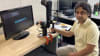
It all started when Owen Kent and Todd Roberts became roommates at the University of California Berkeley. Owen has muscular dystrophy and had recently acquired a robotic arm, which he noticed he was using to do range of motion. Todd had come to Berkeley to study mechanical engineering with a focus on biomechanics, and both were enrolled in Designing for the Human Body, a biomechanics course taught by Mechanical Engineering Professor Grace O’Connell.
“We put our heads together and found a lot of overlapping passions. Ultimately, that's what turned into our first product, Reflex, which is a robotic knee brace for doing at-home physical therapy,” said Kent.
Their focus was initially on helping people like Owen, with neuromuscular conditions, to do daily physical therapy and contraction management — trying to get the joints to move with external forces. If you stay stationary for an extended period of time, the ligaments and tendons begin to shrink and harden into what are called contractures. Then you start to permanently lose range of motion. “Unfortunately, insurance does not cover daily exercise for a lot of people in this condition because it's considered a nice-to-have, which is a brutal designation, even though it would lead to huge improvements in quality of life,” said Roberts.
“Todd and I met in the summer of 2019 and built our first prototype with popsicle sticks, yarn, and a pool noodle. We went from there to some resin-molded, custom things, and then finally settled on 3D printing,” said Kent.
One of the biomechanics problems they had to solve was, how to safely and comfortably attach a motor to somebody's body. That’s a particularly difficult task for somebody who has a very small amount of muscle mass. At Berkeley they were able to take advantage of 3D scanning and 3D printing technologies to take a custom scan of the patient's limb and 3D print custom cuffs that would comfortably attach to the user's limb. But when they transitioned to the commercial version, produced at their startup, ATDev, they realized they had to have general sizing for a middle-of-the-bell-curve population.
It also had to be very lightweight — their whole system is only 5 lbs. They achieved that by using a lightweight nylon material with chopped carbon fiber infill and a continuous carbon fiber that can be 3D printed and selecting motors and batteries that were lightweight, powerful, and reliable.
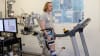
In accordance with the treatment plan, Reflex can apply either supportive forces that move the patient’s leg back and forth to restore range of motion, or resistive forces to build quadricep and hamstring strength. While in use, the device also collects patient data, including how well they are doing with daily range of motion and strength progress. That information is then sent to the patient’s care team, so they can remotely monitor and update parameters.
“We use a brushless DC motor at the joint of the reflex for either applying or resisting force. Since the motor current correlates pretty linearly with the motor torque, we use that to measure joint strength,” said Roberts. “And we measure range of motion with a magnetic encoder at the joint.”
The physical therapist sets the maximum resistance and range of motion for a given patient, and the patient can then adjust the settings up to the maximum on their own. The therapist’s settings can be remotely reset daily. When the patient first puts on the device, they move through their comfortable range of motion, and then the device tries to push them toward the maximum set by the physical therapist.
Once the device was ready to go and the new company, ATDev, was established, their first step was raising capital, which they managed from several different sources. Then there had to be FDA approval. “A lot of people talk about the FDA and regulatory being a big burden in medical device commercialization. But from our perspective, although it was certainly a lot of work, our biggest hurdle, as for all medical devices, has been reimbursement from insurance — if you don’t get it, people will have to pay out of pocket,” said Roberts.
“We think that telehealth is going to be an ever-increasing part of medicine, and there aren't really any physical therapy devices that integrate with it. A lot of people who have knee surgeries, get sent home with a pamphlet or maybe a software app on their phone that can show them how to do their exercises. But there's really nothing like Reflex that can be a proxy for hands-on measuring of joint strength and range of motion,” said Kent. Its unique importance is that it extends the reach of physical therapists by enabling them to use telehealth.
This article was written by Ed Brown, Associate Editor at SAE Media Group. For more information, visit here .