 A goal of scientists has been to develop an artificial version of photosynthesis that can be used to produce liquid fuels from carbon dioxide and water. Researchers with the U.S. Department of Energy’s Lawrence Berkeley National Laboratory (Berkeley Lab) took a step towards this goal.
They discovered that nano-sized crystals of cobalt oxide can effectively carry out the critical photosynthetic reaction of splitting water molecules.
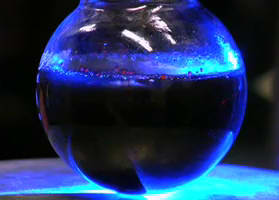
In the video, an aqueous solution contains silica particles that have been embedded with photooxidizing cobalt oxide nanocrystals plus a sensitizer to allow the water-splitting reaction to be driven by visible light. When laser light hits the solution it turns from gold to blue as the sensitizer absorbs light. Bubbles soon begin to form as oxygen gas is released from the spilt water molecules.
Transcript
No transcript is available for this video.