

For a wide range of engineers and scientists, the sound generated by a vibrating structure represents a critically important phenomenon. These sounds can be of significance for accomplishing rapid, low-cost inspection of critical infrastructure. For example, there are approximately 600,000 highway bridges in the United States. The timely inspection of these bridges requires a significant outlay of resources from federal, state, and local governments. A system capable of detecting significant structural flaws without requiring extensive physical contact with the structure would increase the frequency of inspections, thus improving the safety of the aging bridge infrastructure.
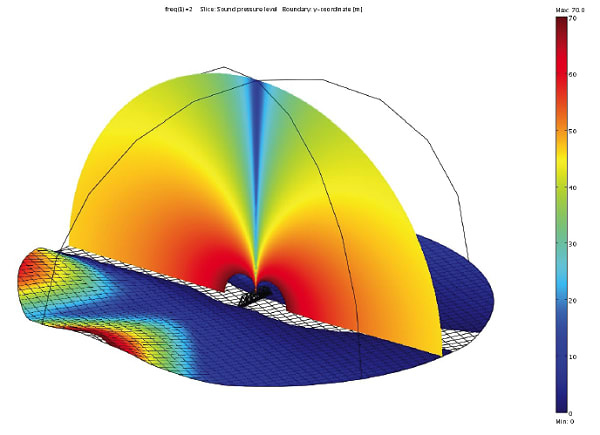
The figure shows the acoustic waves generated by a vibrating bridge reflecting off the local topology surrounding the bridge. The plane at the bottom represents the topology with colors that specify relative elevation. At the center of the topology is a riverbed that appears white; the bridge spans the riverbed at the center of the image. A cut plane in the figure shows the distribution of sound pressure level as it propagates away from the bridge. These results provide clear guidance for specifying the type and location of sensors necessary for assessing the structural condition of the bridge.
This research was sponsored by the US Army Engineer Research and Development Center under the Infrasound Assessment of Infrastructure program.
This work was performed by Dr. K.C. Koppenhoefer, Dr. J.S. Crompton, and Dr. S. Yushanov of AltaSim Technologies, LLC using COMSOL Multiphysics software. For more information, Click Here .











