Inside this issue
Supplements

Overview
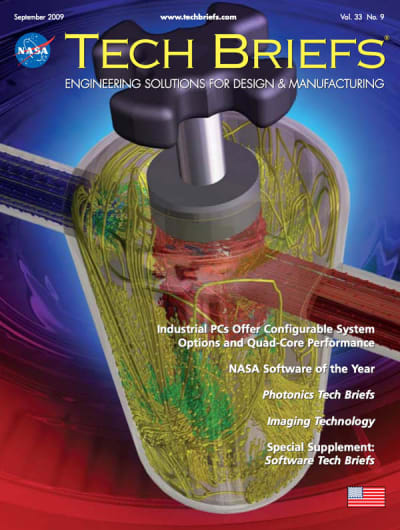
The September 2009 issue of NASA Tech Briefs, along with its supplementary publications, presents a comprehensive overview of advancements in technology, particularly focusing on industrial computing, imaging technology, and photonics. This edition is designed to inform engineers, researchers, and technology enthusiasts about the latest innovations and applications in these fields.
Key Highlights:
-
Industrial PCs: The issue features a detailed discussion on industrial PCs that offer configurable system options and quad-core performance. These systems are designed to meet the demanding requirements of industrial environments, providing robust performance and flexibility for various applications. The article emphasizes the importance of customization in industrial PCs, allowing users to tailor their systems to specific operational needs, which can enhance productivity and efficiency.
-
NASA Software of the Year: A significant highlight of this issue is the recognition of a software solution as NASA's Software of the Year. This accolade underscores the software's impact on aerospace technology and its potential applications in various engineering fields. The article provides insights into the software's capabilities, including its role in improving data analysis, simulation, and modeling processes, which are crucial for mission planning and execution.
Photonics Technology: The issue includes a special focus on photonics, showcasing the latest advancements in laser technology and imaging systems. One notable product featured is the SLIM-561-150, a continuous wave diode-pumped solid-state (DPSS) laser that operates at 561 nm with an output power of 150 mW. Its single-frequency emission makes it suitable for applications such as Raman spectroscopy, holography, and laser Doppler velocimetry. This section highlights the growing importance of photonics in various scientific and industrial applications, emphasizing its role in enhancing measurement precision and enabling new research avenues.
-
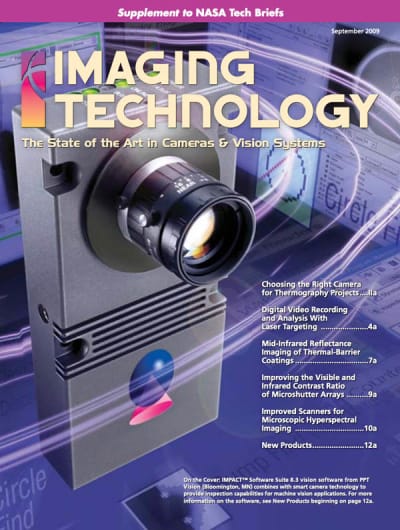
Imaging Technology: The magazine also delves into the state of the art in cameras and vision systems, particularly in the context of thermography projects. The articles provide guidance on selecting the right camera for specific applications, discussing factors such as resolution, sensitivity, and imaging speed. This information is vital for engineers and researchers who rely on thermal imaging for diagnostics, monitoring, and analysis in various fields, including aerospace, manufacturing, and environmental science.
-
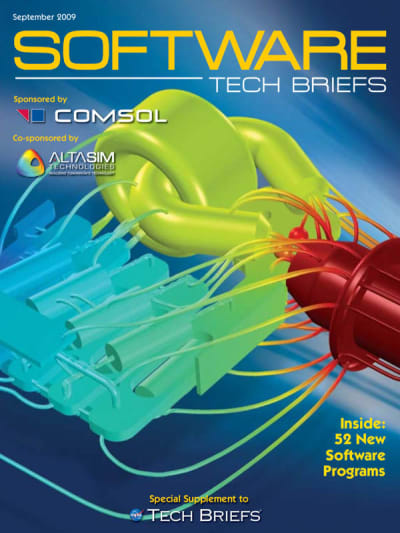
Supplementary Content: The issue includes several supplementary sections that provide additional insights into software technologies and their applications. These supplements are designed to enhance the reader's understanding of the latest tools and methodologies available for engineers and researchers. They cover topics such as software development, data management, and the integration of new technologies into existing systems.
-
Advertisers Index: The magazine features an advertisers index, allowing readers to easily access product literature and additional resources from various companies. This section serves as a valuable resource for those looking to explore new products and solutions in the market.
Conclusion:
The September 2009 issue of NASA Tech Briefs and its supplementary publications serve as a vital resource for professionals in the fields of engineering, technology, and research. By highlighting advancements in industrial PCs, software innovations, and photonics technology, the issue provides readers with the knowledge and tools necessary to stay at the forefront of technological development. The focus on practical applications and real-world solutions makes this edition particularly relevant for those looking to implement cutting-edge technologies in their work. Overall, this issue encapsulates the dynamic nature of technology and its continuous evolution, offering insights that are both informative and inspiring for the engineering community.
Features
-
Application Briefs
Micro-Molded Spacers Protect Thermal Insulation of Cryogenic Propellants
-
Articles
NASA Awards 2008 Software of the Year
Industrial PCs Offer Configurable System Options and Quad-Core Performance
Tech Briefs
-
Physical Sciences
Dynamic Self-Locking of an OEO Containing a VCSEL
-
Manufacturing & Prototyping
High-Efficiency Artificial Photosynthesis Using a Novel Alkaline Membrane Cell
Silicon Wafer-Scale Substrate for Microshutters and Detector Arrays
-
Materials
Large-Format Carbon Nanotube Sheets Fabricated With Chemical Vapor Deposition
Filtering Water by Use of Ultrasonically Vibrated Nanotubes
Improvements in Production of Single-Walled Carbon Nanotubes
Progress Toward Sequestering Carbon Nanotubes in PmPV
Functionalizing CNTs for Making Epoxy/CNT Composites
Fluoroester Co-Solvents for Low-Temperature Li⁺ Cells
-
Information Sciences
Rate-Compatible LDPC Codes With Linear Minimum Distance
Minimizing Input-to-Output Latency in Virtual Environment
PrimeSupplier Cross-Program Impact Analysis and Supplier Stability Indicator Simulation Model
-
Mechanics & Machinery
-
Semiconductors & ICs
Parallel-Processing CMOS Circuitry for M-QAM and 8PSK TCM
Circuit for Driving Piezoelectric Transducers
-
Electronics & Computers
Two-Stage Variable Sample-Rate Conversion System
Estimating Transmitted-Signal Phase Variations for Uplink Array Antennas
Differential InP HEMT MMIC Amplifiers Embedded in Waveguides
Compact, Low-Overhead, MIL-STD-1553B Controller
Battery Cell Voltage Sensing and Balancing Using Addressable Transformers
Products
-
Applications
-
Articles
Understanding Complex-Domain, Floating-Point DSPs
Distributing a Simulink® Model Across Multiple Heterogeneous Processors
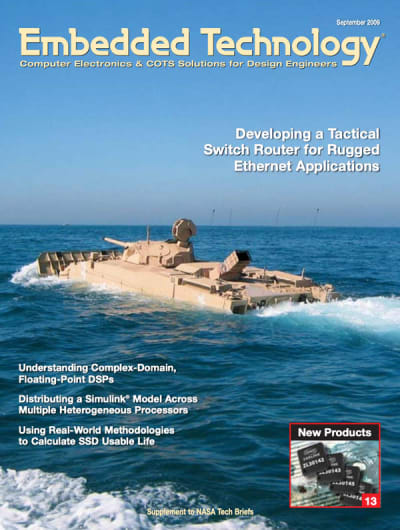
Developing a Tactical Switch Router for Rugged Ethernet Applications
-
Briefs
Qualifying Software for Nuclear-Safety-Related Calculations
Acoustic Structure Interactions
Analysis of Transient Electric Dipole
Spacecraft Station-Keeping Trajectory and Mission Design Tools
Simulation of Attitude and Trajectory Dynamics and Control of Multiple Spacecraft
Port-O-Sim Object Simulation Application
Efficient Model-Based Diagnosis Engine
Proton Upset Monte Carlo Simulation
Using Thermal Radiation in Detection of Negative Obstacles
Planning Flight Paths of Autonomous Aerobots
Tracking Debris Shed by a Space-Shuttle Launch Vehicle
Oxygen Generation System Laptop Bus Controller Flight Software
Estimating Thruster Impulses From IMU and Doppler Data
Monitoring and Controlling an Underwater Robotic Arm
Digital Camera Control for Faster Inspection
Reaction Wheel Disturbance Model Extraction Software — RWDMES
Evolvable Neural Software System
Conical-Domain Model for Estimating GPS Ionospheric Delays
Complex Event Recognition Architecture
Interactive, Automated Management of Icing Data
Prediction of Launch Vehicle Ignition Overpressure and Liftoff Acoustics
LDPC-PPM Coding Scheme for Optical Communication
TurboTech Technical Evaluation Automated System
Perl Modules for Constructing Iterators
Relay Sequence Generation Software
Tropical Cyclone Information System
Dynamic Hurricane Data Analysis Tool
XML Translator for Interface Descriptions
Mars Science Laboratory Workstation Test Set
GlastCam: A Telemetry-Driven Spacecraft Visualization Tool
Computing Bounds on Resource Levels for Flexible Plans
Mission Operations and Navigation Toolkit Environment
Extensible Infrastructure for Browsing and Searching Abstracted Spacecraft Data
Lossless Compression of Data Into Fixed-Length Packets
Video-Game-Like Engine for Depicting Spacecraft Trajectories
Analog Input Data Acquisition Software
MSLICE Science Activity Planner for the Mars Science Laboratory Mission
Alert Notification System Router
MAGIC: Model and Graphic Information Converter
Lossless Compression of Classification-Map Data
Policy-Based Management Natural Language Parser
Framework for ReSTful Web Services in OSGi
Data Management Applications for the Service Preparation Subsystem