

A method of determining the position and attitude of a body equipped with a Global Positioning System (GPS) receiver includes an accounting for the location of the nonunique phase center of a distributed or wraparound GPS antenna. The method applies, more specifically, to the case in which (1) the GPS receiver utilizes measurements of the phases of GPS carrier signals in its position and attitude computations and (2) the body is axisymmetric (e.g., spherical or round cylindrical) and wrapped at its equator with a single- or multiple-element antenna, the radiation pattern of which is also axisymmetric with the same axis of symmetry as that of the body.
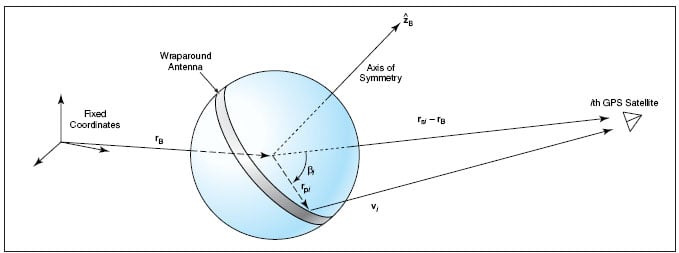
||rsi – rB|| = ||vi|| + ||rpi|| cos(ßi) (1) and
cos(ßi) = [ 1 - (r^sib • z^B)2 ] 1/2 (2) where
- ßi is the angle between rsi – rB and rpi as shown in the figure,
- zˆB is the unit vector along the axis of symmetry as shown in the figure, and
- r^sib is the unit vector along rsi – rB.
The computation of the desired pseudorange ||rsi – rB|| begins with a coarse estimate of rB — for example, a previously computed value or a value computed anew without the phase correction. The coarse estimate of rB is used to obtain an estimate of rˆsib, which is used in iterations of equation 1 to obtain successively refined estimates of rB. Optionally, one can also obtain successively refined estimates of rˆsib from the iterations, though in most GPS applications, the error in the initial estimate of rˆsib should be negligible.
The iterations follow one of two courses, depending on whether or not ||rpi|| and the attitude of the body are known a priori. If the attitude is known, then zˆB is known and can be inserted in equation 2, which yields cos(ßi) for use in equation 1. Then ||rpi|| and cos(ßi) can be used in equation 1 without further ado. If ||rpi|| and zˆB are not known a priori, then it is necessary to determine ||rpi||,the attitude, and the phase-correction term ||rpi|| cos(ßi) from a least-squares or other fit of (a) an approximate geometric model of the amount by which the phase at rpi leads the phase at rB to (b) phase measurements for all of the GPS signals detected by the receiver.
This work was done by Patrick W. Fink and Justin Dobbins of Johnson Space Center.
This invention is owned by NASA, and a patent application has been filed. Inquiries concerning nonexclusive or exclusive license for its commercial development should be addressed to the Patent Counsel, Johnson Space Center, (281) 483-0837. Refer to MSC-23228.











