

Integrated arrays of microscopic solid-state batteries have been demonstrated in a continuing effort to develop microscopic sources of power and of voltage reference circuits to be incorporated into low-power integrated circuits. Perhaps even more importantly, arrays of microscopic batteries can be fabricated and tested in combinatorial experiments directed toward optimization and discovery of battery materials.
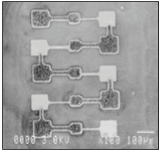
Microbattery arrays (see figure) are fabricated on substrates by use of conventional integrated-circuit manufacturing techniques, including sputtering, photolithography, and plasma etching. The microbatteries incorporate the same cathode materials of interest for conventional lithium-ion batteries such as LiCoO2 and LiCoxNi1–xO2. If multiple deposition sources are used in the fabrication of a given array, then the chemical compositions of battery components of interest can be varied across the substrate, making it possible to examine what amounts to almost a continuum of compositions. For example, assuming that a 4-in. (10-cm) substrate is used, the test-device pitch is 50 μm, and the concentration gradient is 80 percent across the substrate, then the compositions of adjacent test cells can be expected to differ by only about 0.04 percent. Because thousands of test cells can be fabricated in a single batch, it becomes practical to test thousands of combinations of battery materials by use of microbattery arrays, as contrasted with only about 10 to 20 combinations by use of macroscopic cells.
The following is an example of a procedure for fabricating an array of [LiCoxNi1–xO2 cathode/lithium phosphorus oxynitride solid electrolyte/nickel anode] cells like those shown in the figure, with a gradient in the cathode composition.
- A Ti film is deposited on a 4-in. (Å10-cm) oxidized Si substrate. A Mo film is subsequently deposited on the Ti film.
- The Mo-Ti bilayer is patterned by use of photolithography and wet etching to define the cathode current collectors.
- The substrate is patterned with thick negative photoresist, with vias in the photoresist opened over selected areas of the current collectors.
- A film of LiCoxNi1–xO2 cathode material is deposited on the substrate with the desired gradient in x and selectively removed by use of a lift-off process, such that LiCoxNi1–xO2 is present only on the cathode current collectors.
- A film of the solid electrolyte lithium phosphorous oxynitride is deposited.
- A film of Ni is deposited.
- The Ni film is patterned to define the anode current collectors.
- The Ni film is selectively removed by ion milling.
- A protective coat (for example, vapor-deposited Parylene) is applied.
All depositions described above are performed by magnetron sputtering. The procedure can be readily modified to yield gradients in the cathode with other cations of interest: for example, LiCoxNi1–xO2 could be replaced with LiCoxNiyMn1–x–yO2 with the desired gradients in x and y.
The cells can be tested by use of a commercial semiconductor-parameter analyzer connected to the test cells via tungsten probe needles. By applying a current of the order of 5 nA to a cell from the cathode to the anode, the cell can be charged by oxidizing the cathode and reducing the Li at the anode. The charged cell can be discharged by reversing the polarity of the current. The cells can be tested in the same manner as that used to test conventional lithium-ion cells to obtain information on such characteristics as cycle life and charge/discharge capacities, all as a function of compositions of the cathode.
This is a Scanning Electron Micrograph of a microbattery array. The lightly shaded contact pads are cathode current collectors. The darker contact pads are anode current collectors. The cathodes and solid electrolyte of each cell are sandwiched between the anode and cathode contact pads and are not visible in this view.
This work was done by William West, Jay Whitacre, and Ratnakumar Bugga of Caltech for NASA's Jet Propulsion Laboratory. For further information, access the Technical Support Package (TSP) free on-line at www.nasatech.com/tsp under the Computers/Electronics category.
NPO-21216
This Brief includes a Technical Support Package (TSP).
Microbatteries for Combinatorial Studies of Conventional Lithium-Ion Batteries
(reference NPO-21216) is currently available for download from the TSP library.
Don't have an account?
Overview
The document is a NASA Technical Support Package detailing advancements in microbattery arrays for combinatorial studies of battery materials, prepared under the sponsorship of NASA and authored by inventors from the Jet Propulsion Laboratory (JPL). It emphasizes the development of integrated arrays of microscopic solid-state batteries, which are designed to serve as power sources and voltage reference circuits for low-power integrated circuits.
The primary innovation presented is the fabrication of microbatteries with microscale dimensions, a first in the field. These microbatteries are particularly useful for applications requiring low power, such as on-chip voltage references. The document highlights the significance of using microbattery arrays in combinatorial experiments, which allow for the optimization and discovery of new battery materials. This approach is advantageous because it enables the testing of hundreds or thousands of material combinations simultaneously, overcoming the limitations of traditional methods that require building and testing full-size batteries, which are time-consuming and costly.
The document outlines the motivation behind this research, noting the ongoing demand for battery materials with higher voltage, capacity, and cycle life. It identifies key components affecting battery performance, including current collectors, anodes, electrolytes, and cathodes. While conventional characterization methods like x-ray diffraction can assess new materials, the ultimate evaluation of their performance necessitates the fabrication of test cells, which is often impractical due to resource constraints.
The proposed solution involves using microfabricated cells to directly measure the performance of various battery materials, facilitating a more efficient exploration of material properties and their effects on battery performance. This combinatorial approach is positioned as a significant improvement over existing techniques, which often rely on indirect characterization methods that may not yield meaningful results.
Overall, the document underscores the potential of microbattery arrays to revolutionize battery material research and development, making it a valuable tool for industries seeking to enhance battery technology. The work is framed within the broader context of advancements in optoelectronics, pharmaceuticals, and bioengineering, where combinatorial methods have already proven beneficial. The document concludes by emphasizing the innovative nature of this research and its implications for future battery technologies.











