

The TMOD (Tele- communications and Mission Operations Directorate) Integrated Ground Resource Allocation and Sched- uling (TIGRAS) computer program provides an integrated computing environment for analysis, allocation, and scheduling of antennas and other ground resources of NASA’s Deep Space Network (DSN). TIGRAS includes sophisticated forecasting and schedulegeneration algorithms that enable users to perform their tasks with the help of decision-support infor- mation. TIGRAS connects to a centralized database, both for retrieval of data needed to perform analyses and for storage of results of analyses. TIGRAS has a graphical user interface that combines time-line navigation, display selection, graphics, text, and metrics, all on one screen for viewing. Users can open multiple windows to display user requirements, viewperiods, forecasts, and schedules, all simultaneously. Users can also edit data while viewing them. Included in TIGRAS is software that controls access to selected parts of TIGRAS on the basis of privileges assigned to users. TIGRAS supports mission-phase-based analysis in addition to weekly analysis, so that users can focus more on planned missionphase activities than on activities asso- ciated with fixed time intervals. TIGRAS can be executed on personal computers that utilize the Windows 2000, Windows 95, or Windows NT operating system.
This program was written by Yeou-Fang Wang, Chester Borden, and Silvino Zendejas of Caltech for NASA’s Jet Propulsion Laboratory.
This software is available for commercial licensing. Please contact Don Hart of the California Institute of Technology at (818) 393- 3425. Refer to NPO-30247.
This Brief includes a Technical Support Package (TSP).
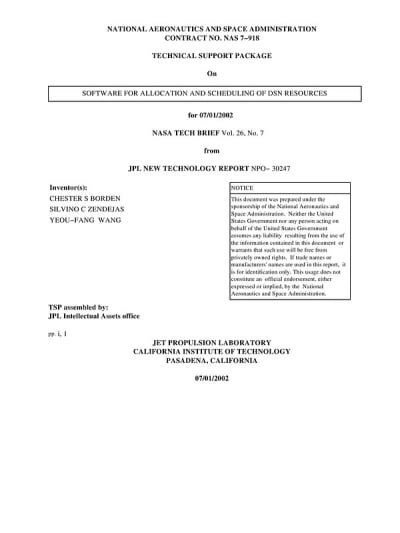
Software for Allocation and Scheduling of DSN Resources
(reference NPO-30247) is currently available for download from the TSP library.
Don't have an account?
Overview
The document presents an overview of the TIGRAS (Telecommunications and Mission Operations Directorate Integrated Ground Resource Allocation and Scheduling) software, developed for NASA's Deep Space Network (DSN). TIGRAS serves as an integrated analysis environment designed to assist resource allocation planners and project teams in forecasting antenna loads and scheduling mission tracks.
Key features of TIGRAS include its sophisticated forecasting and scheduling algorithms, which enable users to perform analyses and make informed decisions regarding the allocation of antennas and other ground resources. The software connects to a centralized database, facilitating both data retrieval for analysis and storage of results. This integration allows for a seamless workflow, enhancing the efficiency of resource management.
TIGRAS boasts a graphical user interface that consolidates various functionalities into a single screen. Users can navigate timelines, select display options, and view graphics, text, and metrics simultaneously. The ability to open multiple windows allows users to monitor requirements, view periods, forecasts, and schedules concurrently, making it easier to manage complex data. Additionally, users can edit data in real-time while viewing it, further streamlining the analysis process.
The software supports mission-phase-based analysis, enabling users to focus on specific mission activities rather than being constrained by fixed time intervals. This feature is particularly beneficial for planning and executing space missions, as it aligns resource allocation with the dynamic needs of ongoing projects.
TIGRAS is compatible with personal computers running Windows 2000, Windows 95, or Windows NT operating systems, making it accessible to a wide range of users. The program was developed by a team from Caltech, including Yeou-Fang Wang, Chester Borden, and Silvino Zendejas, and is available for commercial licensing.
The document also includes a disclaimer stating that references to specific commercial products or services do not imply endorsement by the U.S. Government or the Jet Propulsion Laboratory. It emphasizes that the work was conducted under NASA's sponsorship and outlines the limitations of liability associated with the use of the information provided.
In summary, the document highlights the capabilities and benefits of the TIGRAS software, which plays a crucial role in optimizing the allocation and scheduling of resources for NASA's deep space missions.










