

A report provides additional information about two major sub- systems of the software system described in “Software for Ground Operations for a Prototype Mars Rover” (NPO-21235), NASA Tech Briefs, Vol. 25, No. 11 (November 2001), page 46. The software system was designed for, and field-tested on, the Field Integrated Design and Operations rover — a prototype similar to rovers of the planned 2003 Mars Explorer Rover mission. The software subsystems addressed in the report are the Web Interface for Telescience (WITS) and the Multi-mission Encrypted Communication System (MECS). The WITS (aspects of which have been described in several prior NASA Tech Briefs articles) displays information downlinked from the rover (principally, images from several rover cameras) along with alphanumeric data and annotations registered with terrain features. The MECS enables secure communication between a primary terrestrial operations center and geographically distributed, Internet-based users. The emphasis in the report is on the capability, afforded by the WITS and the MECS acting together, to enable geographically dispersed users to communicate with each other and to collaborate in the generation of a sequence of commands to be uplinked to the rover.
This work was done by Jeffrey Norris and Paul Backes of Caltech for NASA’s Jet Propulsion Laboratory.
This Brief includes a Technical Support Package (TSP).
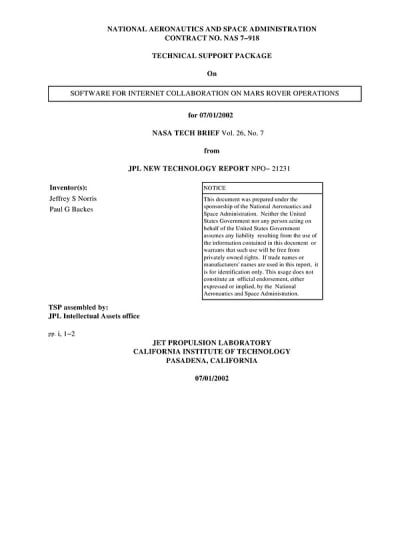
Software for Internet Collaboration on Mars Rover Operations
(reference NPO-21231) is currently available for download from the TSP library.
Don't have an account?
Overview
The document is a technical support package from NASA detailing the software developed for Internet collaboration on Mars rover operations, specifically focusing on the Field Integrated Design and Operations (FIDO) rover. This software was designed to enhance communication and collaboration among geographically dispersed users involved in Mars exploration missions.
Two major subsystems are highlighted: the Web Interface for Telescience (WITS) and the Multi-mission Encrypted Communication System (MECS). The WITS allows users to view downlinked data from the rover, including images from its cameras and associated alphanumeric data. This interface enables users to collaborate by submitting target requests and command sequences to a common server. However, earlier versions of WITS lacked certain collaborative features, such as the ability to send messages or markers to other users' views.
The MECS provides secure communication between a primary operations center and remote users, ensuring that sensitive data is protected during transmission. The integration of WITS and MECS allows for effective collaboration, enabling users to communicate and coordinate their efforts in real-time, which is crucial for generating command sequences to be uplinked to the rover.
The document also discusses the challenges faced during field tests of distributed operations. Users had access to the same downlink data but struggled with communication, particularly when trying to orient new participants in ongoing planning sessions. To address these issues, the software was enhanced with group collaboration features that allow users to see what others are viewing, annotate images, and highlight specific terrain locations for collective focus.
The work was conducted by Jeffrey Norris and Paul Backes at the Jet Propulsion Laboratory (JPL) under NASA's sponsorship. The document emphasizes the importance of these advancements in facilitating efficient collaboration among scientists and engineers working on Mars missions, ultimately improving the planning and execution of rover operations.
In summary, this technical support package outlines the innovative software solutions developed for Mars rover operations, emphasizing the integration of WITS and MECS to enhance collaborative efforts among distributed teams, thereby improving mission outcomes and scientific exploration on Mars.











