

A batch of experimental diffusion-cooled hot-electron bolometers (HEBs), suitable for use as mixers having input frequencies in the terahertz range and output frequencies up to about a gigahertz, exploit the superconducting/normal-conducting transition in a thin strip of tantalum. The design and operation of these HEB mixers are based on mostly the same principles as those of a prior HEB mixer that exploited the superconducting/ normal-conducting transition in a thin strip of niobium and that was described in "Diffusion-Cooled Hot-Electron Bolometer Mixer" (NPO-19719), NASA Tech Briefs, Vol. 21, No. 1 (January 1997), page 12a.
One reason for now choosing tantalum instead of niobium arises from the fact that the superconducting-transition temperature (TC) of tantalum lies between 2 and 3 K, while that of niobium lies between 6 and 7 K. Theoretically, the input mixer noise of a superconducting HEB is proportional to TC and the power demand on the local oscillator that supplies one of the input signals to the mixer is proportional to TC2. The lower noise and power demand associated with the lower TC of tantalum could make tantalum HEBs more attractive, relative to niobium HEBs, in applications in which there are requirements to minimize noise and/or to provide mixers that can function well using the weak signals generated by typical solid-state local oscillators. Of course, to reach the required lower TC, it is necessary to use more complex cryogenic equipment. Fortunately, such equipment (e.g., helium-3 cryostats) is commercially available. In order to make a practical tantalum HEB, it is necessary to overcome a challenge posed by the fact that thin films of tantalum tend to contain grains of two different crystalline phases. The presence of the two phases would be unacceptable in a practical device because (1) the additional electron scattering at the grain boundaries would tend to suppress the diffusion-cooling mechanism, and (2) the different TCs of the two phases would lead to broadening of the transition.
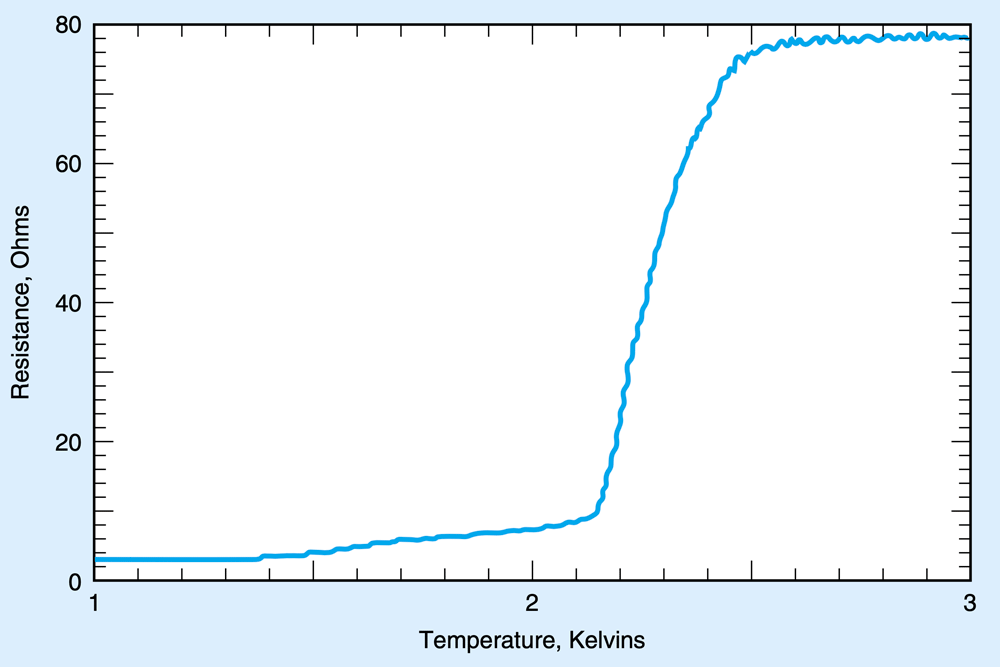
The present HEB mixers contain tantalum microbridges having lengths of 100 to 400 nm, widths of 100 to 200 nm, and thicknesses of 10 nm. The bridges were made from a 10-nm-thick film of tantalum deposited by sputtering onto a 1.5-nm-thick seed layer of niobium on a silicon wafer. The niobium seed layer was used to promote the growth of one of the two crystalline phases (the a phase) to ensure the required crystalline purity and thereby keep the superconducting transition (see figure) as sharp as possible.
The results of microwave impedance tests of one of the experimental tantalum HEBs have been interpreted as signifying that the 3-dB roll-off frequency for mixer conversion efficiency can be expected to be about 1 GHz, neglecting the effect of electrothermal feedback. End effects are small enough (as illustrated by the smallness of the "foot" of the resistance-versus-temperature curve in the figure) that it should be possible to use devices as short as 100 nm and possibly even shorter. Inasmuch as the thermal-relaxation time for diffusion cooling is proportional to the square of the device length, the 100-nm-long devices should be capable of "raw" speeds of about 16 GHz. Since only a few gigahertz of bandwidth is needed for most mixer applications, it is expected that tantalum HEBs will be fast enough even in the presence of slowing effects of electrothermal feedback, which is present in most bolometer mixer circuits.
This work was done by Anders Skalare, William McGrath, Bruce Bumble, and Henry LeDuc of Caltech for NASA's Jet Propulsion Laboratory. For further information, access the Technical Support Package (TSP) free on-line at www.techbriefs.com/tsp under the Physical Sciences category. NPO-30695
This Brief includes a Technical Support Package (TSP).
Diffusion-Cooled Tantalum Hot-Electron Bolometer Mixers
(reference NPO-30695) is currently available for download from the TSP library.
Don't have an account?
Overview
The document is a Technical Support Package from NASA's Jet Propulsion Laboratory (JPL) detailing the development of diffusion-cooled hot-electron bolometers (HEBs) made from tantalum films. These bolometers are significant for their application in heterodyne mixing, which is crucial for various scientific and technological endeavors, particularly in the field of radio astronomy and advanced sensing technologies.
The key innovation presented in the document is the fabrication of tantalum films on a thin niobium seed layer. This seed layer facilitates single-phase growth of the tantalum films, resulting in high-quality bolometers with notable performance characteristics. The bolometers achieve transition temperatures of up to 2.35 K and transition widths of less than 0.2 K, which are critical parameters for their operational efficiency.
The document describes experimental setups used to measure the device impedance versus frequency, specifically utilizing a 400 nm long device at a temperature of 400 mK. The results indicate that a 3 dB roll-off frequency of approximately 1 GHz can be achieved when the device resistance is matched to the impedance of the embedding network, without the influence of electrothermal feedback. This finding suggests that a 100 nm device could potentially operate at frequencies around 16 GHz, indicating the bolometer's capability to function effectively even with significant electrothermal feedback.
The implications of this research extend beyond basic science; the advancements in bolometer technology could lead to improved performance in various applications, including telecommunications, remote sensing, and other fields requiring sensitive detection of electromagnetic signals.
The document also provides information on how to access further resources and assistance related to the research and technology discussed, emphasizing NASA's commitment to sharing aerospace-related developments with broader technological, scientific, and commercial applications.
In summary, this Technical Support Package outlines the innovative work on tantalum hot-electron bolometers at JPL, highlighting their fabrication, performance characteristics, and potential applications, while also providing avenues for further exploration and support in this area of research.











