

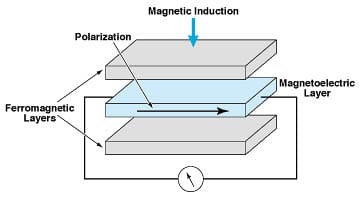
Electric generators and magnetic-field sensors of a proposed type would be based on the magnetoelectric effect. A simple device of this type (see figure) would consist mainly of an inner layer of a magnetoelectric material sandwiched between two outer layers of a ferromagnetic material. Electrical contacts would be placed at opposite ends of the magnetoelectric material.
As its name suggests, a magnetoelectric material is one that exhibits the magnetoelectric effect, which is a linear coupling between magnetization and electric polarization. The polarization electric field is perpendicular to the magnetic induction vector and its magnitude is proportional to the strength of the magnetic induction vector.
The electrical contacts could be used to connect the ends of the magnetoelectric layer to a voltmeter or other suitable instrument for measuring changes in the polarization electric charge. The voltage reading would be proportional to the change in the charge and thus to the change in the polarization electric field and thus, further, to change in the magnetic induction. Operated in this way, the device could be used as a magnetic-field sensor.
If the ends of the magnetoelectric layer were connected to suitable external circuitry and the magnetic field varied, then a sustained electrical current would flow. Operated in this way, the device could be used to sense or to extract power from a strongly varying magnetic field.
This work was done by Julian Blosiu and Mary Boghosian of Caltech for NASA's Jet Propulsion Laboratory. For further information, access the Technical Support Package (TSP) free on-line at www.nasatech.com/tsp under the Electronics & Computers category. NPO-20523
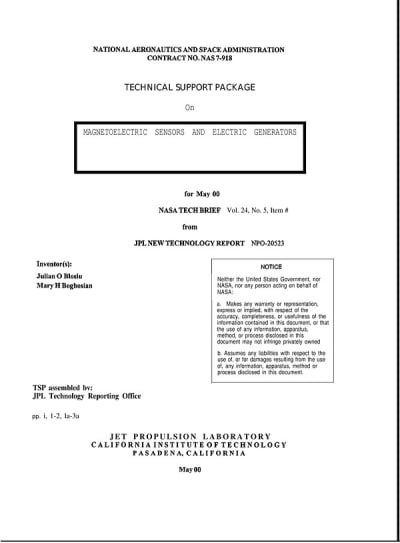
This Brief includes a Technical Support Package (TSP).
Magnetoelectric Sensors and Electric Generators
(reference NPO-20523) is currently available for download from the TSP library.
Don't have an account?
Overview
The document is a technical support package from NASA detailing advancements in magnetoelectric sensors and electric generators, primarily attributed to inventors Julian O. Blosiu and Mary H. Boghosian. It outlines a novel approach to harnessing energy from space's natural magnetic fields through the development of a conductor-like device capable of generating electric current directly from these magnetic fields.
The primary motivation behind this technology is to explore alternative energy sources in space, specifically by converting the existing magnetic field into usable electrical energy. The document emphasizes the novelty of the invention, which leverages the properties of various magnetic materials to engineer a device that can effectively harvest energy from the environment.
The technical disclosure includes a detailed description of the device's design and functionality, highlighting the experimentation with different types of magnetic materials, including soft magnetic and non-magnetic materials. The document notes that while the technology has not yet been built or commercially utilized, significant experimentation is ongoing to refine the conductor-like device's structure and performance.
Additionally, the document discusses the potential applications of this technology, particularly for NASA and the Department of Defense (DOD), while also envisioning spin-off technologies that could benefit various industries, especially in electric power generation and magnetic field sensing.
The report also addresses the dissemination of this technology through NASA Tech Briefs, which is considered an appropriate platform for sharing such innovations with interested U.S. industry representatives. It emphasizes the importance of patent determination and inventor approval before publication.
Overall, the document serves as a comprehensive overview of the ongoing research and development in magnetoelectric technology, showcasing its potential to revolutionize energy harvesting in space and beyond. It reflects NASA's commitment to exploring new energy solutions and advancing technological capabilities in the field of aerospace and beyond.











