

The designs of microscopic toroidalcore inductors in integrated circuits of DC-to-DC voltage converters would be modified, according to a proposal, by filling the gaps in the cores with permanent magnets that would apply bias fluxes (see figure). The magnitudes and polarities of the bias fluxes would be tailored to counteract the DC fluxes generated by the DC components of the currents in the inductor windings, such that it would be possible to either reduce the sizes of the cores or increase the AC components of the currents in the cores without incurring adverse effects. Reducing the sizes of the cores could save significant amounts of space on integrated circuits because relative to other integrated-circuit components, microinductors occupy large areas — of the order of a square millimeter each.
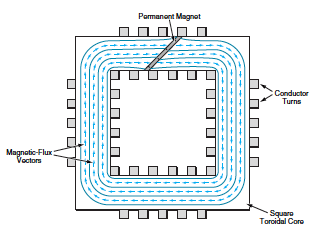
The equations show that, other things remaining equal, as the maximum current is increased, one must increase the size of the core to prevent the flux density from rising to the saturation level. By using a permanent bias flux to oppose the flux generated by the DC component of the current, one would reduce the net DC component of flux in the core, making it possible to reduce the core size needed to prevent the total flux density (sum of DC and AC components) from rising to the saturation level. Alternatively, one could take advantage of the reduction of the net DC component of flux by increasing the allowable AC component of flux and the corresponding AC component of current. In either case, permanent-magnet material and the slant (if any) and thickness of the gap must be chosen according to the equations to obtain the required bias flux.
In modifying the design of the inductor, one must ensure that the inductance is not altered. The simplest way to preserve the original value of inductance would be to leave the gap dimensions unchanged and fill the gap with a permanent magnet material that, fortuitously, would produce just the required bias flux. A more generally applicable alternative would be to partly fill either the original gap or a slightly enlarged gap with a suitable permanent- magnet material (thereby leaving a small residual gap) so that the reluctance of the resulting magnetic circuit would yield the desired inductance.
This work was done by Udo Lieneweg and Brent Blaes of Caltech for NASA’s Jet Propulsion Laboratory.
NPO-21102
This Brief includes a Technical Support Package (TSP).
Torodial-Core Microinductors Biased by Permanent Magnets
(reference NPO-21102) is currently available for download from the TSP library.
Don't have an account?
Overview
The document discusses a proposal for enhancing the design of microscopic toroidal-core inductors used in DC-to-DC voltage converters by incorporating permanent magnets into the core gaps. This innovative approach aims to address the challenges posed by the DC components of current that generate flux in the inductors, which can lead to magnetic saturation and necessitate larger core sizes.
By using a permanent bias flux generated by the magnets, the net DC component of flux in the core can be reduced. This reduction allows for either a decrease in the size of the core or an increase in the allowable AC component of flux and current, thereby preventing saturation at higher current levels. The design modifications are particularly significant because microinductors occupy considerable space on integrated circuits, often around a square millimeter each. Reducing their size could lead to substantial space savings, which is critical in the compact environment of integrated circuits.
The document emphasizes the importance of maintaining the original inductance value during the design modifications. One method to achieve this is by leaving the gap dimensions unchanged and filling the gap with a permanent-magnet material that produces the required bias flux. Alternatively, the gap can be partially filled with a suitable permanent-magnet material, allowing for a small residual gap that adjusts the reluctance of the magnetic circuit to yield the desired inductance.
The work was conducted by Udo Lieneweg and Brent Blaes at the Jet Propulsion Laboratory (JPL) for NASA, highlighting its significance in advancing microinductor technology. The document also notes that the design considerations are governed by several equations based on traditional magnetic-circuit approximations, which take into account core and gap dimensions as well as the magnetic properties of the materials involved.
Overall, this proposal represents a significant step forward in the design of microinductors, potentially leading to more efficient and compact integrated circuits. The integration of permanent magnets into the design not only addresses the issue of magnetic saturation but also opens up new possibilities for optimizing the performance of inductors in electronic applications.











