

A method of electromechanical testing has been proposed for general diagnosis, evaluation of performance, and burn-in (accelerated life testing) of microelectromechanical devices. The tests would ordinarily be performed at the wafer level; that is, after the devices have been fabricated on wafers but before the wafers have been diced and the dies packaged. Alternatively or in addition, the tests could be performed at other stages of the fabrication process.
According to this method, a probe would apply a specified mechanical and/or electrical stimulus to each device (sensor or actuator) on a wafer, and the response of the device to the stimulus would be measured. The things most likely to be useful as probes are piezoelectric transducers because they are easy to use, rugged, and compact and they have wide dynamic ranges.
A piezoelectric transducer can function as a driver, a force-measuring sensor, or both simultaneously. The displacement or change of thickness of a piezoelectric crystal is proportional to the voltage applied across it. If the voltage applied to a piezoelectric crystal oscillates sinusoidally with time, then the amplitude of the acceleration is proportional to the applied voltage and to the square of the oscillation frequency. In that case, the force exerted by the crystal on a tested device is related to the amplitude and phase of the electrical impedance of the crystal.
If sinusoidal excitation were used, the ratio between the force applied to, and the resultant acceleration of, a tested device would be a complex impedance quantity that could be characterized as the effective mass of the device; the effective mass would reflect the mass, stiffness, and damping characteristics of the device. If the device were an accelerometer or pressure transducer, then the effective mass would include the proof mass (in the case of the accelerometer) or the mass of the diaphragm (in the case of the pressure transducer); the effective mass could also include part of the mass of a housing and/or the masses of other structures that participate in motion.
Piezoelectric transducers for testing the devices on a wafer could be assembled into a probe station. Typically, each probe would contain a piezoelectric crystal that had a specified thickness and a flat and smooth contact surface that would match the portion of the wafer area occupied by a die containing a device to be tested. The probe would be fixed to a probe platform with an elastomeric material. Electrical-connection buttons would also be suspended in the elastomeric material. The piezoelectric crystal and connection buttons would be aligned with the die before lowering the probe platform and thereby compressing elastomer and preloading the crystal. The compressive preload would be made large enough to prevent the loss of compressive load on the crystal at any stage of the test process.
Once the preload was applied, testing could begin. The resonance frequencies, damping rates, and performance parameters of the devices on the wafers could be measured. Accelerated life testing could be performed by stimulating the devices at their resonances for extended times.
This work was done by Frank Hartley of Caltech for NASA's Jet Propulsion Laboratory . For further information, access the Technical Support Package (TSP) free on-line at www.nasatech.com/tsp under the Test & Measurement category. NPO-20563
This Brief includes a Technical Support Package (TSP).
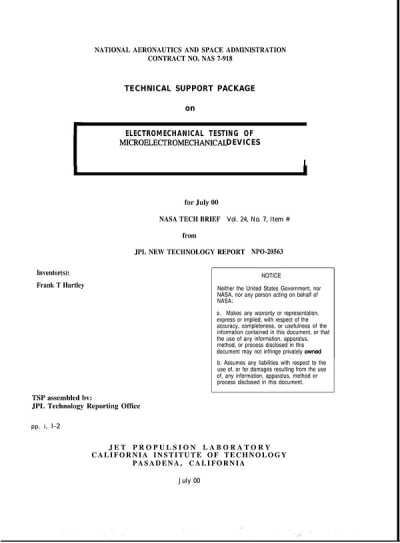
Electromechanical Testing of Microelectromechanical Devices
(reference NPO-20563) is currently available for download from the TSP library.
Don't have an account?
Overview
The document outlines a method for electromechanical testing of microelectromechanical devices (MEMS), focusing on their diagnosis, performance evaluation, and accelerated life testing (burn-in) at the wafer level. This testing occurs after the devices are fabricated on wafers but before they are diced and packaged, allowing for early detection of issues and performance characterization.
The proposed method employs piezoelectric transducers as probes to apply specified mechanical and electrical stimuli to each device on the wafer. These transducers are advantageous due to their compact size, ruggedness, and wide dynamic range. They can function both as drivers and sensors, measuring the response of the devices to the applied stimuli. The relationship between the force applied to a device and the resultant acceleration is characterized as a complex impedance quantity, which reflects the device's effective mass, stiffness, and damping characteristics.
The document details the construction of modified probe stations that facilitate mechanical stimulation of individual dies on a wafer. Each probe station includes a piezoelectric crystal with a flat, smooth surface that matches the die area. The crystal is fixed to a probe platform using elastomeric material, which also suspends electrical connection buttons. This setup allows for precise alignment and application of compressive preload to the crystal, ensuring consistent testing conditions.
Testing can include measuring resonance frequencies, damping rates, and other performance parameters of the devices. The method also supports extensive mechanical burn-in testing by stimulating devices at their resonances over extended periods, which helps identify potential failures early in the product lifecycle.
The work described in the document was conducted by Frank Hartley at Caltech for NASA’s Jet Propulsion Laboratory, emphasizing its significance in advancing MEMS technology. The testing approach aims to improve the reliability and performance of MEMS devices, which are critical in various applications, including sensors and actuators.
Overall, this document presents a comprehensive strategy for enhancing the testing and characterization of MEMS, contributing to the development of more robust and efficient microelectromechanical systems.











