

WebWinds is an interactive computer program that aids the visualization and exploration of scientific data. WebWinds is the successor to LinkWinds, which was reported in "LinkWinds — Flexible Software for Highly Interactive Visual Data Analysis" (NPO-19786), NASA Tech Briefs, Vol. 20, No. 12 (December 1996), page 46. WebWinds is a platform-independent, reusable code written in the Java computer language. WebWinds has been tested on Linux, Sun, SGI, and Win95 systems.
This program was written by Martin Orton, Lee Elson, Jeff Goldsmith, and William Weibel of Caltech for NASA's Jet Propulsion Laboratory. For further information, access the Technical Support Package (TSP) free on-line at www.nasatech.com/tsp under the Information Sciences category.
This software is available for commercial licensing. Please contact Don Hart of the California Institute of Technology at (818) 393-3425. Refer to NPO-20685.
This Brief includes a Technical Support Package (TSP).
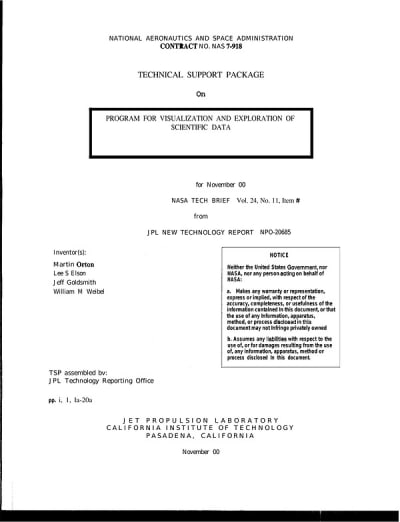
Program for Visualization and Exploration of Scientific Data
(reference NPO-20685) is currently available for download from the TSP library.
Don't have an account?
Overview
The document discusses the development of a software package called WebWinds, created by a team at NASA's Jet Propulsion Laboratory. WebWinds is designed to facilitate the visualization and analysis of atmospheric data for a diverse audience, including scientists, educators, students, and the general public. The software is written in Java, allowing it to operate across various platforms and enabling users to access data from both local disks and the World Wide Web.
One of the primary goals of WebWinds is to improve the efficiency of data transfer and processing. Traditional data archives often require users to download large files, most of which may not be relevant to their specific needs. By implementing subsetting software near the data source, WebWinds aims to allow users to access only the data they require, significantly reducing bandwidth usage and improving performance. This approach is part of a broader design goal to enhance the efficiency of data handling in the context of increasing internet usage for scientific data dissemination.
The document outlines several key considerations in the development of WebWinds, including performance, availability, standardization, and security. Java's platform-independent nature is highlighted, as it allows for the execution of bytecode on any Java-enabled platform, although this universality comes with some performance trade-offs. The use of Just-In-Time (JIT) compilers is noted as a means to enhance execution speed.
Additionally, the document emphasizes the importance of moving some processing power from the server to the client to optimize network bandwidth and server resources. This shift is a central concept in the evolution of Java and is crucial for the effective functioning of WebWinds.
Future developments for WebWinds include the creation of server packages for data processing, interfaces for more sophisticated data queries, and user-extensible applications. The document concludes with an acknowledgment of the collaborative efforts involved in the research and development of WebWinds, underscoring its potential impact on the scientific community and the accessibility of atmospheric data.
Overall, WebWinds represents a significant advancement in the tools available for data visualization and analysis, addressing the challenges posed by the rapid evolution of technology and the growing demand for accessible scientific information.










