

Analog electronic circuits that operate with pulsed input and output signals are undergoing development. The pulsing behavior of these circuits is modeled after a similar behavior, called "spiking," that occurs in biological neural networks. In these circuits, the pulse times and/or the pulse-repetition rates can convey information. These circuits are intended especially for use in high-speed artificial neural networks, which, like the brains of animals that have vision, would process image data to effect invariant pattern recognition. (As used here, "invariant"signifies that the ability to recognize patterns would not be adversely affected by such effects as translation, rotation, distortion, changes in scale, or changes in brightness.)

By locally connecting neurons like this one into an array in which the axons of neighbors would transmit their spike trains via synapto-dendritic connections that would modulate the thresholds, one could construct a complex processing network. In a computational simulation, such a network has been shown to be capable of invariant mapping of binary patterns.
The invariance of the mapping is a result of encoding images in time rather than space. In particular, if the same image is fed as input to a different set of pixels but the same spatial relationships are maintained among parts of the image, the temporal representation of the image remains the same and the mapping is invariant to translation. Invariance with respect to brightness is achieved partly by recognizing that greater brightness is represented simply by a uniform increase in the average firing rates of all affected neurons.
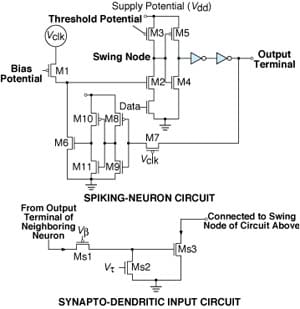
The lower part of Figure 2 shows a synapto-dendritic input circuit connected to the swing node of a spiking neuron. In a locally connected network, there could be eight input circuits like this one for coupling the outputs from eight nearest-neighbor neurons as inputs to the affected neuron. Transistor Ms1 sets the gain of the coupling, while transistor Ms2 controls the timing. Essentially, the spike from a neighboring neuron injects charge onto the gate of Ms3 through Ms1. This charge then slowly leaks away via Ms2 to produce a decaying exponential current response through Ms3. This current modulates the threshold of the spiking neuron by pulling M3 closer to saturation, thereby enabling a decreased membrane potential to trigger a spike.
This work was done by Tyson Thomas of Caltech for NASA's Jet Propulsion Laboratory. For further information, access the Technical Support Package (TSP) free on-line at www.nasatech.com/tsp under the Electronics & Computers category.
NPO-20818
This Brief includes a Technical Support Package (TSP).
Biomorphic Analog Pulse-Coupled Neural Circuits
(reference NPO-20818) is currently available for download from the TSP library.
Don't have an account?
Overview
The document is a NASA Technical Support Package detailing research on Biomorphic Analog Pulse-Coupled Neural Circuits, specifically focusing on their application in invariant pattern recognition. Authored by Tyson Thomas and prepared under the auspices of the National Aeronautics and Space Administration (NASA), the report outlines the development of pulse-coupled neural networks that are inspired by biological neural systems.
The primary objective of this research is to explore how these neural circuits can be implemented in silicon to enhance the capabilities of artificial intelligence systems, particularly in recognizing patterns regardless of variations in scale, orientation, or other transformations. The document emphasizes the potential of these circuits to process information in real-time, which is crucial for applications requiring rapid decision-making and analysis.
The report includes a circuit diagram of the spiking neuron, illustrating the technical aspects of the neural network design. It discusses the underlying principles of how these circuits operate, including concepts such as threshold voltage and membrane potential, which are essential for mimicking the behavior of biological neurons.
Additionally, the document highlights the significance of this research in the context of advancing technology at the Jet Propulsion Laboratory (JPL) and its implications for future applications in various fields, including robotics, computer vision, and autonomous systems. The work is positioned as a step towards creating more efficient and capable artificial neural networks that can perform complex tasks with greater accuracy and speed.
The report also includes disclaimers regarding the use of trade names and the lack of endorsement by the U.S. Government or JPL for any specific products mentioned. It serves as a technical disclosure that may be made available through tech briefs, indicating its relevance to ongoing research and development in the field of neural networks.
In summary, this document presents a comprehensive overview of the research conducted on biomorphic analog pulse-coupled neural circuits, detailing their design, functionality, and potential applications in pattern recognition, while also acknowledging the collaborative efforts of NASA and JPL in advancing this innovative technology.











