

Network Monitor and Control (NMC) Automation Assembly (AA) is a component of the NMC software system, which is used for controlling an antenna connection in the Deep Space Network. NMC AA could also be adapted to commercial applications (e.g., chemical processing), in which human operators must monitor and control multiple equipment subsystems simultaneously in real time. NMC AA is designed to reduce costs and increase efficiency and capacity by relieving human operators of labor-intensive and error-prone routine spacecraft-tracking activities. NMC AA includes software engines that communicate between automation scripts and DSN subsystems. The automation scripts are developed in the Automation Language for Managing Operations (ALMO), which is a programming language that includes specialized constructs for interacting with the subsystems. The contents of the scripts represent knowledge of operations gathered from DSN operators and engineers. The ALMO scripts are organized in a temporal-dependency network and managed via a graphical user interface that enables a human operator to monitor and control the automation at any time.
This program was written by Eva Bokor, Bryan Camilli, Manuel Gomez, Patrick Olguin, Paul Pechkam, Patricia Santos, and Marla Thornton of Caltech for NASA's Jet Propulsion Laboratory. For further information, access the Technical Support Package (TSP) free on-line at www.nasatech.com/tsp under the Software category.
This software is available for commercial licensing. Please contact Don Hart of the California Institute of Technology at (818) 393-3425. Refer to NPO-20516.
This Brief includes a Technical Support Package (TSP).
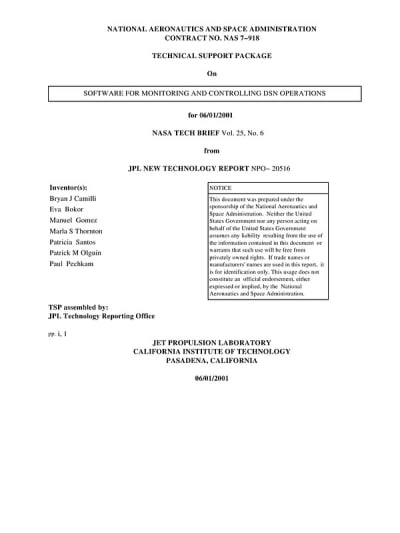
Software for Monitoring and Controlling DSN Operations
(reference NPO-20516) is currently available for download from the TSP library.
Don't have an account?
Overview
The document is a technical support package from NASA's Jet Propulsion Laboratory (JPL) detailing the Network Monitor and Control (NMC) Automation Assembly (AA), a software system designed to enhance the efficiency of operations within the Deep Space Network (DSN). The NMC AA aims to automate routine spacecraft-tracking activities, thereby reducing costs and alleviating the workload of human operators who must monitor and control multiple subsystems in real time.
The NMC AA utilizes a programming language called Automation Language for Managing Operations (ALMO), which includes specialized constructs for interacting with various subsystems. The automation scripts developed in ALMO encapsulate the operational knowledge gathered from DSN operators and engineers. These scripts are organized in a temporal-dependency network and can be managed through a graphical user interface, allowing operators to monitor and control the automation process effectively.
The document highlights the collaborative effort of a team of inventors, including Bryan J. Camilli, Eva Bokor, Manuel Gomez, Marla S. Thornton, Patricia Santos, Patrick M. Olguin, and Paul Pechkam, who contributed to the development of this software for NASA. The NMC AA is not only applicable to space operations but can also be adapted for commercial uses, such as in chemical processing, where real-time monitoring and control of multiple equipment subsystems are essential.
Additionally, the document includes a disclaimer stating that references to specific commercial products or services do not imply endorsement by the U.S. Government or JPL. It emphasizes that the work was conducted under NASA's sponsorship and outlines the limitations of liability regarding the use of the information contained within the document.
The NMC AA software is available for commercial licensing, and interested parties are directed to contact Don Hart at the California Institute of Technology for further information. The document serves as a comprehensive overview of the NMC AA's capabilities, its development team, and its potential applications, showcasing the innovative strides made in automating complex operations in space exploration and beyond.










