

Parameter Identification in Thermal Networks (PITN) is a computer program developed to satisfy a need to update parameters in mathematical models of thermal systems in order to make the temperatures computed by the models equal to the temperatures measured in tests of the corresponding real systems. PITN is suitable for application to network-type models of scientific instruments and general engineering systems, including telescopes, spectrometers, and spacecraft. Relative to software developed previously for the same purpose, PITN can readily be applied to more complex models and yields results in less time. In addition, PITN can accommodate nonlinearities in thermal models (nonlinearities are typically associated with radiative heat transfer). PITN is based partly on the formulation of the parameter-matching problem as a nonlinear least-squares optimization problem, which can be solved by use of very fast and robust optimization techniques. The speed and accuracy of computations are increased by use of analytic expressions for temperature differentials.
This program was written by Miltiadis Papalexandris and Mark Milman of Caltech for NASA's Jet Propulsion Laboratory. For further information, access the Technical Support Package (TSP) free on-line at www.nasatech.com/tsp under the Software category.
This software is available for commercial licensing. Please contact Don Hart of the California Institute of Technology at (818) 393-3425. Refer to NPO-21067.
This Brief includes a Technical Support Package (TSP).
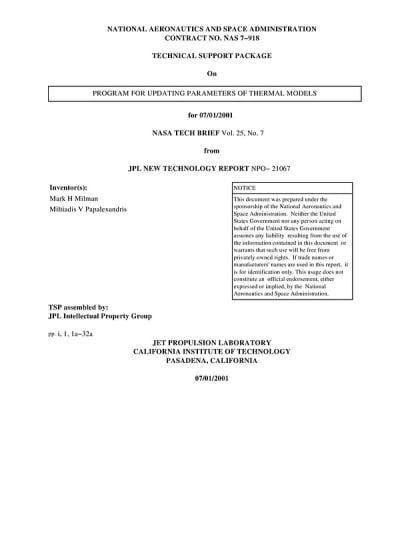
Program for Updating Parameters of Thermal Models
(reference NPO-21067) is currently available for download from the TSP library.
Don't have an account?
Overview
The document outlines a program developed by NASA's Jet Propulsion Laboratory (JPL) called "Parameter Identification in Thermal Networks" (PITN). This innovative software is designed to improve the accuracy of thermal models by enabling the identification and updating of parameters based on real-world temperature measurements. The primary goal of PITN is to ensure that the thermal predictions made by models closely match actual observed data, which is crucial for the reliability of scientific instruments and engineering systems.
PITN is particularly beneficial in scenarios where thermal behavior is complex and involves nonlinearities. The program employs advanced numerical methods to efficiently process and analyze thermal data, allowing for rapid adjustments to model parameters. This capability is essential for researchers and engineers who require precise thermal modeling for various applications, including spacecraft, satellites, and other high-tech systems.
The document emphasizes the importance of having an abstract for the program, which is necessary for review purposes. It highlights the need for clear communication regarding the program's objectives, methodologies, and potential applications. The abstract serves as a concise summary that encapsulates the essence of PITN, making it easier for stakeholders to understand its significance and utility.
Additionally, the document mentions that for those interested in commercial licensing of the program, Don Hart from Caltech is the designated contact person. This indicates that PITN is not only a research tool but also has potential commercial applications, which could lead to broader usage in various industries.
Overall, the document presents PITN as a state-of-the-art solution for enhancing thermal modeling accuracy, showcasing its innovative approach and practical implications for both research and commercial sectors. The emphasis on parameter identification and the ability to adapt models based on empirical data positions PITN as a valuable resource for advancing thermal analysis in engineering and scientific research.











