

The microwave-sterilizable access port is an apparatus that functions in a simple, quick, and reliable manner to reduce significantly the risk of contamination during transfer of materials into or out of bioreactors or other microbially vulnerable closed systems. A major improvement over equipment developed previously for the same purpose, this apparatus can be expected to increase confidence in the microbial integrity of samples taken from closed systems. In tests, the original model of this apparatus exceeded expectations: Although it was rigorously challenged by a variety of microorganisms (e.g., C. albicans, A. niger, S. faecalis, E. coli, K. terrigena, Ps. cepacia, B. pumilus, B. stearothermophilus), it performed very well. The apparatus is easily adaptable to applications in cell culture and tissue engineering, and to applications in the production of diverse products that could include foods, drugs, bottled water, soft drinks, and fruit juices. By ensuring that sterilization can be achieved simply, reliably, and quickly, the microwave-sterilizable access port will facilitate collection of samples, delivery of nutrients, and harvesting of products, all without the potential for contamination of the experimental or production systems, samples, or the environment.
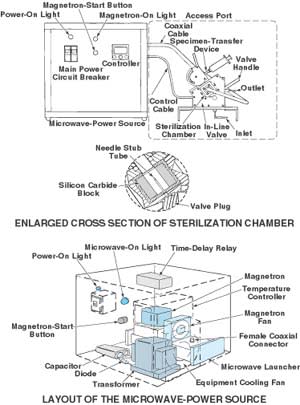
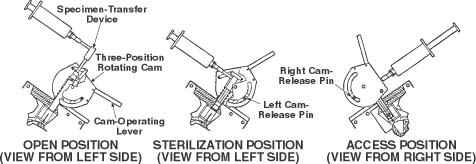
Positioning of the specimen-transfer device within the access port for insertion, sterilization, and puncture of the septum is controlled by a three-position rotating cam mechanism. Figure 2 shows the mechanism in the open, sterilization, and access positions. Rotation of the three-position cam to the sterilization position during insertion causes establishment of a septum seal, so that the chamber becomes closed to the outside. Once this seal has been established, electrical power is applied to a magnetron in the microwave-power source. Microwave power is coupled from the magnetron, via a coaxial cable, into the sterilization chamber, where the microwave power becomes further coupled to a silicon carbide block and with the small amount of water (microwaves can couple strongly with lossy dielectric materials like H2O and SiC) to produce heat. The heat causes the water to flash to superheated steam, which then pressurizes the chamber and sterilizes all exposed surfaces. The temperature is monitored with a thermocouple mounted in the SiC block.
A cabinet houses the magnetron, a microwave-power controller, and other components of the microwave-power source. A time delay relay (TDR), which provides a fixed time safety limit, is set for ≈45 seconds and is latched "on" through the normally closed contacts of a temperature controller to enable sterilization to continue. Sterilization proceeds until the TDR is de-energized.
The totality of destruction of microbes was demonstrated in tests. More specifically, wet thermal sterilization of systems contaminated with a variety of bacteria, yeasts, and molds was demonstrated. It was also shown that by use of hydrogen peroxide solutions instead of pure water, equivalent sterilization levels could be attained at lower temperatures and shorter exposure times without producing the usual chemical contaminant residues. The utility of the microwave-sterilizable access port was shown in repetitive transfers of sterile media through a sterilization chamber that was intentionally contaminated with 106 colony-forming units (CFU) of B. stearothermophilus, a thermophilic spore-forming bacterium used as the standard microbial challenge for wet-heat and steam-sterilization methodologies. Bidirectional transfer of sterile media was also demonstrated: at the end of the trial, no microbial survivors were recovered in any of 80 replicate experiments.
This work was done by Richard L. Sauer of Johnson Space Center and James E. Atwater, Roger Dahl, Frank Garmon, Ted Lunsfort, William F. Michalek, and Richard R. Wheeler, Jr., of Umpqua Research Co.
This invention is owned by NASA, and a patent application has been filed. Inquiries concerning nonexclusive or exclusive license for its commercial development should be addressed to
the Patent Counsel
Johnson Space Center
(281) 483-0837.
Refer to MSC-22802.











