

A computer program solves the differential equations of three-dimensional (3D) thermal convection of an incompressible fluid by use of a parallel-processing, finite volume numerical scheme. The equations of conservation of momentum, and energy are integrated over macroscopic control volumes on a normal, staggered grid. Upwind interpolation functions are used to prevent spurious numerical oscillations at high Rayleigh numbers. The resulting discretized equations, including a pressure equation that demands most of the computation time, are solved by a parallel-processing, multigrid method. The multigrid aspect of the method involves the use of a hierarchy of grids of different mesh sizes to obtain a solution on the finest grid. It has been proven, both theoretically and practically, that the multigrid aspect affords rapid convergence on a solution. The program could be used, for example, to predict oceanic convection currents. The effectiveness of the program has been demonstrated by applying it to test cases on several parallel-computing systems.
This program was written by Ping Wang of Caltech for NASA's Jet Propulsion Laboratory. For further information, access the Technical Support Package (TSP) free on-line at www.nasatech.com/tsp under the Software category.
This software is available for commercial licensing. Please contact Don Hart of the California Institute of Technology at (818) 393-3425. Refer to NPO-21147.
This Brief includes a Technical Support Package (TSP).
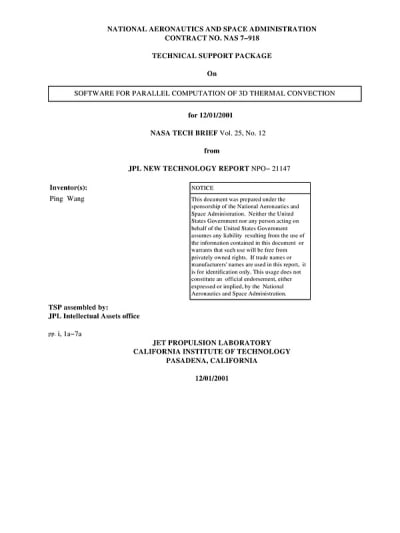
Software for Parallel Computation of 3D Thermal Convection
(reference NPO-21147) is currently available for download from the TSP library.
Don't have an account?
Overview
The document is a technical support package from NASA's Jet Propulsion Laboratory (JPL) detailing a software program designed for the parallel computation of three-dimensional (3D) thermal convection in incompressible fluids. Developed by Ping Wang, this program employs a finite volume numerical scheme to solve the differential equations governing momentum and energy conservation in fluid dynamics.
The software operates on a staggered grid and utilizes upwind interpolation functions to mitigate spurious numerical oscillations, particularly at high Rayleigh numbers, which are indicative of turbulent flow conditions. The discretized equations, including a significant pressure equation that requires substantial computational resources, are solved using a parallel-processing multigrid method. This method leverages a hierarchy of grids with varying mesh sizes to achieve rapid convergence to a solution on the finest grid. The effectiveness of this approach has been validated through both theoretical and practical applications, demonstrating its capability to accurately predict phenomena such as oceanic convection currents.
The document emphasizes the program's applicability in various scientific and engineering contexts, particularly in understanding complex fluid behaviors in natural systems. It highlights the program's successful implementation on multiple parallel-computing systems, showcasing its robustness and efficiency.
Additionally, the document includes a notice regarding the liability and endorsement of the software, clarifying that the U.S. Government and individuals acting on its behalf do not assume any liability for the use of the information contained within. It also states that references to specific commercial products or services do not imply endorsement by NASA or JPL.
For those interested in obtaining the software, the document provides contact information for Don Hart at the California Institute of Technology, indicating that the software is available for commercial licensing under reference NPO-21147.
Overall, this technical support package serves as a comprehensive overview of a sophisticated computational tool that enhances the understanding of thermal convection processes in fluids, with potential applications in various fields, including oceanography and engineering.











