

A systematic experimental study has been performed to determine the effects of each of the operating conditions in a double-pulse laser ablation process that is used to produce single-wall carbon nanotubes (SWCNTs). The comprehensive data compiled in this study have been analyzed to recommend conditions for optimizing the process and scaling up the process for mass production.
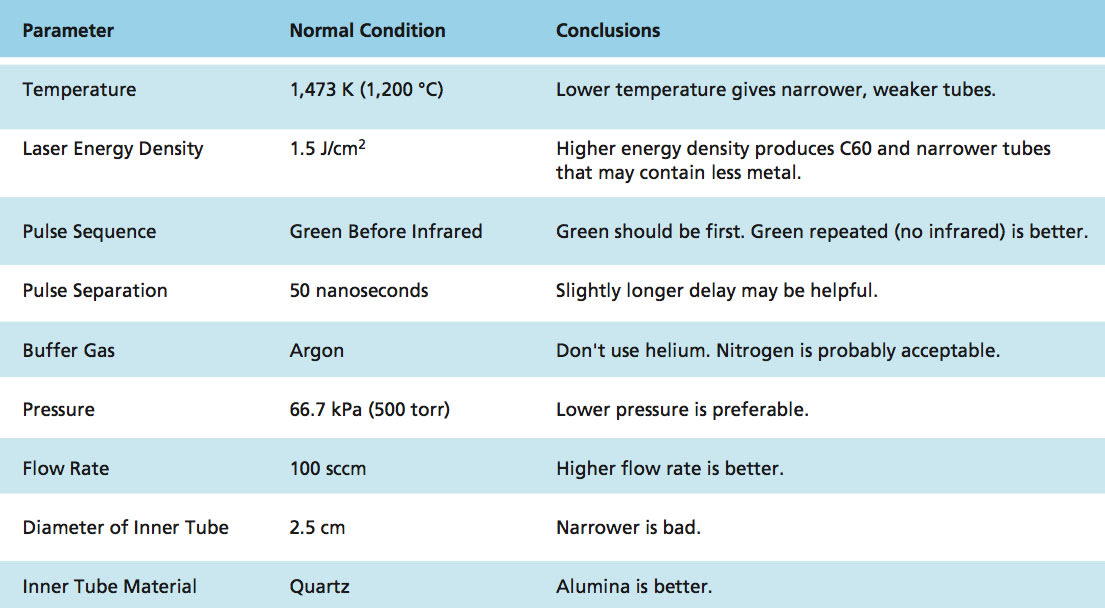
This was a parametric study, in which several production runs were carried out, changing one operating condition for each run. The study involved variation of a total of nine parameters: the sequence of the laser pulses, pulse-separation time, laser pulse energy density, buffer gas (helium or nitrogen instead of argon), oven temperature, pressure, flow speed, inner diameter of the flow tube, and flow-tube material. The same graphite target was used in all the runs. The nanotube-containing material produced in each run was collected and characterized by a variety of analytical techniques.
The results of the characterizations indicated trends in the effects of process parameters that could be used to optimize the process and increase the efficiency of the production process. Among the conclusions (see table) reached in this study is that SWCNT material of better quality can be produced by use of lower pressure and faster flow, relative to the normal version of the process. This conclusion could be useful in scaling up the process. This limited study could be extended by changing more than one parameter at a time in an effort to identify some of the intricate mutual effects of different process parameters.
This work was done by Sivaram Arepalli, Pavel Nikolaev, and William Holmes of GB Tech Inc. for Johnson Space Center. For more information, download the Technical Support Package (free white paper) at www.techbriefs.com/tsp under the Materials category. MSC-23508-1










