

Inside this issue
Supplements
Overview
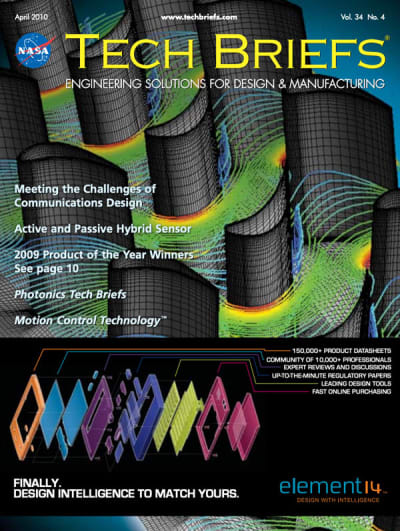
The April 2010 edition of NASA Tech Briefs, Photonics Tech Briefs, and Motion Control Technology presents a comprehensive overview of advancements in technology and engineering, focusing on innovative solutions and products that address contemporary challenges in various fields.
Key Highlights:
-
Communications Design Challenges: The issue opens with a discussion on the challenges faced in communications design, emphasizing the need for robust and efficient systems. This section explores the integration of new technologies to enhance communication capabilities, particularly in aerospace and defense applications.
-
Active and Passive Hybrid Sensors: A significant feature of this edition is the exploration of hybrid sensors, which combine both active and passive sensing technologies. These sensors are crucial for applications requiring high precision and reliability, such as in autonomous vehicles and advanced robotics. The article discusses the benefits of hybrid sensors, including improved accuracy and reduced power consumption.
-
2009 Product of the Year Winners: The magazine highlights the winners of the 2009 Product of the Year awards, showcasing innovative products that have made a significant impact in their respective fields. This section serves as a testament to the creativity and ingenuity of engineers and designers who strive to push the boundaries of technology.
-
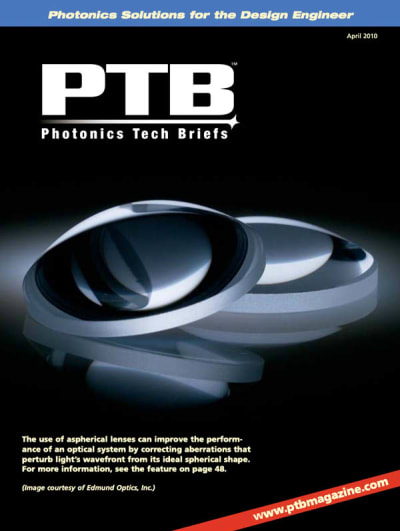
Photonics Solutions: The issue delves into photonics, particularly the use of aspherical lenses in optical systems. Aspherical lenses are designed to correct aberrations that can distort light’s wavefront, thereby enhancing the performance of optical devices. This feature underscores the importance of precision optics in various applications, from telecommunications to medical imaging.
Motion Control Technologies: The magazine provides insights into the latest developments in motion control technology. Key articles discuss:
- Reducing Electromagnetic Interference (EMI): A critical concern in motion systems, EMI can disrupt the performance of electronic devices. The article outlines strategies for minimizing EMI, ensuring reliable operation in sensitive environments.
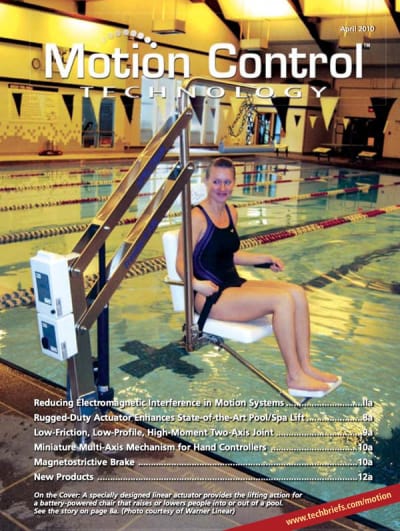
- Rugged-Duty Actuators: A spotlight on a rugged-duty actuator designed for pool and spa lifts illustrates the application of motion control technology in enhancing accessibility for individuals with mobility challenges. This actuator exemplifies how engineering can improve quality of life.
- Low-Friction, Low-Profile Joints: The introduction of low-friction, low-profile, high-moment two-axis joints is discussed, highlighting their potential in compact robotic systems and hand controllers. These joints enable smoother and more efficient movement, which is essential for advanced robotic applications.
-
Miniature Multi-Axis Mechanisms: The magazine features a miniature multi-axis mechanism designed for hand controllers, showcasing innovations that allow for greater control and precision in user interfaces. This technology is particularly relevant in gaming and simulation environments, where user experience is paramount.
-
Magnetostrictive Brakes: Another innovative product discussed is the magnetostrictive brake, which offers enhanced performance in motion control applications. The article explains the principles behind magnetostrictive technology and its advantages in providing precise control over motion.
-
New Products Section: The magazine concludes with a section dedicated to new products, providing readers with a glimpse of the latest technologies and solutions available in the market. This section serves as a valuable resource for engineers and designers looking to stay updated on industry trends.
Conclusion:
The April 2010 edition of NASA Tech Briefs, Photonics Tech Briefs, and Motion Control Technology is a rich resource for professionals in engineering and technology. It not only highlights the latest advancements and products but also addresses the challenges faced in various sectors, offering insights into innovative solutions. The combination of theoretical discussions and practical applications makes this issue a must-read for anyone interested in the future of technology and engineering.
Overall, this edition exemplifies the ongoing commitment to innovation and excellence in the fields of photonics, motion control, and communications design, encouraging readers to explore new possibilities and applications in their work.
Features
-
Eye on Innovation
-
Application Briefs
Deformable Mirrors Key to Advancement of Space Imaging Research
Simulation Software Helps Phoenix Mission Interpret Data From Mars
Monitoring Carbon Composite Structures With Optical Fiber Sensors
Tech Briefs
-
Physical Sciences
Active and Passive Hybrid Sensor
AlGaN Ultraviolet Detectors for Dual-Band UV Detection
Method for Detecting Perlite Compaction in Large Cryogenic Tanks
Directional Spherical Cherenkov Detector
Using Thin-Film Thermometers as Heaters in Thermal Control Applications
-
Manufacturing & Prototyping
Coaxial Propellant Injectors With Faceplate Annulus Control
Adaptable Diffraction Gratings With Wavefront Transformation
-
Software
Natural-Language Parser for PBEM
Policy Process Editor for P³BM Software
Trajectory Optimization: OTIS 4
Computer Software Configuration Item-Specific Flight Software Image Transfer Script Generator
-
Information Sciences
Processing Images of Craters for Spacecraft Navigation
Efficient Bit-to-Symbol Likelihood Mappings
Landmark Detection in Orbital Images Using Salience Histograms
-
Mechanics & Machinery
Quick-Response Thermal Actuator for Use as a Heat Switch
-
Electronics & Computers
K-Band Traveling-Wave Tube Amplifier
Sideband-Separating, Millimeter-Wave Heterodyne Receiver
Simplified Load-Following Control for a Fuel Cell System
Loosely Coupled GPS-Aided Inertial Navigation System for Range Safety
Products
-
Briefs
Low-Friction, Low-Profile, High-Moment Two-Axis Joint











