

The Centennial Challenges are NASA’s prizes for the citizen inventor. Through open competitions, we seek novel solutions from diverse sources in technology challenges of interest to NASA and the nation. Competitions are open to anyone, and teams have included small businesses, university students, independent groups, and individual inventors.
Last year was an especially fruitful year, as prizes were finally claimed in some of the most demanding challenges after several years of competition. Five competition events were held with winners in four of them, for a total of $3.65 million in prizes.
2009 Challenge Winners
The Strong Tether Challenge, for super-strong materials, was held last August in Seattle, WA. There were no winners, but an impressive, two-meter-long carbon nanotube loop was entered. The Strong Tether Challenge will continue in 2010 with $2 million in prize money available and a new set of rules that is expected to attract a bigger field. The Spaceward Foundation manages the Strong Tether Challenge.
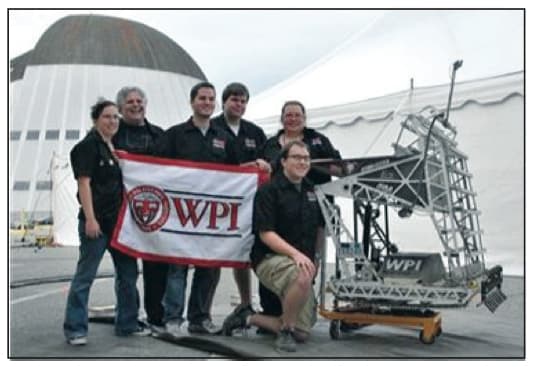
The Regolith Excavation Challenge, held in October with 23 teams, was the largest competitive field yet for a Centennial Challenges event. The contest was conducted at the new Lunar Regolith Testbed at the NASA Research Park in Mountain View, CA, and was managed by the California Space Education and Workforce Institute. After three years of unsuccessful attempts, all of the prizes were won by veteran teams, including the first-place prize of $500,000 earned by Paul’s Robotics, a team of college students from Worcester Polytechnic Institute (Worcester, MA).

The 2009 Power Beaming Challenge provided the spectacle of a vertical cable suspended in the sky under a helicopter 4,300 feet above the dry lakebed at the NASA Dryden Flight Research Center in California. Since 2005, no team has met the challenge of driving a robot up an increasingly higher vertical cable using only power transmitted from the ground, without wires. This year, with the goal at one kilometer, LaserMotive LLC from Seattle met the challenge at an average speed of almost 4 meters per second and won $900,000. A prize purse of $1.1 million remains for the next round, and that can be won by a team that can reach the one-kilometer height at an average speed of over 5 meters per second. The Spaceward Foundation manages the Power Beaming Challenge.
The final competition for 2009 was the Astronaut Glove Challenge, managed by Volanz Aerospace, and held this year in Titusville, FL. In 2007, the challenge was to construct an inner pressure-suit glove that was more flexible than the current NASA spacesuit glove, and in 2009, competitors had to provide a similarly flexible outer glove layer as well. Peter Homer of Southwest Harbor, ME repeated his success from 2007 by again winning the first-place prize of $250,000. Ted Southern of Brooklyn, NY won second place.
In July 2009, NASA and the Comparative Aircraft Flight Efficiency Foundation announced the new Green Flight Challenge for an aircraft that can travel 200 miles in less than two hours with efficiency equivalent to 200 passenger miles per gallon. The competition to demonstrate such an aircraft will be held in July 2011 in Santa Rosa, CA. A number of teams have already registered to compete.
More Information
NASA expects to announce several new prize challenges in 2010. Further information on those new competitions and the ongoing challenges can be found online at www.nasa.gov/challenges.







