Structures capable of deployment into complex, three-dimensional trusses have well known space technology applications such as the support of spacecraft payloads, communications antennas, radar reflectors, and solar concentrators. Such deployable trusses could also be useful in terrestrial applications such as the rapid establishment of structures in military and emergency service situations, in particular with regard to the deployment of enclosures for habitat or storage. To minimize the time required to deploy such an enclosure, a single arch-shaped truss is preferable to multiple straight trusses arranged vertically and horizontally. To further minimize the time required to deploy such an enclosure, a synchronous deployment with a single degree of freedom is also preferable.
This work was done by Louis R. Giersch and Kevin Knarr of Caltech for NASA’s Jet Propulsion Laboratory. For more information, download the Technical Support Package (free white paper) at www.techbriefs.com/tsp under the Mechanics/Machinery category. NPO-47269
This Brief includes a Technical Support Package (TSP).
Deployment of a Curved Truss
(reference NPO-47269) is currently available for download from the TSP library.
Don't have an account?
Overview
The document outlines NASA's Technical Support Package (NPO-47269) focused on the development of a deployable truss structure designed for spacecraft applications. The primary goal is to create a structure that can be stowed compactly and deployed synchronously into a complex three-dimensional shape, enhancing the versatility and performance of spacecraft payload interfaces.
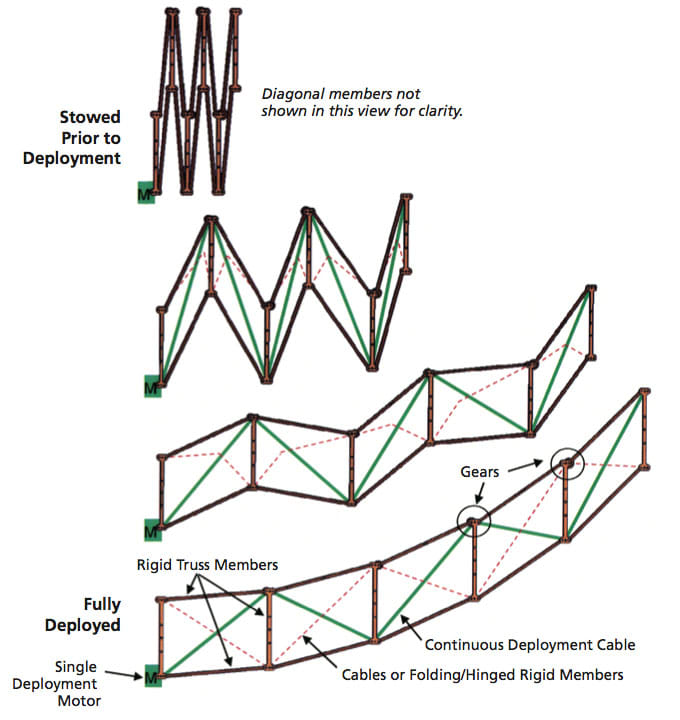
The need for such a structure arises from the challenges associated with deploying traditional trusses, which often limit deployment to linear configurations or result in asynchronous deployment into curved shapes. The proposed solution utilizes a series of gears and a continuous deployment cable, allowing for a predictable and repeatable deployment sequence. This method ensures that the truss maintains high strength-to-mass and stiffness-to-mass ratios, essential for aerospace applications.
The deployment process begins with the activation of a motor that draws in the continuous deployment cable, initiating the deployment of the truss from its stowed position. Gears at the ends of select truss members constrain the system to a single degree of freedom, governed by the cable length, which facilitates synchronous deployment. The design incorporates diagonal members made from either cables or folding/hinged rigid elements, which, along with the gear ratios, determine the final curvature of the deployed truss.
The document emphasizes the novelty of this approach, as it allows for the deployment of trusses into approximately curved shapes, providing greater flexibility and optimization compared to conventional systems. The use of thermally stable materials, such as composites, further enhances the performance and reliability of the structure.
In summary, the Technical Support Package presents a significant advancement in deployable truss technology, addressing the limitations of existing systems by enabling synchronous deployment into complex geometries. This innovation not only improves the predictability and testability of the deployment process but also ensures that the deployed structure can accommodate a wide range of spacecraft payloads and systems, ultimately contributing to the success of future aerospace missions.