

The goals of this research are to develop a relatively inexpensive, compact, and modular power package for deep offshore oil drilling or other undersea applications that provides 2 to 5 MW electricity, minimal maintenance, and at least 30 years of life.
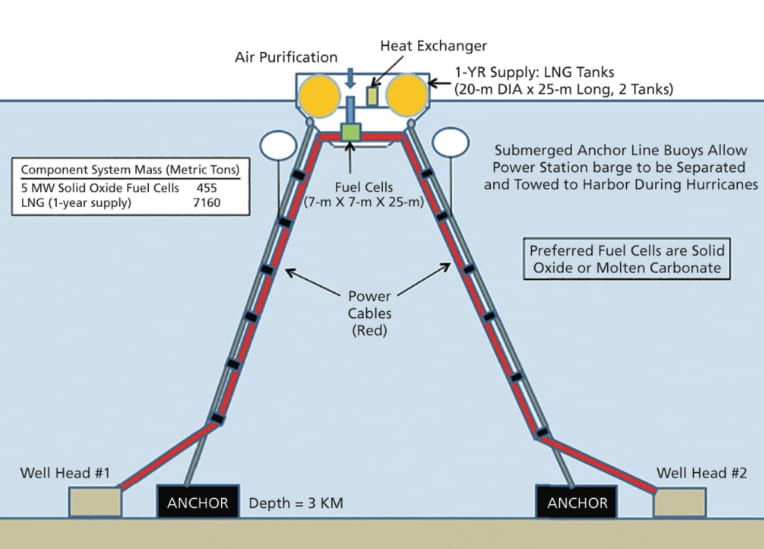
A barge is used to support an internal fuel cell (solid oxide or molten carbonate preferred, incorporating internal fuel processing) and a year’s supply of liquefied natural gas (LNG). Heat generated by the fuel cell system can be used in partial fulfillment of the energy required to vaporize the LNG in the integrated power system to increase the efficiency beyond the high efficiency provided by the fuel cell. Submerged buoys are attached to the anchor lines so that the power and anchor cables can be removed during a storm and yet float beneath the ocean surface, and the portable power barge can be towed to a harbor. Relatively simple annual maintenance, such as filter cleaning, is necessary for the fuel cells, so this type of maintenance can be performed in situ or in a harbor.
The barge can also be partially filled with seawater to allow the vessel to sink partly during storms, or the anchor lines can be made tighter to completely submerge the floating vessel during hurricanes. Air purification and fuel tanks are located on top of the barge to facilitate maintenance. For very long operation in rough seas, the heavier LNG tanks could be located below the barge, and the fuel cells could be above or below the barge.
A hybrid power system may be created in which fresh water produced by the fuel cells is used to generate power in a pressure-retarded osmosis (PRO) unit when integrated with seawater.
This work was done by Jack A. Jones and Gerald E. Voecks of Caltech for NASA’s Jet Propulsion Laboratory. NPO-49330
This Brief includes a Technical Support Package (TSP).
Ultra-Low-Maintenance Portable Ocean Power Station
(reference NPO49330) is currently available for download from the TSP library.
Don't have an account?
Overview
The document outlines the Ultra-Low-Maintenance Portable Ocean Power Station, developed by Jack A. Jones and Gerald Voecks at NASA's Jet Propulsion Laboratory (JPL). This innovative power station is designed to harness ocean energy efficiently and is particularly suited for deployment in challenging marine environments.
Key components of the power station include solid oxide fuel cells, which are preferred for their efficiency and low maintenance requirements. The system is designed to operate with a one-year supply of liquefied natural gas (LNG), stored in two tanks measuring 20 meters in diameter and 25 meters in length. The total mass of the fuel cells is approximately 455 metric tons, while the LNG supply weighs around 7,160 metric tons.
The power station is engineered to be portable, allowing it to be towed to safety during adverse weather conditions, such as hurricanes. This is facilitated by submerged anchor line buoys that enable the power station barge to be separated and moved as needed. The design also incorporates air purification systems to ensure environmental compliance and operational efficiency.
The document emphasizes the importance of the power station's design in terms of stability and maintenance. It highlights the use of pressure-retarded osmosis (PRO) as a method to enhance energy efficiency. The overall goal of the project is to create a sustainable and reliable source of power that can be deployed in various marine applications, potentially benefiting remote communities and supporting scientific research.
The Technical Support Package serves as a resource for understanding the technological advancements and potential commercial applications of the ocean power station. It is part of NASA's Commercial Technology Program, aimed at disseminating aerospace-related developments with broader technological implications.
In summary, the Ultra-Low-Maintenance Portable Ocean Power Station represents a significant advancement in renewable energy technology, combining innovative engineering with practical applications for ocean energy harnessing. The project reflects NASA's commitment to developing technologies that can address energy challenges while promoting sustainability and environmental stewardship.











