A robust sensor based on the electrochemical oxidation of methanol has been developed for use in measuring the concentration of methanol dissolved in water. The sensor is expected to be particularly useful in continuous monitoring and control of the concentration of an aqueous solution of methanol metered into a liquid-feed, direct-oxidation methanol fuel cell.

Other methanol sensors respond to changes in concentration too slowly to be useful for monitoring and control. Moreover, methanol sensors based on spectroscopy are relatively insensitive at high concentrations. The present sensor responds rapidly enough for monitoring and control. It also offers wide dynamic range; it can measure concentrations from 0.01 M to 5 M. Furthermore, it functions over the entire temperature range of liquid water at normal atmospheric pressure; that is, from 0 to 100 °C.
The sensor (see Figure 1) resembles a small liquid-feed, direct-oxidation fuel cell in some respects, but is operated in a different manner. It includes a polymer-electrolyte membrane coated on one side with a catalytic electrode composed of Pt/Ru-alloy powder and coated on the other side with a catalytic electrode composed of Pt black. Some details of the preparation of the Pt/Ru powder, the polymer-electrolyte membrane, and coating the membrane with the Pt/Ru powder were described in "Making Catalysts and Electrodes for Liquid-Feed Fuel Cells" (NPO-19893) NASA Tech Briefs, Vol. 20, No. 10 (October 1996), page 60. The coated membrane is pressed between sheets of the porous carbon paper. The resulting sandwich is mounted between graphite plates that act as both current collectors and structural supports. Circular openings in the graphite plates expose the sandwich to the aqueous solution of methanol.
When the Pt/Ru and Pt electrodes are connected to the positive and negative sides, respectively, of a dc power supply, electric current flows through the sensor, causing the following reactions:
CH3OH + H2O → CO2+ 6H+ + 6e¯ at the Pt/Ru electrode and 6H+ + 6e¯ → 3H2 at the Pt electrode.
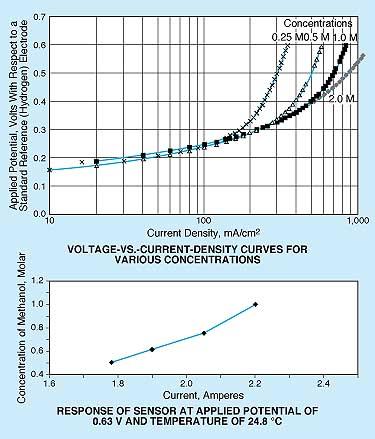
As the applied potential increases, the rate of this reaction (and thus the electric current) becomes subject to limitation on the rate of transport of methanol to the surface of the Pt/Ru electrode. As the concentration of methanol increases, more methanol becomes available for transport, making it possible to sustain a larger transport-limited current. Thus, for a given applied potential, the current increases with the concentration of methanol (see Figure 2). This behavior is exploited in designing the methanol sensor; in the basic mode of operation, one applies a specified potential in the range in which current is strongly transport-limited (e.g. 0.63 V) and measures the current as an indication of the concentration of methanol.
The response of the sensor also depends on temperature. At each operating temperature of interest, the sensor is calibrated by applying the potential and measuring the current in the presence of aqueous solutions with known concentrations of methanol.
This work was done by Sekharipuram Narayanan, William Chun, and Thomas Valdez of Caltech for NASA's Jet Propulsion Laboratory. For further information, access the Technical Support Package (TSP) free on-line at www.techbriefs.com under the Physical Sciences category. In accordance with Public Law 96-517, the contractor has elected to retain title to this invention. Inquiries concerning rights for its commercial use should be addressed to
Technology Reporting Office JPL Mail Stop 122-116 4800 Oak Grove Drive Pasadena, CA 91109 (818) 354-2240
Refer to NPO-20125, volume and number of this NASA Tech Briefs issue, and the page number.
This Brief includes a Technical Support Package (TSP).
Sensor for Monotoring Concentration of Methanol
(reference NPO20125) is currently available for download from the TSP library.
Don't have an account?
Overview
The document discusses a novel sensor developed by NASA's Jet Propulsion Laboratory for monitoring methanol concentration in aqueous solutions, particularly for applications in direct-oxidation methanol fuel cells. This sensor is notable for its rapid response time and wide dynamic range, capable of measuring methanol concentrations from 0.01 M to 5 M, and it operates effectively across the entire temperature range of liquid water (0 to 100 °C).
The sensor's design is based on the electrochemical oxidation of methanol, utilizing a polymer-electrolyte membrane with catalytic electrodes made of platinum/ruthenium (Pt/Ru) alloy and platinum (Pt) black. When connected to a power supply, the sensor facilitates reactions that convert methanol and water into carbon dioxide and protons, generating an electric current that correlates with methanol concentration. This current is measured under transport-limited conditions, allowing for accurate concentration readings.
The document highlights the sensor's advantages over existing methanol sensors, which often have slow response times or limited sensitivity at high concentrations. The new sensor's ability to provide real-time monitoring is crucial for controlling methanol delivery in fuel cell systems, making it a vital component for efficient operation. The integration of this sensor with control electronics can streamline the process of methanol delivery, reducing complexity and enhancing reliability in fuel cell applications.
Additionally, the document outlines an alternative implementation method that pairs the sensor with a reference sensor in a known concentration solution, eliminating the need for calibration and temperature compensation. This approach further enhances the sensor's reliability and ease of use.
The development of this sensor is particularly relevant given the growing interest in methanol fuel cells for portable power sources and electric vehicles, suggesting promising commercial applications. The document concludes by noting that inquiries regarding the commercial use of this technology should be directed to NASA's Technology Reporting Office.
Overall, this innovative sensor represents a significant advancement in the field of fuel cell technology, providing a reliable and efficient means of monitoring methanol concentration, which is essential for optimizing fuel cell performance.