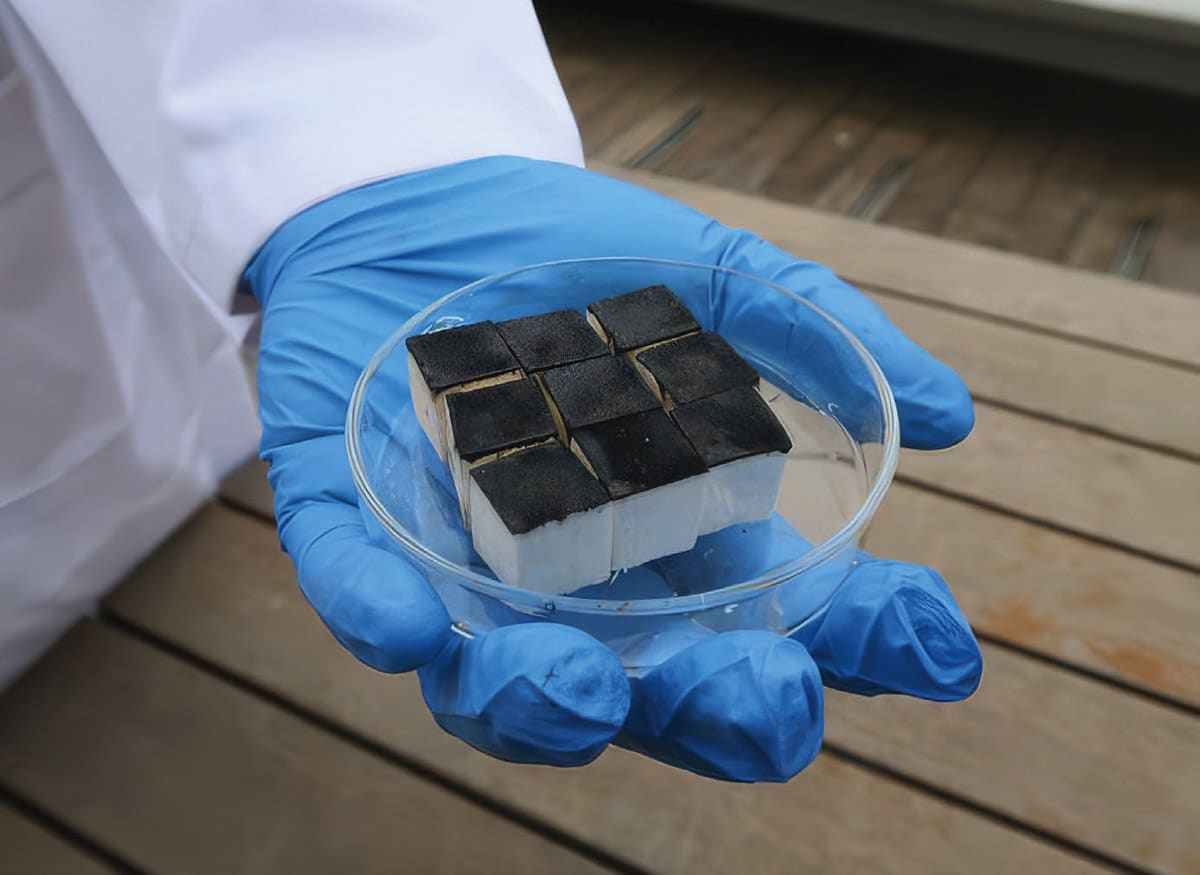
Engineers from Australia and China have invented a sponge-like device that captures water from thin air and then releases it in a cup using the sun’s energy, even in low humidity where other technologies such as fog harvesting and radiative cooling have struggled.
The water-from-air device remained effective across a broad range of humidity levels (30 – 90 percent) and temperatures (5 °C – 55 °C).
Senior researcher Dr. Derek Hao, from RMIT University in Melbourne, said the invention relied on refined balsa wood’s naturally spongy structure, modified to absorb water from the atmosphere and release it on demand.
The wood-based composite developed by the team for their research fit snuggly into a cup with a dome lid and anti-pollution tray, a cooling mechanism and an activation system powered by the sun.
“Billions of people around the world lack access to drinkable water, and millions die from water-borne diseases every year,” said Hao, Materials Scientist and Environmental Engineer, RMIT School of Science.
Hao was corresponding author on the study, which was done in collaboration with five Chinese research institutions, led by Dr. Junfeng Hou from Zhejiang A&F University.
“Our team has invented a device comprising wood’s spongy scaffolding, lithium chloride, iron oxide nanoparticles, a carbon nanotube layer, and other specialized features,” Hao said.
The team used artificial intelligence for accurate prediction and optimization of the device’s water harvesting and discharging performance under varying environmental conditions.
The spongy material, which is an early-stage lab prototype, absorbs moisture from the atmosphere when the cup’s lid is open. When the lid is closed under sunlight, water is released into the cup.
Under laboratory conditions, the water-from-air device absorbed about 2 milliliters of water per gram of material at 90 percent relative humidity and released nearly all the water within 10 hours under sun exposure — higher than most other known methods and at less cost. With nine sponge cubes, each weighing 0.8 grams, 15 milliliters of water can be absorbed and released into the cup.
“In outdoor tests, our device captured 2.5 milliliters of water per gram overnight and released most of it during the day, achieving a daily water collection efficiency of 94 percent” Hou said.
“At 30 percent humidity, our device absorbed water at about 0.6 milliliters per gram.
“These results highlight its potential use in off-grid, solar-driven water harvesting systems.”
Hao said the use of natural wood as a matrix not only reduced costs but also provided structural integrity and enhanced water transport through its porous architecture.
“These features enable the material to be manufactured in large quantities and deployed in real-world applications such as water collection in remote or arid regions,” he said.
“The device retained its flexibility and water-absorbing function even after being stored at -20 °C for 20 days, demonstrating excellent freeze resistance.
“Its moisture absorption–release performance was stable across 10 consecutive cycles, with less than 12 percent decline in efficiency.”
Hao said the device would be suited to emergency scenarios, such as in the wake of natural disasters where water supplies have been compromised, if the team can scale-up and optimize the modular innovation.
“The current demonstration unit size is 15 cubic millimeters. It would be very easy to prepare a larger unit, or we can use the units to form an array,” Hao said.
For more information, contact Will Wright at