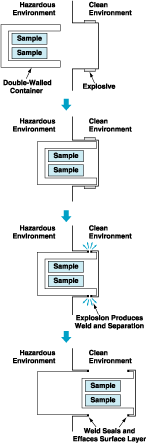
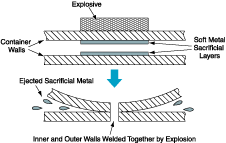
Figure 1 depicts the process stages. In its initial double-wall form, the volume between the walls is isolated from the environment; in other words, the outer wall (which is later sacrificed) initially serves to protect the inner container from contamination. The sample is placed inside the container through an opening at one end, then the container is placed into a transfer dock/lid. The surfaces that will be welded together under the explosive have been coated with a soft metallic sacrificial layer (see Figure 2). During the explosion, the sacrificial layer is ejected, and the container walls are welded together, creating a strong metallic seal. The inner container is released during the same event and enters the clean environment.
This work was done by Benjamin Dolgin and Joseph Sanok of Caltech for NASA's Jet Propulsion Laboratory. For further information, access the Technical Support Package (TSP) free on-line at www.techbriefs.com/tsp under the Manufacturing category. NPO-20868.
This Brief includes a Technical Support Package (TSP).
Explosion Welding for Hermetic Containerization
(reference NPO-20868) is currently available for download from the TSP library.
Don't have an account?
Overview
The document presents a technical support package from NASA's Jet Propulsion Laboratory (JPL) detailing a novel double wall explosion welded container designed for the safe storage and transportation of hazardous materials. This innovative container addresses significant challenges associated with contamination, particularly in the context of extraterrestrial sample return missions, where the properties of the materials are unknown and traditional decontamination methods are inadequate.
The container features a double-wall design, where the outer wall is sacrificed during an explosion-welding process. This process seals the inner container, which holds the hazardous samples, and transfers it to a clean environment. The major advantage of this method is that the outer wall, once the explosion occurs, remains uncontaminated, eliminating the need for complex decontamination procedures that would typically be required to mitigate potential radioactive, chemical, or biological hazards.
The document outlines the technical process involved in the explosion welding. Initially, the container is filled with samples through an opening at one end. It is then placed into a transfer dock or lid, where surfaces coated with a soft metallic sacrificial layer are prepared for welding. During the explosion, this sacrificial layer is ejected, and the container walls are welded together, creating a strong metallic seal. This process not only seals the samples but also ensures that the inner container is isolated from any external contamination.
The container's design is likened to a thermos bottle, where the inner volume is protected from the external environment. The document emphasizes that the explosion welding technique has been demonstrated to produce atomically clean surfaces, ensuring that the integrity of the samples is maintained. Additionally, the document highlights the development of geometries that allow for simultaneous welding and cutting, further enhancing the efficiency of the sealing process.
Overall, this double wall explosion welded container represents a significant advancement in the safe handling of hazardous materials, particularly in the context of space exploration and planetary protection. The work was conducted by Benjamin Dolgin and Joseph Sanok at Caltech for NASA, showcasing the collaboration between scientific research and practical applications in hazardous material management.