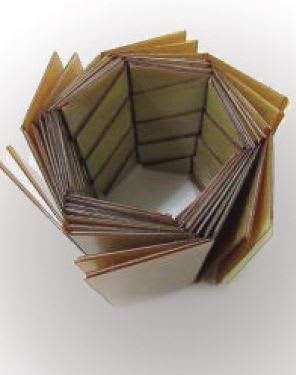
To achieve power of 250 kW or greater, a large compression ratio of stowed-to-deployed area is needed. Origami folding patterns were used to inspire the folding of a solar array to achieve synchronous deployment; however, origami models are generally created for near-zero-thickness material. Panel thickness is one of the main challenges of origami-inspired design.
This work was done by Brian P. Trease, Mark W. Thomson, Deborah A. Sigel, and Phillip E. Walkemeyer of Caltech; Shannon Zirbel and Larry Howell of Brigham Young University; and Robert Lang of Lang Origami for NASA’s Jet Propulsion Laboratory. NPO-48861
This Brief includes a Technical Support Package (TSP).
Origami-Inspired Folding of Thick, Rigid Panels
(reference NPO-48861) is currently available for download from the TSP library.
Don't have an account?
Overview
The document titled "Origami-Inspired Folding of Thick, Rigid Panels" from NASA's Jet Propulsion Laboratory (JPL) discusses innovative design approaches for deployable structures, particularly solar arrays, using origami principles. The research addresses the challenges posed by material thickness when creating foldable structures, which are typically modeled under the assumption of zero or near-zero thickness.
Key concepts include the use of two main hinge types to accommodate panel thickness: membrane hinges and panel hinges. Membrane hinges allow for flexibility and enable the panels to fold flat, while panel hinges are designed to match the thickness of the panels, facilitating effective folding without compromising structural integrity.
The document features various origami-inspired models, including the "map fold" and "flasher model." The map fold is described as the simplest fold requiring sequential deployment, illustrated with a 5x5 array. The final stowed configuration results in a flat stack of panels, with the potential for solar cells to be integrated onto the hinges. The flasher model, on the other hand, demonstrates how panels can bend around thick folds, highlighting the importance of hinge design in achieving a functional and compact deployment.
Figures included in the document showcase prototypes made from materials like balsa wood and poster board, emphasizing the practical applications of these designs. The six-sided flasher model is noted for its rigid-foldable characteristics when specific hinge adjustments are made, further illustrating the versatility of origami-inspired designs in engineering.
The research was conducted under the sponsorship of NASA, with contributions from various experts in the field, including those from Brigham Young University and Lang Origami. The findings are positioned as having broader technological, scientific, and commercial implications, suggesting potential applications beyond aerospace.
Overall, the document serves as a technical support package that not only documents the research findings but also encourages collaboration and further exploration of origami-inspired designs in various fields. It highlights the innovative intersection of art and engineering, showcasing how traditional folding techniques can lead to advanced solutions in modern technology.