5 Ws: Robotics, Automation & Control
Richtech Robotics’ Dex is an industrial humanoid robot that learns in simulation and works in reality to elevate productivity and safety on the factory floor.
5 Ws: Software
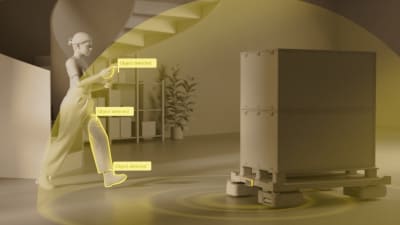
Norway-based startup Sonair has developed a 3D ultrasonic sensor that uses sound waves in air to give robots a precise, real-time 3D view of their surroundings, helping them operate safely in shared spaces.
5 Ws: Imaging
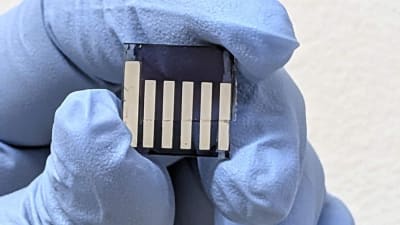
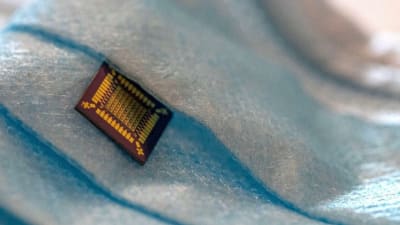
North Carolina State University engineers have built a tiny spectrometer that is orders of magnitude smaller than current technologies and can accurately measure wavelengths of light from ultraviolet to the near infrared.
5 Ws: Software
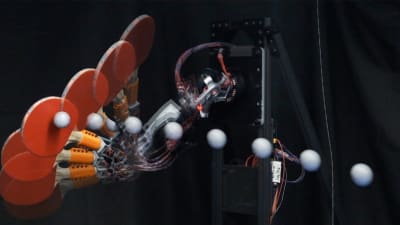
MIT engineers have developed a ping-pong-playing robot that quickly estimates the speed and trajectory of an incoming ball and precisely hits it with precision.
5 Ws: Manufacturing & Prototyping
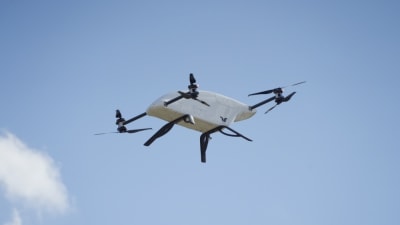
An all-electric drone developed by Blueflite with vertical take-off and landing capabilities and advanced maneuverability for faster and more cost-effective deliveries.
5 Ws: Materials
AstroRad, a next-gen radiation vest for astronauts to wear beyond low-Earth orbit, shields their vital organs from dangerous space radiation during missions beyond low-Earth orbit.
5 Ws: Robotics, Automation & Control
GOAT (Good Over All Terrains), a bioinspired robot developed at EPFL, can change shape to alter its own physical properties in response to its environment, resulting in a robust and efficient autonomous vehicle.
5 Ws: Robotics, Automation & Control
With the goal to democratize space research, MIT engineers have demonstrated the first fully 3D-printed, droplet-emitting electrospray engine which can be produced rapidly and for a fraction of the cost of traditional thruster.
5 Ws: Robotics, Automation & Control
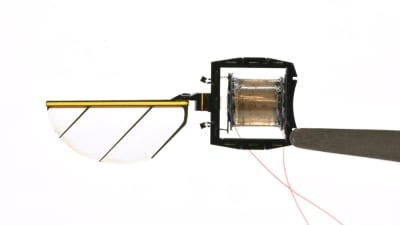
MIT researchers are developing robotic insects that could someday swarm out of mechanical hives to rapidly perform precise pollination.
5 Ws: Unmanned Systems
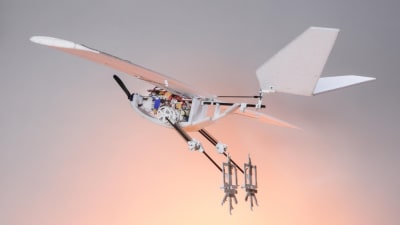
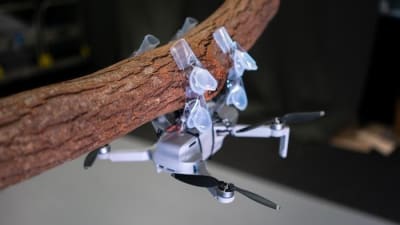
EPFL researchers have built RAVEN, a drone that can walk, hop, and jump into flight with the aid of birdlike legs.
5 Ws: AR/AI
EgoTouch, a new tool developed by researchers in CMU’s Human-Computer Interaction Institute, could put control for AR/VR environments in the palm of your hand.
5 Ws: Manufacturing & Prototyping
MIT engineers have 3D printed sturdy glass bricks for building structures. The interlocking bricks, which can be repurposed many times over, can withstand similar pressures as their concrete counterparts.
5 Ws: Wearables
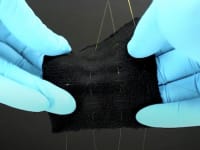
Caltech engineers have developed a prototype for a high-tech paper mask that can be used to monitor a range of metabolic and respiratory conditions.
5 Ws: Robotics, Automation & Control
A novel fabrication approach enables lightweight, untethered operation of soft robots with advanced biomimetic locomotion capabilities.
5 Ws: Wearables
A new device developed by MIT engineers allows people living with paralysis to interact with phones and computers using their tongue, mouth, and head gestures.
5 Ws: Robotics, Automation & Control
A team of researchers at Delft University of Technology has developed a drone that flies autonomously using neuromorphic image processing and control based on the workings of animal brains.
5 Ws: Medical
Rice University engineers have developed the smallest implantable brain stimulator demonstrated in a human patient that could revolutionize treatment for drug-resistant depression and other psychiatric or neurological disorders.
5 Ws: Medical
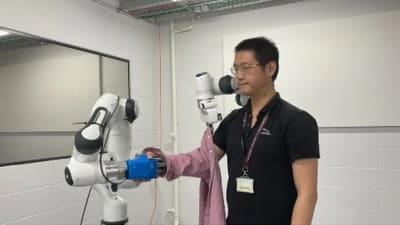
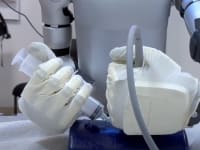
A bimanual dressing robot system developed at the University of York uses AI to mimic how caregivers assist humans in dressing.
5 Ws: Robotics, Automation & Control
A light sail developed by Cornell’s Space Systems Design Studio (SSDS) could one day propel small spacecraft through interstellar realms.
5 Ws: Robotics, Automation & Control
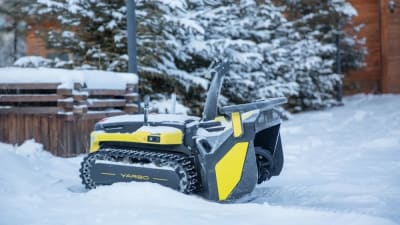
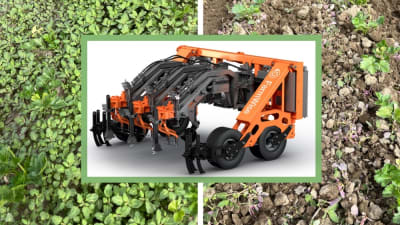
A smart modular yardwork robot that can blow leaves and plow snow as well as achieve reductions in carbon emissions at the same time.
5 Ws: Medical
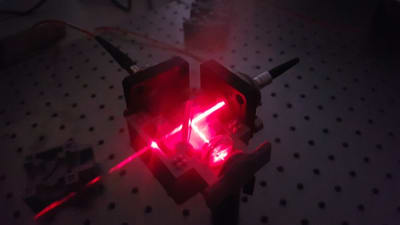
There is an urgent need for new technologies to improve the timeliness of traumatic brain injury diagnosis. Researchers from the University of Birmingham have a laser-based solution.
5 Ws: Materials
Researchers at Tufts University have created microprocessor-scale transistors that can detect and respond to biological states and the environment.
5 Ws: Materials
A team of researchers at the Italian Institute of Technology (IIT) has created a totally edible and rechargeable battery, starting from materials that are normally consumed as part of our daily diet.
5 Ws: Aerospace
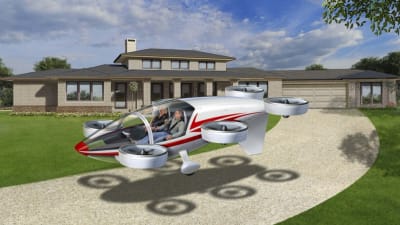
A two-passenger hybrid-electric vertical takeoff and landing (eVTOL) passenger multicopter aircraft with NASA-proven thrusters for advanced air mobility.
5 Ws: Sensors/Data Acquisition
A new ion trap developed by Sandia National Labs enables scientists to build more powerful machines to advance the experimental but potentially revolutionary field of quantum computing.
5 Ws: Energy
Rice University engineers are turning sunlight into hydrogen with record-breaking efficiency with a device that splits water molecules and generates hydrogen when stimulated by simulated sunlight.
5 Ws: Sensors/Data Acquisition
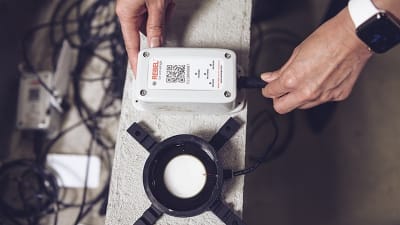
A new technology allows concrete to “talk,” decreases construction time and how often concrete pavement needs repairs while also improving the road’s sustainability and cutting its carbon footprint.
5 Ws: Sensors/Data Acquisition
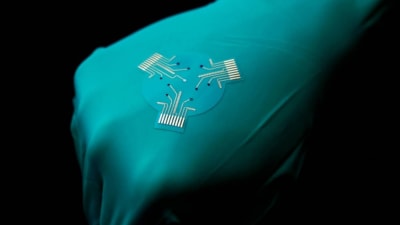
A new kind of smart bandage developed at Caltech may make treatment of chronic wounds easier, more effective, and less expensive.
5 Ws: Manufacturing & Prototyping
MIT alumnus-founded FarmWise uses autonomous machines to snip weeds while preserving crops, eliminating the need for herbicides.