-1
2700
30
News: Imaging
Moving Cameras Track Objects Automatically
University of Washington electrical engineers have developed a way to automatically track people across moving and still cameras by using an algorithm that trains the networked cameras to learn one another’s differences. The cameras first identify a person in a video frame, then follow that same person...
News: Energy
Ocean Gliders Measure Melting Polar Ice
The rapidly melting ice sheets on the coast of West Antarctica are a potentially major contributor to rising ocean levels worldwide. Although warm water near the coast is thought to be the main factor causing the ice to melt, the process by which this water ends up near the cold continent is not well...
News: Robotics, Automation & Control
Microbot Muscles Self-Assemble and Flex
In a step toward robots smaller than a grain of sand, University of Michigan researchers have shown how chains of self-assembling particles could serve as electrically activated muscles in the tiny machines."We are inspired by ideas of microscopic robots," said Michael Solomon, a professor of chemical...
News: Photonics/Optics
NASA Technologists Advance Next-Generation 3D Imaging
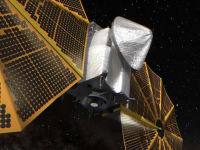
Building, fixing, and refueling space-based assets or rendezvousing with a comet or asteroid will require a robotic vehicle and a super-precise, high-resolution 3D imaging lidar that generates the real-time images needed to guide the vehicle to a target traveling at thousands of miles per hour.A...
News: Communications
Cockroach Biobots Detect Sound
North Carolina State University researchers have developed technology that allows cyborg cockroaches, or biobots, to pick up sounds with small microphones and seek out the source of the sound. The technology is designed to help emergency personnel find and rescue survivors in the aftermath of a disaster.The...
News
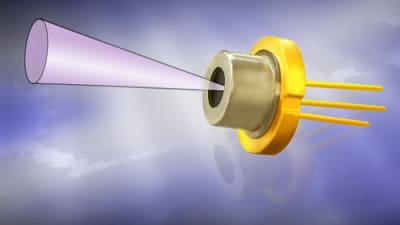
OSI Laser Diode, Inc. (LDI) (Edison, NJ) has introduced a 1550 nm pulsed laser diode with an integrated micro lens that delivers a far‑field beam pattern. The beam pattern's divergence is equivalent in both the...
Question of the Week
Would you eat 3D-printed food?
This week's Question: A startup company, Natural Machines, has introduced a 3D printer called Foodini. The technology creates food with stainless steel capsules and edible, fresh ingredients. The microwave‑oven‑sized Foodini, displayed during Dublin's Web Summit technology conference last week, serves as a...
INSIDER: Materials
Particle physicists have a hard time identifying all the elementary particles created in their particle accelerators. But now researchers at Chalmers University of Technology have...
INSIDER: Photonics/Optics
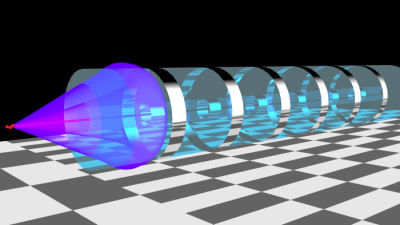
Energy loss in optical systems, such as lasers, is a chief hindrance to their performance and efficiency and it occurs on an ongoing, frustrating basis. To help laser systems overcome loss,...
INSIDER: Test & Measurement
Scientists have developed a high‑resolution magnetic line camera to measure magnetic fields in real time. Field lines in magnetic systems such as generators or motors that are...

INSIDER: Sensors/Data Acquisition
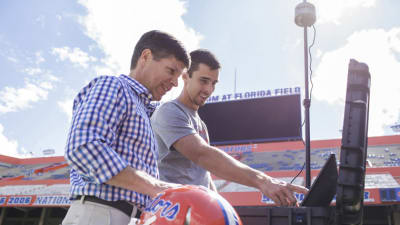
In football, a tackle can supply 100 Gs of force or more, well above the amount that can cause a concussion and more than 10 times the force of an F‑16 jet roll maneuver. University of...
INSIDER: Aerospace
A new space‑based instrument to study how effectively plants use water is being developed at NASA's Jet Propulsion Laboratory. The ECOsystem Spaceborne Thermal Radiometer Experiment on Space...

Question of the Week
Will "4D" materials catch on?
This week's Question: While 3D printing has still not yet reached the mainstream, MIT and other researchers are performing primary tests on the next design dimension. 4D printing, a self-assembly design process, enables the production of composite materials that react and change shape in predictable ways when exposed...
News: Manufacturing & Prototyping
Engineers Harvest and Print Parts for New Breed of Aircraft
Student interns and engineers at NASA's Ames Research Center rapidly prototyped and redesigned aircraft using 3D-printed parts. The aircraft was custom-built by repurposing surplus Unmanned Aerial Vehicles (UAVs). By lengthening the wings, the team was able to improve aerodynamic...
News: Energy
Solar Material Converts 90 Percent of Captured Light into Heat
A multidisciplinary engineering team at the University of California, San Diego developed a new nanoparticle-based material for concentrating solar power plants designed to absorb and convert to heat more than 90 percent of the sunlight it captures. The new material can also withstand...
News: Communications
Harness-Mounted Computer Improves Communication Between Dogs and Humans
North Carolina State University researchers have developed a suite of technologies that can be used to enhance communication between dogs and humans. The communication tool enables applications in search-and-rescue operations and pet training. “We’ve developed a platform...
INSIDER: Robotics, Automation & Control
Scientists from Nanyang Technological University (NTU) and German Aerospace Centre (DLR) have invented a 2-in-1 electric motor that increases the range of electric vehicles. The engine integrates...

INSIDER: Automotive
More than 60 percent of the energy generated in vehicle engines by fuel is lost through the exhaust gas and the coolant. The biggest part of this simply slips off into the environment as heat. The...
INSIDER: Robotics, Automation & Control
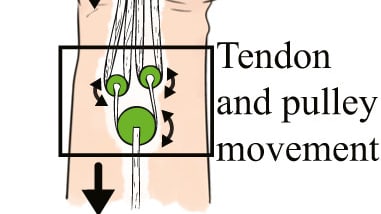
Engineers at Oregon State University have developed and successfully demonstrated a simple pulley mechanism to improve hand function after surgery. The device is one of the first instruments...
News: Photonics/Optics
NASA Team Proposes Laser for Orbital Debris Tracking
Barry Coyle and Paul Stysley, laser researchers at NASA’s Goddard Space Flight Center in Greenbelt, Maryland, want to develop a method to define and track orbital debris using laser ranging — a promising approach that could overcome shortfalls with passive optical and radar techniques, which...
Question of the Week
Are robots an effective way of combating outbreaks like Ebola?
This week's Question: Next month, scientists will convene at universities across the country to consider the role that autonomous machines might play in combating the Ebola crisis. Telepresence robots, according to some researchers, could theoretically perform healthcare tasks like...
INSIDER: Semiconductors & ICs
Researchers from The University of Texas at Dallas have created technology that could be the first step toward wearable computers with self-contained power sources or, more immediately, a...
INSIDER: Aerospace
Because of the difficulty of monitoring turbine engines in operation, most manufacturers test turbine blades either after flight or rely on simulated tests to give them the...

INSIDER: Energy
Fuel cells could replace batteries in mobile phones and laptop computers, and the UPV/EHU-University of the Basque Country is looking at ways of enhancing their efficiency....

News: Energy
Ultra-Thin 3D Display Promises Greater Energy Efficiency
An ultra-thin LCD screen, developed by a group of researchers from the Hong Kong University of Science and Technology, holds three-dimensional images without a power source, making the display technology a compact, energy-efficient way to display visual information.In a traditional LCD,...
News: Test & Measurement
NASA to Launch Soil Moisture Mapper
A NASA spacecraft designed to track Earth's water in one of its most important, but least recognized forms — soil moisture — now is at Vandenberg Air Force Base, California, to begin final preparations for launch in January.The Soil Moisture Active Passive (SMAP) spacecraft arrived Wednesday at its launch...
News: Sensors/Data Acquisition
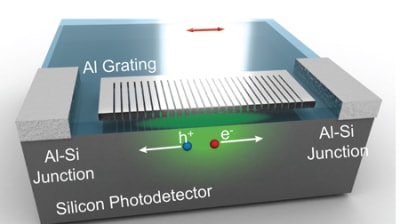
Rice University researchers have created a CMOS-compatible, biomimetic color photodetector that directly responds to red, green, and blue light in much the same way the human eye does. The new device...
Question of the Week
Will cosmic elevators take us to space?
This week's Question: Penn State researchers recently developed ultra-thin, super-strong nanothreads made from diamonds. The nanothreads could ultimately be used to construct a "space elevator" to take people to orbit. A Japanese company, Obayashi, similarly sees the feasibility of such an elevator and...
News: Electronics & Computers
Researchers Develop Thinnest Electric Generator
Researchers from Columbia Engineering and the Georgia Institute of Technology made the first experimental observation of piezoelectricity and the piezotronic effect in an atomically thin material, molybdenum disulfide (MoS2), resulting in a unique electric generator and mechanosensation devices that...
Top Stories
 Blog: Lighting

A Stretchable OLED that Can Maintain Most of Its Luminescence
 Blog: Energy

Batteries that Can Withstand the Cold
 INSIDER: Energy

Advancing All-Solid-State Batteries
 Blog: Power

My Opinion: We Need More Power Soon — Is Nuclear the Answer?
 Quiz: Power

 Blog: Data Acquisition

Webcasts
 Upcoming Webinars: Test & Measurement

From Spreadsheets to Insights: Fast Data Analysis Without Complex...
 Upcoming Webinars: Aerospace

Cooling a New Generation of Aerospace and Defense Embedded...
 Upcoming Webinars: Sensors/Data Acquisition

Beyond AI-Copy-Paste Engineering: Advanced AI-Integration Success...
 Upcoming Webinars: Energy

Battery Abuse Testing: Pushing to Failure
 Upcoming Webinars: Power

A FREE Two-Day Event Dedicated to Connected Mobility
 Upcoming Webinars: RF & Microwave Electronics

Choosing the Right N-Port Strategy: Multiport VNAs vs. Switch...