
52
-1
60
30
Briefs: Green Design & Manufacturing
An Accurate, Low-Cost Tool for Forest Measurement
Researchers have developed an algorithm, which gives an accurate measurement of tree diameter, an important measurement used by scientists to monitor forest health and levels of carbon sequestration.
Briefs: Lighting
The ability to control light using a semiconductor device could allow low-power, relatively inexpensive sources like LEDs or flashlight bulbs to replace more powerful laser beams in new technologies.

Briefs: Aerospace
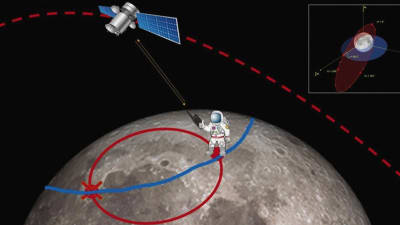
Scientists have developed a novel concept for a lunar navigation system based on the reverse-ephemeris technique.
Briefs: Sensors/Data Acquisition
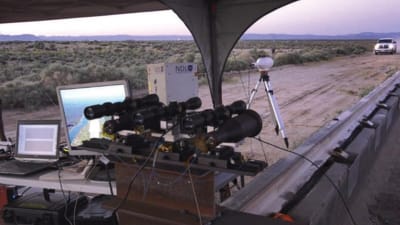
Research reveals that expertly timed lasers shined at an approaching LIDAR system can create a blind spot in front of the vehicle.

Briefs: Design
This technology will pave the way for new applications of integrated semiconductor lasers in LiDAR.
Briefs: Communications
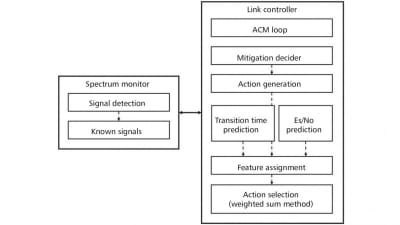
Innovators from the NASA Glenn Research Center developed a software-based automated RFI mitigation system to increase communication reliability.
Briefs: Energy
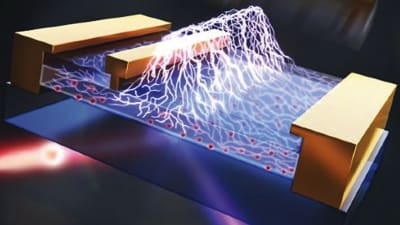
Researchers have developed a technique that will allow for faster communication systems and better energy-saving electronics.
Briefs: Unmanned Systems
A new robotic system fuses visual information and radio-frequency signals to efficiently find hidden items buried under a pile of objects.

Briefs: Aerospace
Concept Development for Advanced Spaceborne Synthetic Aperture Radar
Spaceborne Synthetic Aperture Radar (SAR) can globally monitor dynamic processes on the Earth’s Surface. The last SAR to be developed and deployed by NASA was in the year 2000.
Briefs: RF & Microwave Electronics
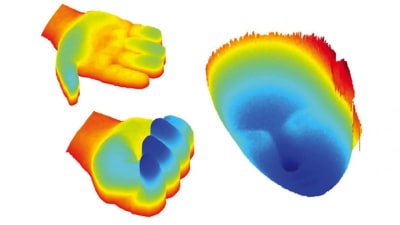
Traditional time-of-flight LiDAR has many drawbacks that make it difficult to use in many 3D vision applications.
Briefs: Aerospace
The LiDAR sensor utilizes Frequency Modulated Continuous Wave (FMCW) technique to determine the distance to the target and the velocity between the sensor and target.
Briefs: Photonics/Optics
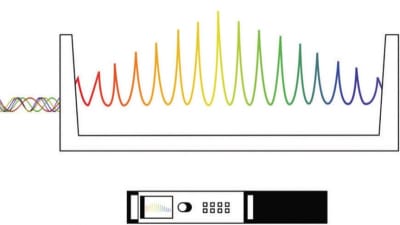
Enter the frequency comb, a Nobel Prize-winning device and the result of decades of research from NIST and others. The comb generates a billion pulses of light per second, which bounce back and forth inside an optical cavity.
Briefs: RF & Microwave Electronics
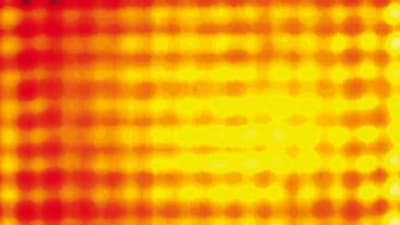
The new NIST instrument captures waves in action by relying on a device known as an optical interferometer.
Briefs: RF & Microwave Electronics
The design produces a compact, efficient, long-lifetime laser transmitter as needed for use in space, while also having potential applications as an airborne or ground-based wind measurement tool.

Briefs: Communications
Inside every cellphone lies a tiny mechanical heart, beating several billion times a second. These micromechanical resonators play an...

Briefs: RF & Microwave Electronics
Researchers have created a device that enables them to electronically steer and focus a beam of terahertz electromagnetic energy with extreme precision....
Briefs: Materials
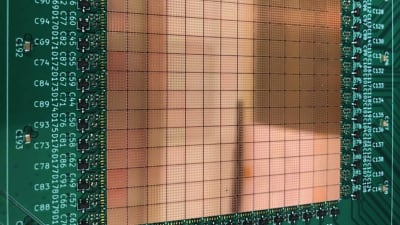
Metamaterials that manipulate microwave energy can be fabricated using low-cost inkjet printing.

Briefs: Imaging
The high-bandwidth, high-resolution ISAR technology can be used to study subsurface structures.

Briefs: RF & Microwave Electronics
Columbia researchers are reducing both the size and the power consumption of a visible-spectrum phase modulator, from one millimeter to 10 microns.

Briefs: Sensors/Data Acquisition
Researchers successfully demonstrated the use of the human body as a medium for transmitting and harvesting energy to power wearables.

Briefs: Mechanical & Fluid Systems
Vibrating transducers create tunnels in a thin layer of oil to transport droplets across a chip without leaving a trace behind.

Briefs: Electronics & Computers
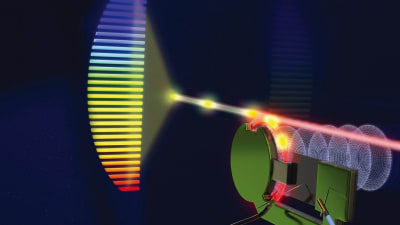
Mechanical control and modulation of light on a silicon chip could enhance LiDAR.
Briefs: Imaging
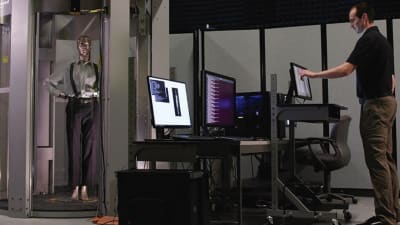
In an airport, the scanner could eliminate the need for passengers to remove shoes at the checkpoint, speeding the screening process.
Briefs: Semiconductors & ICs
Better detection of microwave radiation will enable improved thermal imaging, electronic warfare, radio communications, and radar.

Briefs: Photonics/Optics
The Laser Communications Relay Demonstration (LCRD) will usher in a new era of laser communications.

Briefs: Manufacturing & Prototyping
Applications include manufacturing/assembly line tracking, industrial transportation and logistics, and healthcare.
Briefs: Unmanned Systems
The camera combines lasers, computers, and terahertz waves to see “unseen” details.
Briefs: RF & Microwave Electronics
A silicon chip provides a low-cost solution to help machines see the world clearly.

Briefs: Sensors/Data Acquisition
This technology improves the detection of low-power far-infrared (FIR) signals.

Top Stories
 Blog: Design

Aerial Microrobots That Can Match a Bumblebee's Speed
 Blog: Energy

My Opinion: We Need More Power Soon — Is Nuclear the Answer?
 Blog: Electronics & Computers

Turning Edible Fungi into Organic Memristors
 Blog: Semiconductors & ICs

Revolutionizing the Production of Semiconductor Chips
 Blog: Robotics, Automation & Control

Microscopic Swimming Machines that Can Sense, Respond to Surroundings
 Quiz: Energy

Webcasts
 Upcoming Webinars: Power

Hydrogen Engines Are Heating Up for Heavy Duty
 Upcoming Webinars: Transportation

Advantages of Smart Power Distribution Unit Design for Automotive...
 Upcoming Webinars: Unmanned Systems

Quiet, Please: NVH Improvement Opportunities in the Early Design...
 Upcoming Webinars: Power

A FREE Two-Day Event Dedicated to Connected Mobility
 On-Demand Webinars: Automotive

E/E Architecture Redefined: Building Smarter, Safer, and Scalable Vehicles
 Podcasts: Unmanned Systems

How Sift's Unified Observability Platform Accelerates Drone Innovation