
Stories
38
49
0
2220
30
Question of the Week: Materials
Will shape memory polymers play a prominent role in non-aerospace applications?
This week's Question: A featured Tech Brief in today's INSIDER highlighted a shape memory polymer from Langley Research Center. Designed initially for morphing spacecraft, the material changes shape when temperature shifts; the thermosetting polymer than returns to its...
Briefs: Materials
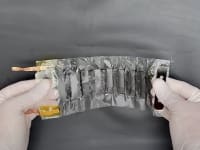
NASA’s Langley Research Center has developed a novel shape memory polymer (SMP) made from composite materials for use in morphing structures. In response to an external stimulus such as...
Briefs: Materials
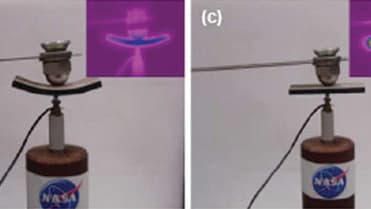
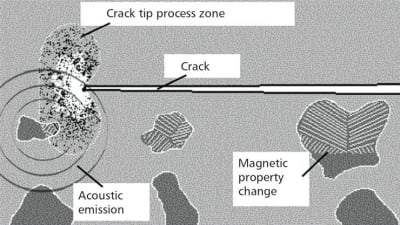
NASA Langley Research Center has developed a metallic material that can be embedded into structural alloys to enhance nondestructive evaluation (NDE) of a structure. Current NDE tools, such as eddy current...
Briefs: Materials
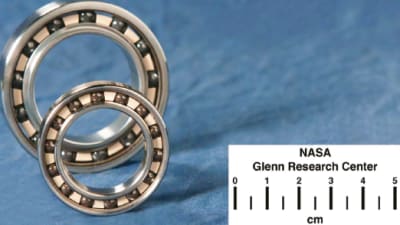
NASA's Glenn Research Center has developed high-temperature solid lubricant materials suitable for foil gas bearings that enable the...

Briefs: Materials
NASA's Langley Research Center has created a new class of materials based on depositing nanometer-sized metal particles onto carbon allotropes. The method is scalable and relatively...

Briefs: Materials
In Situ Mechanical Property Measurements of Amorphous Carbon-Boron Nitride Nanotube Nanostructures
Utilizing the full mechanical capabilities of individual nanotubes is a primary research goal in nanotube reinforced nanocomposite materials. Practical use of these nanomaterials requires creating stable and strong linkages between nanotubes without...
Briefs: Materials
Negative Dielectric Constant Material Based on Ion Conducting Materials
NASA Langley Research Center has developed a novel negative dielectric constant material based on ion-conducting materials. A negative dielectric constant material is an essential key for creating metamaterials, or artificial negative index materials (NIMs). NIMs have generated...
INSIDER: Materials
Non-Toxic Material Generates Electricity Through Heat, Cold Air
Imagine a body sensor powered by one's jewelry, or a cooking pan that charges a cell phone in a few hours.
Using a combination of the chemical elements calcium, cobalt, and terbium, University of Utah researchers created an efficient, inexpensive and bio-friendly material that...
INSIDER: Photonics/Optics
Researchers working at the Ultrafast Laser Lab at the University of Kansas successfully created a new bilayer material, with each layer measuring less than one nanometer in...

INSIDER: Materials
Researchers Find 'Golden' Idea for New Wearables
Researchers at Missouri University of Science and Technology have developed a way to “grow” thin layers of gold on single crystal wafers of silicon, remove the gold foils, and use them as substrates on which to grow other electronic materials. The discovery could lead to new wearable...
NASA Spinoff: Materials
Spinoff is NASA's annual publication featuring successfully commercialized NASA technology. This commercialization has contributed to the development of products and services in the fields...

Articles: Materials
Historically, high-strength materials have been heavy and dense. The need for high-strength but lightweight materials has become more widespread when designing everything from vehicles and...

INSIDER: Materials
'Tougher-than-Metal' Hydrogels Support New Biomaterials
Scientists from Japan's Hokkaido University have created tough hydrogels combined with woven fiber fabric. The "fiber-reinforced soft composite" fabrics are highly flexible, stronger than metals, and can support a number of potential applications, including artificial ligaments and tendons...
INSIDER: Motion Control
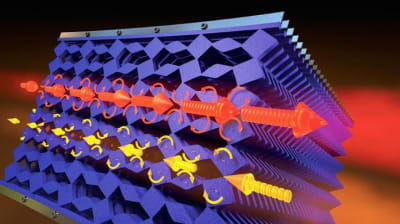
Engineers and scientists at the University of Texas at Austin and the AMOLF institute in the Netherlands have invented mechanical metamaterials that transfer motion in one direction...
INSIDER: Materials
Light-Absorbent Material Keeps Buildings Cool
Engineers at the University of California San Diego have created a thin, flexible, light-absorbing material that absorbs more than 87 percent of near-infrared light. The technology could someday support the development of solar cells; transparent window coatings to keep cars and buildings cool; and...
Briefs: Materials
NASA's Kennedy Space Center (KSC) seeks to license its Multidimensional Damage Detection System for Flat Surfaces technology. The ability to detect damage to composite surfaces can be crucial,...

Briefs: Materials
Methods for Intercalating and Exfoliating Hexagonal Boron Nitride
Innovators at NASA's Glenn Research Center have developed a number of materials and methods to optimize the performance of nanomaterials by making them tougher, more resistant, and easier to process. Glenn's scientists are generating critical improvements at all stages of...
Briefs: Materials
Method for Fabricating Diamond-Dispersed, Fiber-Reinforced Composite Coating onLow-Temperature Sliding Thrust Bearing Interfaces
Innovators at NASA's Glenn Research Center have developed a method for fabricating a fiber-reinforced diamond composite coating on the surfaces of sliding thrust bearings at low and cryogenic temperatures. The...
Briefs: Materials
Enhanced Composite Damping Through Engineered Interfaces
Material damping is important in the design of structures as it limits vibration amplitudes, increases fatigue life, and affects impact resistance. This is particularly true for composite materials, which are currently used extensively in applications that experience frequent dynamic loading....
Briefs: Materials
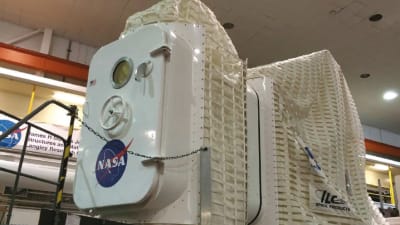
NASA's Langley Research Center is developing an innovative self-healing resin that automatically reacts to mechanical stimuli. Current structural materials are not self-healing, making it necessary to depend...
Briefs: Materials
Methodology for the Effective Stabilization of Tin-Oxide-Based Oxidation/ReductionCatalysts
NASA Langley researchers, in work spanning more than a decade, have developed a portfolio of technologies for low-temperature gas catalysis. Originally developed to support space-based CO2 lasers, the technology has evolved into an array of...
Briefs: Materials
Polymer-Reinforced, Non-Brittle, Lightweight Cryogenic Insulation for Reduced Lifecycle Costs
The objective of this project was to develop inexpensive structural cryogenic insulation foam that has increased impact resistance for launch and ground-based cryogenic systems. Two parallel approaches were used: a silica-polymer co-foaming technique and a...
INSIDER: Materials
Researchers Create Metallic Hydrogen
Nearly a century after it was theorized, scientists from Harvard University have created the first-ever sample of one of the rarest materials on the planet: metallic hydrogen. The atomic metallic hydrogen has a potentially wide range of applications, including as a room-temperature superconductor.
Question of the Week: Materials
Will metallic hydrogen improve transportation?
This week's Question: Today's lead INSIDER story featured the development of metallic hydrogen, a technology that has a range of potential applications, from advanced rocket propellants to room-temperature superconductors. According to the Harvard University researchers, the material could support the...
INSIDER: Materials
Researchers Awaken Graphene's Hidden Superconductivity
Since its discovery in 2004, scientists have believed that graphene contained an innate ability to superconduct. Now researchers from the University of Cambridge have found a way to activate that previously dormant potential, enabling the material to carry an electrical current with zero...
INSIDER: Materials
A University of California, Riverside assistant professor has combined photosynthesis and physics to make a key discovery that could help make solar cells more efficient. Nathan Gabor is focused on...

INSIDER: Manufacturing & Prototyping
Researchers Design Lightweight, 'Stronger-Than-Steel' Material
A team of engineers at the Massachusetts Institute of Technology has successfully designed a new 3D material with five percent the density of steel and ten times the strength. By compressing and fusing flakes of graphene, a two-dimensional form of carbon, the sponge-link configuration...
Briefs: Materials
NASA’s Glenn Research Center (GRC) has developed a method for fabricating low-density, flexible aerogel composites for use as thermal insulation for myriad...

Briefs: Materials
NASA’s Glenn Research Center has developed a new method for producing a shock- and corrosion-proof, superelastic, intermetallic material, NiTiNOL 60 (60NiTi), for...
Top Stories
 Blog: Robotics, Automation & Control

Aerial Microrobots That Can Match a Bumblebee's Speed
 Blog: Electronics & Computers

Turning Edible Fungi into Organic Memristors
 Blog: Manufacturing & Prototyping

Revolutionizing the Production of Semiconductor Chips
 News: Energy

 INSIDER: Electronics & Computers

World’s Smallest Programmable, Autonomous Robots
 INSIDER: Manufacturing & Prototyping

Webcasts
 On-Demand Webinars: Power

E/E Architecture Redefined: Building Smarter, Safer, and Scalable Vehicles
 Upcoming Webinars: Energy

Hydrogen Engines Are Heating Up for Heavy Duty
 Upcoming Webinars: Electronics & Computers

Advantages of Smart Power Distribution Unit Design for Automotive...
 Upcoming Webinars: Automotive

Quiet, Please: NVH Improvement Opportunities in the Early Design...
 Upcoming Webinars: Power

A FREE Two-Day Event Dedicated to Connected Mobility
 Podcasts: Defense

How Sift's Unified Observability Platform Accelerates Drone Innovation