
Stories
38
54
0
180
30
Briefs: Semiconductors & ICs
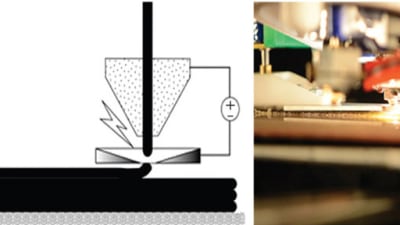
NASA Langley Research Center has developed a simple mechanism for the clean cutting of high-strength and high-toughness carbon nanotube/poly-mer fiber composites on demand without high blade wear or replacement...
Briefs: Mechanical & Fluid Systems
Compact Termination for Structural Soft Goods
Space environments are particularly harsh for the high-strength fibers NASA relies on for soft structures. Kevlar, Nomex, Nylon, and other synthetic fibers are broken down by exposure to the combination of vacuum, atomic oxygen, and ultraviolet radiation. Glass fiber offers unique advantages for...
Blog: Electronics & Computers
A stretchy material, modeled after squid skin, achieves thermal invisibility by reflecting heat.

Briefs: Materials
Researchers at NASA’s Glenn and Langley Research Centers have developed a groundbreaking bio-mimicking acoustic liner for quieting noisy environments. Conventional approaches have not been able to absorb...
Briefs: Materials
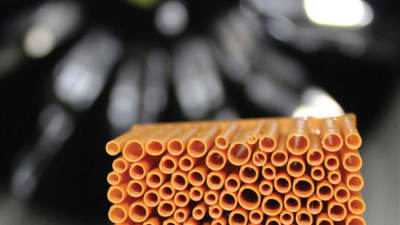
Plastic Material Works as a Heat Conductor
Plastics are excellent insulators, meaning they can efficiently trap heat — a quality that can be an advantage in something like a coffee cup sleeve. But this insulating property is less desirable in products such as plastic casings for laptops and mobile phones that overheat, in part, because the...
Briefs: Materials
Green Approach for Toughening Thermosetting Reactive Resins
Thermosetting reactive resin systems such as epoxy, bismaleimide, and polyimide classes of material are brittle. The origin of brittleness is attributed to the high crosslinking density that exists in the fully cured forms of these materials. Traditionally, the toughness of these resins is...
Briefs: Manufacturing & Prototyping
Currently, most 3D-printed organ models are made using hard plastics or rubbers. This limits their application for accurate prediction and replication of the organ’s physical behavior...

Facility Focus: Research Lab
The Department of Energy’s (DOE) Pacific Northwest National Laboratory (PNNL) in Richland, WA, has been operated by Battelle and its predecessors since the lab’s inception in 1965. For more than 50...

News: Materials
A reversible fabric from Stanford University could warm up or cool down its wearers, depending on their preference – and which side of the material faces out.

Sound-Off: Materials
New plastics are helping automotive manufacturers reduce the weight of their vehicles. But how do thermoset composites stack up against traditional metals? A Tech Briefs reader asks our automotive expert.
Articles: Materials
This column presents technologies that have applications in commercial areas, possibly creating the products of tomorrow. To learn more about each technology, see the contact information provided for that innovation.
Briefs: Manufacturing & Prototyping
Sometimes referred to as “solid smoke,” aerogels are the world’s lightest solid materials, composed of approximately 85% air by volume. Polyamide aerogels open up a whole new world of...
INSIDER: Nanotechnology
Plastic-Based Textile Leads to 'Cool' Clothes
A low-cost, plastic-based textile from Stanford University engineers could cool the body efficiently when woven into clothing.
Briefs: Materials
Aromatic Thermosetting coPolyester (ATSP) Composites for High-Temperature and Cryogenic Applications
Advanced composite materials processable by cost-effective manufacturing play an important role in developing lightweight structures for future space and planetary exploration missions. With the growing demand for improved performance in the...
INSIDER: Manufacturing & Prototyping
The present-day chemical industry is based on oil. Many chemical products – from plastics through to detergents and solvents, to medication and crop protection products – have their origins...

INSIDER: Electronics & Computers
Researchers Keep Hydrogels Hydrated
Engineers at the Massachusetts Institute of Technology (MIT) have developed a way to prevent hydrogels from dehydrating. The water-based technique could lead to longer-lasting contact lenses, stretchy microfluidic devices, flexible bioelectronics, and even artificial skin.
INSIDER: Materials
3D-Printed Polymer Turns Methane to Methanol
By combining biology and 3D printing, Lawrence Livermore National Laboratory (LLNL) scientists have created a reactor that continuously produces methanol from methane at room temperature and pressure.
INSIDER: Manufacturing & Prototyping
'On the Fly' 3D Printer Adjusts to Design Changes
In conventional 3D printing, a nozzle scans across a stage: depositing drops of plastic, rising slightly after each pass, and building an object in a series of layers. A new "on-the-fly" prototyping system from Cornell University allows the designer to make refinements while printing is in...
News: Materials
Since the 1600s, chocolatiers have been perfecting the art of the bonbon, passing down techniques for crafting a perfectly smooth, even chocolaty shell. Now a theory and a simple fabrication...

INSIDER: Materials
Researchers from Northwestern University used a light-powered 3D printer to create a terahertz lens. The imaging component is made from a novel metamaterial that exhibits properties not readily...

News: Materials
New research findings contradict a fundamental assumption about the functioning of "organic" solar cells made of low-cost plastics, suggesting a new strategy for...

Briefs: Materials
Strong and Flexible Carbon Fiber Reinforced Phenolic Composites
A new class of phenolic and carbon-fiber-reinforced phenolic composites has been developed for thermal protection systems. The new materials have the advantage of being lightweight, strong, and tough, yet heat resistant and flexible. They retain excellent mechanical strength at high...
INSIDER: Materials
Researchers Create Shape-Shifting Plastic
Researchers from Washington State University and the Department of Energy's Oak Ridge Laboratory have created a tunable shape-memory polymer. The shape-shifting plastic can “remember” its original shape and return to it after being deformed with heat or other forces.
News: RF & Microwave Electronics
Stanford engineers have invented a wireless pressure sensor that has already been used to measure brain pressure in lab mice with brain injuries. The underlying technology has such broad...
News: Robotics, Automation & Control
Robotic Fabric Moves and Contracts
Researchers are developing a robotic, sensor-embedded fabric that moves and contracts. Such an elastic technology could enable a new class of soft robots, stretchable garments, "g-suits" for pilots or astronauts to counteract acceleration effects, and lightweight, versatile robots to roam alien landscapes during...
News: Materials
3D Printer Heads to International Space Station
The first 3D printer is soon to fly into Earth orbit, finding a home aboard the International Space Station (ISS). The size of a small microwave, the unit is called Portal. The hardware serves as a testbed for evaluating how well 3D printing and the microgravity of space combine. The soon-to-fly 3D...
News: Energy
Researchers Create See-Through Solar Concentrator
A team of researchers at Michigan State University has developed a new type of solar concentrator that when placed over a window creates solar energy.The device is called a transparent luminescent solar concentrator and can be used on buildings, cell phones, and any other device that has a clear...
News: Motion Control
New Strain Gauge Enables 'Soft Machines'
Purdue University researchers have developed a technique to embed a liquid-alloy pattern inside a rubber-like polymer to form a network of sensors. The approach may be used to produce "soft machines" made of elastic materials and liquid metals.Such an elastic technology could be used to create robots with...
News: Materials
Sulfur left over from refining fossil fuels can be transformed into cheap, lightweight plastic lenses for infrared devices, including night-vision goggles, a University of Arizona-led...

Top Stories
 Blog: Robotics, Automation & Control

Aerial Microrobots That Can Match a Bumblebee's Speed
 Blog: Electronics & Computers

Turning Edible Fungi into Organic Memristors
 Blog: Manufacturing & Prototyping

Revolutionizing the Production of Semiconductor Chips
 News: Energy

 INSIDER: Electronics & Computers

World’s Smallest Programmable, Autonomous Robots
 INSIDER: Manufacturing & Prototyping

Webcasts
 On-Demand Webinars: Power

E/E Architecture Redefined: Building Smarter, Safer, and Scalable Vehicles
 Upcoming Webinars: Energy

Hydrogen Engines Are Heating Up for Heavy Duty
 Upcoming Webinars: Electronics & Computers

Advantages of Smart Power Distribution Unit Design for Automotive...
 Upcoming Webinars: Automotive

Quiet, Please: NVH Improvement Opportunities in the Early Design...
 Upcoming Webinars: Power

A FREE Two-Day Event Dedicated to Connected Mobility
 Podcasts: Defense

How Sift's Unified Observability Platform Accelerates Drone Innovation