Stories
51
167
0
1200
30
Briefs: Test & Measurement
Trained rescue dogs are the best disaster workers — their sensitive noses help them track down people buried by earthquakes or avalanches. But dogs need breaks. A new measuring device is always ready...

Briefs: Sensors/Data Acquisition
A process has been developed that enables the production of a 2-mm flat camera. The lens is partitioned into 135 tiny facets, similar to the eyes of an insect. The facetVISION camera is suitable...

Briefs: Medical
The Inductive Non-Contact Position Sensor is a highly accurate sensor for motion control applications. The sensor was designed to monitor the precise movements of an optical inspection system that measured...
Briefs: Transportation
Researchers have developed a new propulsion concept for swimming robots that exploits temperature fluctuations in the water for propulsion without the need for an engine, propellant, or power supply.
Blog: Robotics, Automation & Control
InSight project manager Tom Hoffman spoke with Tech Briefs about the importance of digging deep in our knowledge of Mars.

Blog: Imaging
Professor Hadas Kress-Gazit tells Tech Briefs about the "great promise" of autonomous modular robots.

Articles: Materials
DON’T MELT. MELD.™
The MELD™ technology enables additive manufacturing (AM) of metals. This patented process is unique because there is no...
Articles: Manufacturing & Prototyping
The Create the Future Design Contest was launched in 2002 by Tech Briefs Media Group (publishers of Tech Briefs magazine) to help stimulate and reward engineering innovation. Since...
Briefs: Robotics, Automation & Control
Robots that are adapted to respond to physical human-robot interaction (pHRI) traditionally treat such interactions as disturbances, and resume their original behaviors when the...

Briefs: Electronics & Computers
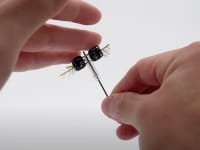
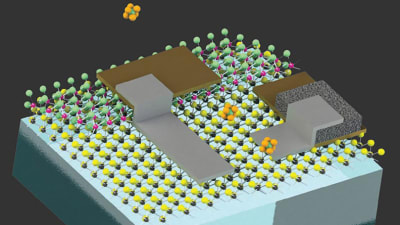
Colloids — insoluble particles or molecules anywhere from a billionth to a millionth of a meter across — are so small they can stay suspended indefinitely in a liquid or even in air. Robots about...
Special Reports: Manufacturing & Prototyping

Robotics & Machine Vision - November 2018
Advances in robotics and machine vision are transforming the factory floor. To help you keep pace with the latest developments in industrial automation, we present this compendium of recent articles...Blog: Test & Measurement
Rivers Ingersoll spoke with Tech Briefs about why it is so important to have an up-close understanding of the hummingbird and nectar bat.

Products: Motion Control
Multi-Voltage Motors
Simotics SD Pro low-voltage motors from Siemens (Munich, Germany) are suited for mains-fed operation or with a converter for voltages up to 690 volts. There is generally no need to use special filters at the...

Articles: Test & Measurement
For six decades, NASA has led the peaceful exploration of space, making discoveries about our planet, our solar system, and our universe. At home, NASA research has made great advances in aviation,...

Articles: Propulsion
NASA at 60: Celebrating Success
Over the past 60 years, NASA scientists and engineers have developed many advanced technologies and processes. But NASA has also partnered with industry, using commercially available products to complete its missions. Here, some of those companies join NASA in celebrating these collaborative successes.
Articles: Photonics/Optics
The benefits of NASA's space exploration efforts are not limited to the cosmos. NASA technologies provide innovative solutions for people around the world. NASA missions have generated thousands of spinoffs —...

Briefs: Mechanical & Fluid Systems
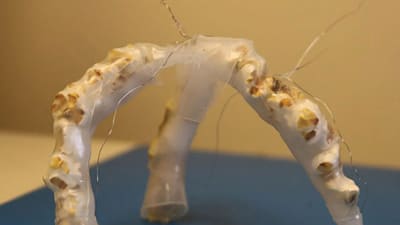
When heated, popcorn can expand more than 10 times in size, change its viscosity by a factor of 10, and transition from regular to highly irregular granules with surprising force. These unique qualities can...
Briefs: Robotics, Automation & Control
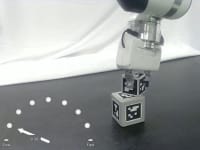
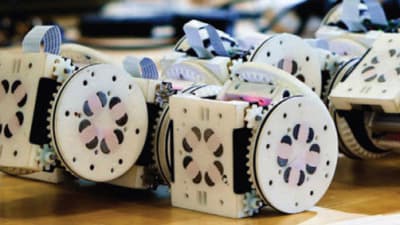
Given the exact parameters of the task at hand, a robot can assemble a car door or pack a box faster and more efficiently than a human, but such purpose-built machines are not suited...
Briefs: Mechanical & Fluid Systems
A process for engineering next-generation soft materials with embedded chemical networks that mimic the behavior of neural tissue lays the foundation for soft active matter with highly...

Briefs: Sensors/Data Acquisition
A technique was developed to quickly teach robots novel traversal behaviors with minimal human oversight. The technique allows mobile robot platforms to navigate autonomously in...
Briefs: Aerospace
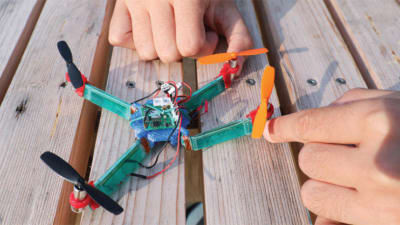
Origami manufacturing has led to considerable advances in the field of foldable structures with innovative applications in robotics, aerospace, and metamaterials; however, existing origami are either...
Briefs: Robotics, Automation & Control
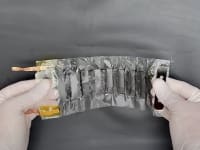
Wearable technologies are exploding in popularity in both the consumer and research spaces, but most of the electronic sensors that detect and transmit data from wearables are made of hard,...

Blog: Test & Measurement
A NASA researcher spoke with Tech Briefs about the importance of the Curiosity rover's latest find on Mars.

Application Briefs: Test & Measurement
Stanford Research SystemsSunnyvale, CAwww.thinksrs.com
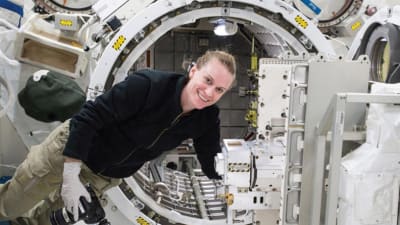
The Robotic External Leak Locator (RELL) — a collaboration between NASA's Johnson Space Center and Goddard Space Flight Center — was...
Briefs: Mechanical & Fluid Systems
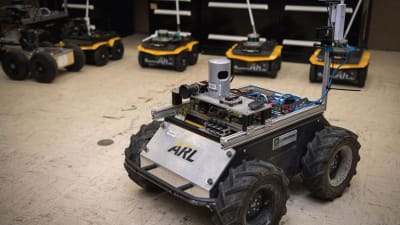
The Army uses robots that are structurally rigid, making them impractical when performing military operations in highly congested and contested urban environments where covert maneuvering is critical for...

Briefs: Robotics, Automation & Control
Stanford and Seoul National University researchers have developed an artificial sensory nerve system that can activate the twitch reflex in a...

Question of the Week: Robotics, Automation & Control
Will Social Robots Enter the Consumer Market?
In today's lead story, neuroscientist Dr. Philipp Kellmeyer told Tech Briefs:
Blog: Robotics, Automation & Control
For social robots to become commonplace in clinical settings, engineers will need to build both technology improvements as well something slightly more complicated: Trust.

Question of the Week: Robotics, Automation & Control
Can Popcorn Power Robots?
In last week's INSIDER, we featured a Q&A with Cornell University researcher Steven Ceron, who is experimenting with a new way — and delicious — way of powering robots: Popcorn.
Top Stories
 Blog: Lighting

A Stretchable OLED that Can Maintain Most of Its Luminescence
 News: Energy

 INSIDER: Energy

Advancing All-Solid-State Batteries
 Blog: Energy

My Opinion: We Need More Power Soon — Is Nuclear the Answer?
 Blog: Robotics, Automation & Control

Aerial Microrobots That Can Match a Bumblebee's Speed
 Blog: Communications

Microscopic Swimming Machines that Can Sense, Respond to Surroundings
Webcasts
 Upcoming Webinars: Transportation

Advantages of Smart Power Distribution Unit Design for Automotive...
 Upcoming Webinars: Unmanned Systems

Quiet, Please: NVH Improvement Opportunities in the Early Design...
 Upcoming Webinars: Test & Measurement

From Spreadsheets to Insights: Fast Data Analysis Without Complex...
 Upcoming Webinars: Aerospace

Cooling a New Generation of Aerospace and Defense Embedded...
 Upcoming Webinars: AR/AI

Beyond AI-Copy-Paste Engineering: Advanced AI-Integration Success...
 Upcoming Webinars: Test & Measurement