
Stories
48
201
-1
390
30
Briefs: Aerospace
Nodal Averaging Program for CFD Planes
Aerodynamic heating of aerospace vehicles such as aircraft and spacecraft occurs when air passes over a vehicle during transit, ascent, descent, and re-entry, and is a function of re-entry angle, speed, air density, thermal protection system material, and vehicle configuration. The degree of aerodynamic...
Briefs: Aerospace
NASA has developed a game-changing deployable aeroshell concept for entry, descent, and landing (EDL) of large science and exploration-class payloads. The...

Briefs: Aerospace
High Speed Idle Engine Control Mode
Innovators at NASA's Glenn Research Center have developed an engine control mode that improves an engine's responsiveness to throttle commands during emergency landing conditions. The high speed idle (HSI) control mode increases the speed of the engine's fan and core shafts, allowing faster response and increased...
Briefs: Aerospace
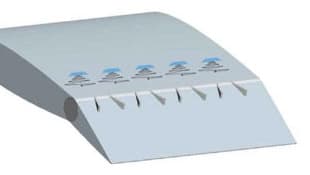
This technology is a new type of design for the wing flap, aileron, or flaperon located directly behind the engine nozzle on jet aircraft. Using a concave-down curved shape for...

Briefs: Aerospace
Method and System for Air Traffic Rerouting for Airspace Constraint Resolution
NASA's National Airspace System Constraint Evaluation and Notification Tool (NASCENT) is a dynamic constraint avoidance system that automatically analyzes routes of aircraft flying, or to be flown, in or near constraint regions, and attempts to find more time- and...
Briefs: Aerospace
NASA's Langley Research Center has created a novel process that significantly improves the effectiveness of high-lift devices on aircraft wings by utilizing a hybrid concept of...
NASA Spinoff: Aerospace
NASA Technology
One common hazard facing airplanes is ice: not just on the ground, but in the air, where it can coat wings or engines. But how do you know when icing conditions exist up...

Question of the Week: Aerospace
Will we be a “multi-planetary” species?
This week's Question: In recent years, hundreds of millions of dollars have been invested into space ventures. SpaceX, an advanced spacecraft manufacturer founded by Elon Musk, has completed more than 30 successful launches since 2006, delivered cargo to the International Space Station, and secured...
Briefs: Aerospace
Miles-In-Trail with Passback Restrictions for Use in Air Traffic Management
NASA has developed a unique innovation to compute passed back spacing requirements in air traffic management. The air traffic managers of the National Airspace System (NAS) in the United States regularly implement various Traffic Management Initiatives (TMI) to handle...
Briefs: Aerospace
A new engine concept from NASA’s Glenn Research Center allows for truly distributed propulsion. The concept enables airframe and system modularity by...

Briefs: Aerospace
Improved Ground Collision Avoidance System (iGCAS)
Researchers at NASA’s Armstrong Flight Research Center have dramatically improved upon existing ground collision avoidance technology for aircraft. NASA’s system leverages leading-edge fighter safety technology, adapting it to civil aviation use as an advanced warning system. It offers higher...
Briefs: Aerospace
The AeroPod, developed at NASA Goddard Space Flight Center’s Wallops Flight Facility, is a passive device that uses aerodynamic forces to stabilize an instrument package suspended from a kite or...

Briefs: Aerospace
NASA’s Langley Research Center has developed a novel design for a lightweight energy absorbing (EA) composite subfloor structure. The technology’s primary application is to increase occupant survivability in the...
Briefs: Aerospace
Improvements to the Functional Beamforming Formula
The purpose of this work is to improve the signal-to-noise ratio of acoustic measurements made in a wind tunnel with a microphone phased array. The functional beamforming method is improved to compensate for effects of acoustic propagation through turbulence, and to correct for inaccurate steering...
Briefs: Aerospace
NASA’s Langley Research Center researchers have developed a novel noise reduction system for jet engines. Aircraft jet engine noise is a major issue for airports, the communities...

INSIDER: Robotics, Automation & Control
Drones and Biobots Map Disaster Areas
North Carolina State University researchers will use unmanned aerial vehicles (UAVs) and insect cyborgs, or biobots, to map large, unfamiliar locations.
Who's Who: Aerospace
On September 8, NASA launched OSIRIS-Rex (Origins, Spectral Interpretation, Resource Identification, Security-Regolith Explorer). The probe will spend two...

INSIDER: Motion Control
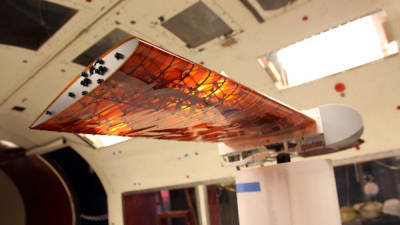
A new morphing wing architecture could greatly simplify the manufacturing process and reduce fuel consumption of aircraft by improving the wing’s aerodynamics, as well as...
Question of the Week: Aerospace
Would you use drones for home security?
This week's Question: A new home security technology called the Sunflower Home Awareness System deploys a drone to patrol one’s property. The combination of intelligent outdoor sensors and an aerial drone-based camera detects motion, vibration, and sound, and provides users with a view of the home’s...
Question of the Week: Aerospace
Will we see a flying car transportation service?
This week’s Question: Ride-hailing company Uber recently released a white paper outlining its new transport service: the flying car. The company envisions a “network of small, electric aircraft that take off and land vertically.” The proposal aims to use airspace to relieve transportation...
Briefs: Aerospace
Efficient and safe arrival operations under challenging traffic conditions are a key objective for air transportation modernization efforts taking place throughout the world. However,...

Briefs: Aerospace
System and Method for Dynamic Aeroelastic Control
Innovators at NASA’s Armstrong Flight Research Center are developing a collection of algorithms that can accurately determine the structural state of an aircraft. This work is in response to new airframe designs that save weight — and thereby improve fuel efficiency — by removing stiffness in...
Briefs: Aerospace
NASA has developed a traffic management system for Unmanned Aerial Systems (UASs) to maintain safe and efficient UAS operations. This novel technology enables the growth in civilian applications of UAS...
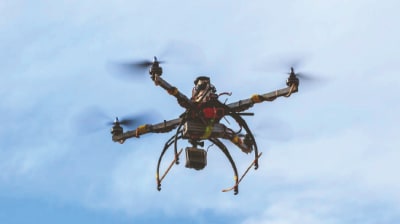
Briefs: Aerospace
This technology is a new type of aircraft pylon design for noise control. A pylon connects the engine to the airframe of an aircraft. This design uses air passing through the pylon to actively disrupt...
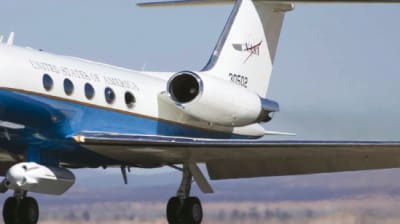
Briefs: Aerospace
Supporting Test Aircraft with Lift Airbags
Innovators at NASA’s Armstrong Flight Research Center have developed a method of using aircraft lift airbags to support test aircraft during wing strain gage load calibration. In calibration testing, a set of known loads is applied to the wing, and the loads and strain gage responses are then recorded....
Briefs: Aerospace
Enhanced Aircraft State Display for Improved Situation Awareness of Flight Envelope Limitations
In the case of an aircraft system failure such as control surface or engine failure, an aircraft’s flight envelope may change. Notifying the pilots of these changes may improve situational awareness and, hence, increase flight safety because pilots...
Briefs: Aerospace
Turbine film cooling flows typically are subject to jet detachment and reduced cooling effectiveness for high blowing rates. Current concepts to improve jet attachment involve impractical or overly complex hole designs due...
Briefs: Aerospace
Aeronautical Data Link and Radar Simulator (ADRS)
Air traffic management research needs to adequately address all players, including flight crews, air traffic controllers/managers, and airline dispatchers. Interactions between the different stakeholders are crucial elements for the viability of a given concept. A simulation capable of addressing...
Briefs: Aerospace
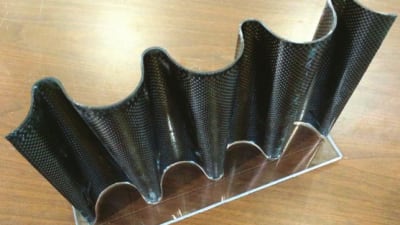
Flaps can significantly alter wing aerodynamics for high lift generation. Conventional flaps are mainly deployed for takeoff and landing, but are not suitable for in-cruise flight. It is widely speculated that...

Top Stories
 Blog: Robotics, Automation & Control

Aerial Microrobots That Can Match a Bumblebee's Speed
 Blog: Electronics & Computers

Turning Edible Fungi into Organic Memristors
 Blog: Manufacturing & Prototyping

Revolutionizing the Production of Semiconductor Chips
 News: Energy

 INSIDER: Electronics & Computers

World’s Smallest Programmable, Autonomous Robots
 INSIDER: Manufacturing & Prototyping

Webcasts
 On-Demand Webinars: Power

E/E Architecture Redefined: Building Smarter, Safer, and Scalable Vehicles
 Upcoming Webinars: Energy

Hydrogen Engines Are Heating Up for Heavy Duty
 Upcoming Webinars: Electronics & Computers

Advantages of Smart Power Distribution Unit Design for Automotive...
 Upcoming Webinars: Automotive

Quiet, Please: NVH Improvement Opportunities in the Early Design...
 Upcoming Webinars: Power

A FREE Two-Day Event Dedicated to Connected Mobility
 Podcasts: Defense

How Sift's Unified Observability Platform Accelerates Drone Innovation