
Inside this issue
Supplements

Overview
The February 2010 edition of NASA Tech Briefs, along with its companion publications Photonics Tech Briefs and Motion Control Technology, showcases a variety of innovative technologies and advancements across multiple fields, including disease detection, electronic components, and motion control systems. This issue highlights the latest trends and solutions that can inspire engineers, researchers, and industry professionals.
Key Features and Innovations:
-
Reinventing Disease Detection and Diagnosis: This edition emphasizes the importance of advancements in medical technology, particularly in the realm of disease detection and diagnosis. The articles discuss new methodologies and tools that enhance the accuracy and efficiency of diagnosing various health conditions. These innovations are crucial for improving patient outcomes and streamlining healthcare processes.
-
Insulation-Testing Cryostat with Lifting Mechanism: A notable technological advancement featured in this issue is the insulation-testing cryostat equipped with a lifting mechanism. This device is designed to facilitate the testing of insulation materials at low temperatures, which is essential for various applications in cryogenics and superconductivity. The lifting mechanism enhances usability, allowing technicians to operate the device more efficiently and safely.
-
Electronic Components: The magazine includes a product focus on electronic components, highlighting new developments that improve reliability and performance in various applications. These components are vital for the functioning of modern electronic devices, and the innovations presented in this issue aim to reduce costs while enhancing overall system performance.
-
Photonics Solutions for Design Engineers: Photonics Tech Briefs features articles that delve into the latest photonics technologies, including micro optical time domain reflectometers (OTDRs). These compact and user-friendly devices are essential for troubleshooting fiber optic networks, offering significant advantages over traditional OTDRs, such as reduced size and cost. The issue discusses how these advancements can benefit design engineers in their work.
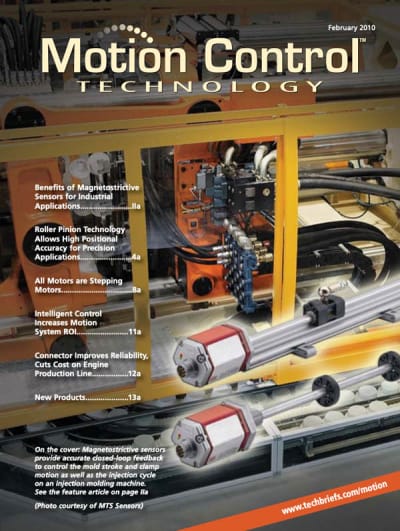
Motion Control Technology: The Motion Control Technology section of the magazine presents various innovations in motion control systems. One highlighted technology is magnetostrictive sensors, which provide accurate closed-loop feedback for controlling mold strokes, clamp motions, and injection cycles in injection molding machines. These sensors enhance precision and efficiency in manufacturing processes, making them invaluable in industrial applications.
-
Roller Pinion Technology: Another significant advancement discussed is roller pinion technology, which allows for high positional accuracy in precision applications. This technology is particularly beneficial in industries that require exact movements and positioning, such as robotics and automation.
-
Stepping Motors: The issue also covers the evolution of stepping motors, emphasizing their versatility and applications in various fields. Stepping motors are crucial for precise control in motion systems, and the articles explore how advancements in this area can lead to improved performance and reliability.
-
Intelligent Control Systems: The magazine discusses the role of intelligent control systems in increasing the return on investment (ROI) for motion systems. By integrating advanced control algorithms and technologies, these systems can optimize performance, reduce energy consumption, and enhance overall system efficiency.
-
Connector Innovations: A feature on new connectors highlights innovations that improve reliability and reduce costs on engine production lines. These connectors are essential for ensuring robust connections in automotive and aerospace applications, where reliability is paramount.
-
New Products and Technologies: The issue concludes with a section dedicated to new products, showcasing a range of technologies that are entering the market. This section provides readers with insights into the latest tools and solutions available for various engineering and industrial applications.
Conclusion: The February 2010 edition of NASA Tech Briefs, Photonics Tech Briefs, and Motion Control Technology serves as a comprehensive resource for professionals in engineering and technology fields. With its focus on innovative solutions and advancements, this issue highlights the ongoing evolution of technology and its impact on various industries. Readers are encouraged to explore the articles and features to gain insights that can inform their work and inspire future projects. The magazine not only showcases cutting-edge technologies but also emphasizes the importance of collaboration and knowledge sharing in driving innovation forward.
Features
-
Application Briefs
Spectrometer Helps NASA Detect Water in Excavated Moon Matter
Near-Infrared Cameras Indicate Signature of Water on the Moon
Tech Briefs
-
Physical Sciences
Insulation-Testing Cryostat With Lifting Mechanism
Optical Testing of Retroreflectors for Cryogenic Applications
Measuring Cyclic Error in Laser Heterodyne Interferometers
Self-Referencing Hartmann Test for Large-Aperture Telescopes
Measuring a Fiber-Optic Delay Line Using a Mode-Locked Laser
White-Light Phase-Conjugate Mirrors as Distortion Correctors
Biasable, Balanced, Fundamental Submillimeter Monolithic Membrane Mixer
-
Manufacturing & Prototyping
Two Concepts for Deployable Trusses
Use of Nanofibers to Strengthen Hydrogels of Silica, Other Oxides, and Aerogels
-
Information Sciences
ICER-3D Hyperspectral Image Compression Software
Context Modeler for Wavelet Compression of Spectral Hyperspectral Images
-
Mechanics & Machinery
-
Semiconductors & ICs
Compact, Reliable EEPROM Controller
Ka-Band Waveguide Two-Way Hybrid Combiner for MMIC Amplifiers
-
Electronics & Computers
Reconfigurable Hardware for Compressing Hyperspectral Image Data
Spatio-Temporal Equalizer for a Receiving-Antenna Feed Array
Products
-
Applications