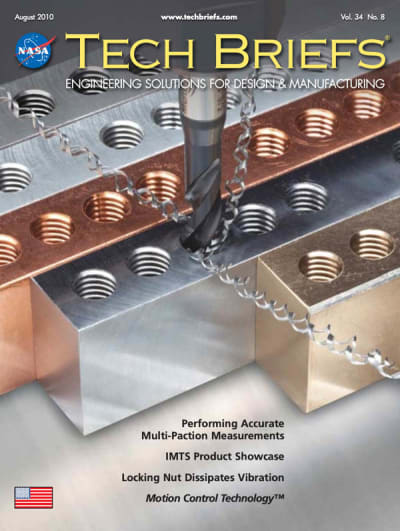
Inside this issue
Supplements
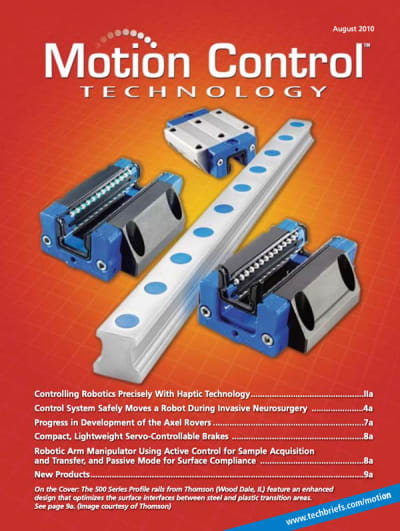
Overview
The August 2010 issue of NASA Tech Briefs, Volume 34, No. 8, presents a comprehensive overview of advancements in motion control technology, robotics, and innovative engineering solutions. This edition features a variety of articles, product showcases, and new technologies that highlight the ongoing progress in these fields.
Key Features and Articles
-
Controlling Robotics Precisely With Haptic Technology: This article discusses the integration of haptic technology in robotics, which allows for more precise control and interaction with robotic systems. Haptic feedback enhances the operator's ability to manipulate robots, making them more effective in tasks that require fine motor skills.
-
Control System Safely Moves a Robot During Invasive Neurosurgery: A significant advancement in medical robotics is highlighted, focusing on a control system designed to safely maneuver robots during delicate neurosurgical procedures. This technology aims to improve patient outcomes by providing surgeons with enhanced control and precision.
-
Progress in Development of the Axel Rovers: The article outlines the latest developments in Axel Rovers, which are designed for exploration and research in challenging environments. These rovers are equipped with advanced mobility systems that allow them to traverse rough terrains, making them suitable for planetary exploration and other remote applications.
-
Compact, Lightweight Servo-Controllable Brakes: Innovations in braking technology are presented, showcasing compact and lightweight servo-controllable brakes. These brakes are essential for applications where space and weight are critical factors, such as in aerospace and robotics.
Robotic Arm Manipulator Using Active Control for Sample Acquisition and Transfer: This feature discusses a robotic arm manipulator that employs active control for efficient sample acquisition and transfer. The manipulator also has a passive mode for surface compliance, allowing it to adapt to various surfaces and improve its operational versatility.
New Products and Technologies
The issue includes a section dedicated to new products and software, showcasing the latest offerings in motion control and robotics. This includes advancements in sensors, actuators, and control systems that enhance the performance and capabilities of robotic systems.
Advertisers Index
The magazine also contains an Advertisers Index, providing readers with information on various companies and their products related to motion control technology. This section serves as a resource for engineers and designers looking for specific solutions or partnerships in the industry.
Technologies of the Month
The "Technologies of the Month" section highlights new, licensable inventions that are available for commercialization. This initiative encourages collaboration between innovators and organizations seeking to implement cutting-edge technologies in their projects.
NASA’s Innovative Partnerships Program
The issue features insights into NASA’s Innovative Partnerships Program, which aims to foster collaboration between NASA and private industry. This program seeks to leverage the expertise and resources of both sectors to accelerate the development of new technologies that can benefit space exploration and other applications.
Conclusion
Overall, the August 2010 issue of NASA Tech Briefs serves as a valuable resource for professionals in the fields of engineering, robotics, and motion control technology. It provides a platform for sharing innovative ideas, showcasing new products, and promoting collaboration between industry and research institutions. The advancements highlighted in this issue reflect the ongoing commitment to pushing the boundaries of technology and improving the capabilities of robotic systems for various applications, from medical procedures to space exploration.
This edition not only informs readers about the latest trends and technologies but also inspires them to explore new possibilities in their work, encouraging a culture of innovation and continuous improvement in engineering practices.
Features
-
Application Briefs
Equipment Enables Communications in Hazardous Locations
Imaging Sensors Examine Evolution of Solar Activity and Space Weather
Tech Briefs
-
Physical Sciences
Suppressing Loss of Ions in an Atomic Clock
Simplified Vicarious Radiometric Calibration
Phase-Conjugate Receiver for Gaussian-State Quantum Illumination
Improved Tracking of an Atomic-Clock Resonance Transition
Infrared Camera System for Visualization of IR-Absorbing Gas Leaks
Submonolayer Quantum Dot Infrared Photodetector
Ionization-Assisted Getter Pumping for Ultra-Stable Trapped Ion Frequency Standards
Phase-Array Approach to Optical Whispering Gallery Modulators
Fiber-Optic Continuous Liquid Sensor for Cryogenic Propellant Gauging
-
Manufacturing & Prototyping
Nearly Seamless Vacuum-Insulated Boxes
Fast-Response-Time Shape-Memory-Effect Foam Actuators
-
Software
-
Materials
Magnesium Diboride Current Leads
Polyimide Aerogels With Three-Dimensional Cross-Linked Structure
Alumina Paste Layer as a Sublimation Suppression Barrier for Yb₁₄MnSb₁₁
-
Information Sciences
Physical Invariants of Intelligence
Rocket-Plume Spectroscopy Simulation for Hydrocarbon-Fueled Rocket Engines
Research on Spoken Dialogue Systems
-
Mechanics & Machinery
Inline Electrical Connector Mate/Demate Pliers
Seal With Integrated Shroud for Androgynous Docking and Berthing
Locking Nut With Stress-Distributing Insert
Adaptable Holders for Arc-Jet Screening Candidate Thermal Protection System Repair Materials
Miniature Low-Mass Drill Actuated by Flextensional Piezo Stack
Compact, Lightweight Electromagnetic Pump for Liquid Metal
Mechanism for Particle Transport and Size Sorting via Low-Frequency Vibrations
-
Electronics & Computers
Digitally Controlled Slot Coupled Patch Array
Reconfigurable Robust Routing for Mobile Outreach Network
Reconfigurable Fault Tolerance for FPGAs
Portable Health Algorithms Test System
Technique for Performing Dielectric Property Measurements at Microwave Frequencies