

An improved, lightweight design has been proposed for super-pressure balloons used to carry scientific instruments at high altitudes in the atmosphere of Earth for times as long as 100 days. [A super- pressure balloon is one in which the pressure of the buoyant gas (typically, helium) is kept somewhat above ambient pressure in order to maintain approximately constant density and thereby regulate the altitude.] The proposed design, called "meshed pumpkin," incorporates the basic concept of the pumpkin design, which is so named because of its appearance (see figure). The pumpkin design entails less weight than does a spherical design, and the meshed-pumpkin design would reduce weight further.
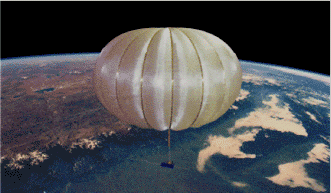
The basic idea of the meshed-pumpkin design is to reinforce the membrane of a pumpkin balloon by attaching a strong, lightweight fabric mesh to its outer surface. The reinforcement would make it possible to reduce the membrane mass to one-third or less of that of the basic pumpkin design while retaining sufficient strength to enable the balloon to remain at approximately constant altitude for months.
For example, the pumpkin balloon shown in the figure is made from a complex composite of polyester fabric, adhesive, polyethylene terephthalate film, and polyethylene film. The balloon has an areal mass density of 62 g/m2 and a total mass of 2,800 kg. The balloon can carry a payload of 1,600 kg at an altitude of 33 km. One corresponding meshed-pumpkin design calls for reinforcement of the membrane with a 1-by-1-in. (2.54-by-2.54-cm) mesh of polybenzoxazole scrim fiber of 25 denier (a lineal mass density of about 2.8 mg/m). With this reinforcement, the complex composite membrane could be replaced by a simple polyethylene film 0.5 mil (12.7 μm) thick, reducing the mass of the balloon to <400 kg. The mesh would provide a strength of 400 N/m, giving a factor of safety of 5, relative to the strength required for a pumpkin balloon with a bulge radius of 8 m.
This work was done by Jack Jones and Andre Yavrouian of Caltech for NASA's Jet Propulsion Laboratory. For further information, access the Technical Support Package (TSP) free on-line at www.techbriefs.com/tsp under the Materials category.
In accordance with Public Law 96-517, the contractor has elected to retain title to this invention. Inquiries concerning rights for its commercial use should be addressed to
Intellectual Property group
JPL
Mail Stop 202-233
4800 Oak Grove Drive
Pasadena, CA 91109
(818) 354-2240
Refer to NPO-21139, volume and number of this NASA Tech Briefs issue, and the page number.
This Brief includes a Technical Support Package (TSP).
Meshed-Pumpkin Super-Pressure Balloon Design
(reference NPO-21139) is currently available for download from the TSP library.
Don't have an account?
Overview
The document discusses advancements in balloon technology, specifically focusing on the NASA Ultra Long Duration Balloon (ULDB) and its innovative "meshed pumpkin" super-pressure balloon design. The ULDB is a high-altitude balloon capable of carrying significant payloads, and the new design aims to enhance its efficiency and reduce its mass.
Historically, high-altitude balloons have been categorized into helium super-pressure balloons and infrared (IR) hot air balloons. Super-pressure balloons maintain a higher internal pressure compared to the outside atmosphere, which necessitates a strong and heavy structure. While previous designs, such as the pumpkin balloon, have made strides in reducing mass, they still remain relatively heavy.
The document highlights a novel approach where a lightweight mesh is integrated with a thin membrane to create a more efficient balloon structure. This new design allows for a mass reduction of at least three times compared to traditional designs. The meshed pumpkin balloon utilizes a composite material that includes polyester fabric, adhesive, mylar film, and polyethylene film. The current ULDB design weighs 2800 kg and can carry a 1600 kg payload at an altitude of 33 km. In contrast, the new design, which incorporates a 0.5 mil polyethylene film and a PBO scrim fiber mesh, reduces the balloon's mass to under 400 kg while maintaining structural integrity.
The mesh provides a strength of 400 N/m, offering a safety factor of five over the requirements for a traditional pumpkin balloon. This innovative design not only enhances the balloon's performance but also simplifies the construction process, making it more feasible for long-duration missions.
The document emphasizes the importance of this technology for scientific research, as it enables prolonged data collection in the upper atmosphere without the limitations of traditional balloon designs. The advancements presented in this report are a result of collaborative efforts at the Jet Propulsion Laboratory (JPL) under NASA's sponsorship, showcasing the potential for future applications in high-altitude research and exploration.
In summary, the document outlines a significant leap in balloon technology through the meshed pumpkin super-pressure balloon design, which promises to revolutionize high-altitude scientific missions by providing a lighter, stronger, and more efficient platform for research.







